Risk of green wedge between Cranbrook and Rockbeare being swallowed up despite Local Plan rules

“Cllr Rob Longhurst said: “The main thing I would be concerned with is the idea that a green wedge could be disposed of if it doesn’t fit. It was put there for a reason after long debate and I think it is wrong to suddenly discard it as being inconvenient.”

Cllr Mark Williamson said: “It is so clear in the strategy of the Local Plan that it only takes up a single sentence, saying within green wedges, development will not be permitted. There are six green wedges in the Local Plan so if this was allowed then there will be sleepless nights around the district, where the other green wedges are, particularly around Seaton and Colyton.”

https://www.devonlive.com/news/devon-news/concerns-raised-building-green-wedges-1400152

“I don’t believe it!” – NHS Providers say we are short of at least 10,000 hospital beds and are treating our elderly shamefully!

“The NHS is more than 10,000 beds short of what it needs to look after older people properly, hospital leaders have said.

NHS Providers, which represents hospitals, said that it was impossible for waiting time targets to be met this year and warned that the government’s pretence that they would be met created a “toxic culture” similar to that which led to the Mid Staffordshire scandal.

This week Theresa May promised that a long-term plan for NHS budget rises would be agreed within months, and will be under pressure to agree increases of up to £20 billion over five years.

However, Jonathan Ashworth, the shadow health secretary, said that “a nod and wink from the prime minister” was not enough for patients.

The NHS has not hit any of its main targets for more than two years. Chris Hopson, chief executive of NHS Providers, said: “The levels of performance expected and the savings demanded for next year are beyond reach. While we strongly welcome the prime minister’s commitment to increase long-term funding for the NHS, it makes no immediate difference to the tough task facing trusts for next year.”

Mr Hopson’s report estimates that 3.6 million patients will not be treated within four hours at A&E over the next year and 560,000 will be denied routine surgery within 18 weeks. He said that hospitals could make £3.3 billion in savings next year but that ministers had demanded 20 per cent more than this.

“This creates a toxic culture, based on pretence, where trusts are pressurised to sign up to targets they know they can’t deliver and then miss those targets as the year progresses,” his report said.

“The NHS is probably somewhere between 10,000 to 15,000 beds short on a bed base of about 100,000.”

One hospital chief executive suggested that hospital overcrowding pointed to deep social problems. He said: “As a country we don’t look after old people well. We have too many people living by themselves in houses that are unsuitable . . . In the end they get really unwell and call 999.”“

Source: The Times, pay wall

People power leads to shake up (down?) at East Budleigh with Bicton Parish Council

Owl says: what IS going on? First the sudden exodus of Tory grandees Moulding and Godbeer at the same time at Axminster Town Council and now the Chair of East Budleigh and Bicton departs extremely swiftly! All change? Hhhmmm … maybe …

“An overwhelming vote of no confidence in East Budleigh with Bicton Parish Council was made at a Parish meeting in the village on Sunday evening (March 25th)

The meeting had been called by a number of residents including the Friends of East Budleigh Recreation Ground after exhausting every other means of engaging with the Council. Over 100 residents were in attendance. Several East Devon District councillors and a Devon county councillor were also present.

Leading up to the vote of no-confidence, many issues and allegations were brought up by the residents as reasoning for their vote against the Council, principally a failure to observe their own codes of conduct.

Two days later at the Parish Council meeting it was announced that the chair of the Parish council had resigned. Amongst other items on the agenda the long running and emotive issue of restrictive use of dogs on the recreation ground was finally resolved through a vote by the councillors to shelve plans for any restrictions in favour of a voluntary community strategy to monitor and maintain the area.

A spokesman from the ‘Friends group’ said “The parish community has come together as a whole and made it very, very clear we’re unhappy with what’s currently going on.”

He also added ” I have to say, in all fairness, the remaining council members have responded swiftly and correctly. There was a much more inclusive atmosphere at the last Parish Council meeting. We feel that they now have a genuine will to see a positive way forwards and work with the village community.”

Council borrowing so high, government intervention may be needed

EDDC is borrowing to fund the building of its new HQ and to fund its “Growth Point” and is also considering going into the housing construction market.

“Local authorities could face further intervention by central government if new changes to investment and treasury codes fail to dampen council borrowing levels, according to a senior Whitehall official. …

[A conference speaker said] … “said: “When last year local authorities borrowed an additional £3.8bn, that was a £3.8bn increase in net debt. “That was £3.8bn less that the chancellor had available to distribute as funding across the board at the last budget. “So, local authority borrowing does have a real world impact in the overall quantum of funding that is available to government.”

In addition, he said that concerns have been raised that councils investing in particular asset classes can drive prices up, creating a bubble.

New principles on proportionality included in the code were triggered by some smaller authorities taking on huge sums of debt relative to their size, Caller [the speaker] added.

“We had concerns that those authorities who were doing that were effectively assuming that government stood behind their risk. “That is not the statutory position, and it is not a position we want to encourage. “What the legislation says is that effectively it is council tax payers that have to make good any deficit in those assumptions, not central government. We want people to remember that.” …

Councils could face ‘additional’ intervention if borrowing rates continue

Health Cheque Up

£20bn for the NHS over 5 years!

Does that mean that the CCG will cease its destruction of Devon’s NHS services? Does it mean that current numbers are now meaningless?

Or does it mean that the cash will arrive too late to prevent this or not arrive at all?

Or does it mean that most of the cash will be directed to marginal Tory seats before a General Election?

Committee promises to double the number of unicorns in Devon and Somerset

How will we know that this committee can or will double productivity in 20 years? They will tell us in 20 years time! How will we know if they are correct? Answers on a postcard …

From the press release:

“Representatives from 23 organisations across Devon and Somerset today agreed steps to drive up productivity at the first meeting of the Heart of the South West (HotSW) Joint Committee.

The inaugural meeting of the Joint Committee unanimously endorsed the Productivity Strategy that has been taking shape over the last two years and aims to double productivity over 20 years.

At the meeting in Plymouth City Council offices, the committee also voted unanimously to appoint Councillor David Fothergill, Leader of Somerset County Council, as the first Chair of the new committee and Councillor Paul Diviani, Leader of East Devon District Council, as the Vice Chair. …

… The Productivity Strategy aims to double productivity in the area over 20 years, focussing on themes including promoting business leadership, housing, connectivity, infrastructure, skills and training. It looks at growth, capitalising on the area’s distinctive assets and maximising the potential of digital technology. … [just as a large part of digital technology has gone into freefall!]

Somerset County Council is acting as the host of the HotSW Joint Committee and meeting agendas and further information including the full Productivity Strategy can be found here:

http://democracy.somerset.gov.uk/mgCommitteeDetails.aspx?ID=357

EDDC to borrow a minimum of £3.4 million and up to £8 million to “improve” Greater Exeter enterprise zone

Owl says: it seems western East Devon/Greater Exeter is to thrive at the expense of eastern East Devon; more of everything for Greater Exeter, less of everything for Lesser East Devon.

“Improved bus services, a new park-and-change car park, and improvements to Exeter Airport are all on the cards.

East Devon District Council’s Cabinet is being asked to approve borrowing of nearly £3.5m to help accelerate the projects in the Enterprise Zone.

The Exeter and East Devon Enterprise Zone consists of the Exeter Science Park, the Skypark, the Exeter Airport Business Park and Cranbrook Town Centre.

A report to the cabinet is seeking approval for £3,391,250m to be borrowed against future ring-fenced business rate income.

The report, that goes to the Cabinet on Wednesday, April 4, written by Naomi Harnett, Enterprise Zone Programme Manager, says: “While not yet fully developed and appraised it is considered that these projects are also likely to make a substantial contribution to the achievement of the objectives of the Enterprise Zone.

“The Enterprise Zone designation is a powerful means of accelerating the delivery of new commercial space and jobs in the four sites in the West End of the District.

“The more that can be done to accelerate the delivery of new commercial space the greater the impact there will be both in terms of business rate income and wider economic benefit. Work has focused on developing projects that help to overcome identified barriers to delivery and/or have a catalytic impact in terms of accelerating the pace of new commercial development.

“Approval is sought for the funding of an initial set of projects that are considered to contribute substantially to meeting the objectives for the EZ.”

The report seeks approval for £3,391,250m to be borrowed against future ring-fenced business rate income.

The four proposals that the council is being asked to invest in are:

1 – An enhanced frequency bus service (30 minute at peak) connecting Exeter to the Enterprise Zone area. This includes connections via the key transport nodes of Exeter St Davids and Exeter Airport. The service is due to commence at around 5am and run through to 11pm, with the intention that this fits with key shift patterns and flight times. Some of the services will also continue to Woodbury and Exmouth. The service builds on an existing service tendered by Devon County Council and the intention is to subsidise this for an initial period of 3 years starting from Summer 2018. The scheme would cost £536,250 and would be delivered by Devon County Council.

2 – A 309 space park-and-change car park located at the Exeter Science Park, alongside bike lockers and an e-bike docking station. The facility will both support the development of the Science Park and contribute to the wider transport strategy for the area. It is anticipated that the works will complete during summer 2019 and be delivered by Devon County Council, and would cost £2.4m

3 – An upgrade to the Exeter Airport Instrument Landing System. The current system installed in 1997 has now reached the point where there is no further operational tolerance to accommodate additional nearby development. Subsequently this is a significant barrier to development coming forward particularly at both Skypark and the Airport Business Park extension. The scheme would be delivered by Exeter Airport and cost £1.4m

4 – An upgrade to Long Lane, the road that runs immediately to the south of the airport. It is the principle means of access to the Airport Business Park extension and is sub-standard to the point where no further development can proceed until it is improved and is therefore a significant barrier to one of the four EZ sites coming forward. An initial sum of up to £100,000 is sought in order to complete the scheme design and would be delivered by Devon County Council.

The investment in the enhanced bus service and park and change facility would be in the form of a grant, and a forward funding mechanism is proposed to secure the timely upgrading of the Instrument Landing Systems at the Airport. The costs of this can then be recouped as development proceeds.

The report also request that the cabinet agrees the principle of borrowing up to £8m against ringfenced business rate income to fund the delivery of projects and makes this recommendation to Council

Further papers setting out specific investment proposals in relation Cranbrook town centre and Exeter Airport would come to the Cabinet at a later date.

Letwin explains rationing new builds to keep up prices with a new phrase “absorption rate”!

“A Government-commissioned report has blamed delays in the house-building process on builders concerns about future sale prices.

In the Autumn Budget the Chancellor set up an independent review to look at the delays between planning permission being granted, and houses being built. This review is being led by Sir Oliver Letwin.

The Treasury has now published the commission’s interim report alongside the Spring Statement:

Click to access Build_Out_Review_letter_to_Cx_and_Housing_SoS.pdf

These initial findings suggest that house-builders concerns about sale prices are a major factor in slow “build out” of homes on many of these larger developments.

Letwin says this review had initially focused on larger housing developments and major housebuilders. Further analysis may look at smaller scale models.

In a letter to the Chancellor and Sajid Javid – the secretary of state for housing communities and local government – Letwin says housebuilders have cited a number of “limitations”, including a shortage of available skilled labour, the availability of capital, provision of local transport infrastructure and the slow speed of installations by utility companies.

But in the interim report Letwin says: “I am not persuaded that these limitations are in fact the primary determinants of the speed of build out on large permitted sites at present.”

He goes on to say the fundamental driver of build out rates, once detailed planning permission is granted, appears to be the “absorption rate” – that is the rate at which newly constructed homes can be sold into the local market without materially disturbing the market price.

This rate, he says appears to be largely determined at present by the type of home being constructed and the pricing of the new homes built.

The interim report goes onto say this problem can be exacerbated by many larger development having a style of size of home that is fairly homogeneous.

The next stage of this review will look at whether build-out rates could be improved, either by reducing the reliance on large builders, or by encouraging them to offer more variety in terms of the type and price of property offered.

The report adds: “We have seen ample evidence from our site visits that the rate and completion of the ‘affordable ‘ and social rented’ homes is constrained by the requirement for cross-subsidy from the open market housing on the site.” This can delay the build out of these homes, the report adds.

Letwin says he plans to publish more detailed draft analysis by the end of June, which will contain a more detailed description of the problem and its causes.

The independent review will then seek comments from interested parties before a final analysis which will include a list of recommendations to improve the situation.”

Interim report on planning delays published alongside Spring Statement

Insolvent Tory council to be run by Commissioners

“A ‘bankrupt’ Tory council will be TAKEN OVER by Commissioners in a drastic, rare step after completely running out of money.

Northamptonshire County Council will be stripped of the power to run its own affairs after a damning inspection into the financial crisis at the town hall.

Now it will be run by Commissioners following a decision by the Ministry of Housing, Communities and Local Government.

Labour said they were vindicated as Local Government Secretary Sajid Javid announced the move in the House of Commons.

Shadow Local Government Secretary Andrew Gwynne blamed “eight years of intransigence and austerity” as “the council bragged about its pioneering approach to services, basically running them like a business.”

“The private sector cannot deliver adequate services when there is too little funding,” he said. …”

https://www.mirror.co.uk/news/politics/bankrupt-tory-council-taken-over-12259651

Coastal towns top bankruptcy list

“Britain’s seaside towns are now hotspots for bankruptcy lawyers – with people in coastal resorts becoming insolvent far faster than anywhere else.

Seaside towns dominate a list of the top areas of the country for personal insolvencies, a new study shows. The Isle of Wight, Great Yarmouth, Scarborough, Whitby and Torquay were said to be struggling to recover from decades of decline in coastal industries and the growth of overseas holidays.

Research among almost 600 Parliamentary constituencies by accountancy firm Moore Stephens placed Plymouth Moor View at the top, with 47 insolvencies per 10,000 population, compared with a national average of around 20.

The report said seasonal tourism was being hit by increasingly cheaper flights and package holidays.

Jeremy Willmont of Moore Stephens said: “Personal debt in many British seaside towns shows no sign of improving. “Seaside areas now come with a handicap that they are struggling to shake off. People living in these towns continue to fall into insolvency as the coastal economy fails to keep up with the rest of the country. “At this point, debt in the UK’s coastal towns seems to have entered something of a downward cycle.

“As the economy along the coast declines, unemployment worsens. This may result in many more highly educated millennials relocating to larger cities, deterring new employers from relocating to the area.”

https://www.mirror.co.uk/money/overdrawn-sea-towns-twice-many-12252381

Is NHS privatisation a good idea? “Carillion bosses displayed ‘greed on stilts’, MPs claim”

We are not allowed to see or scrutinise contracts placed by the NHS with private companies. Carillion (formerly Tarmac) had many service contracts with the government.

“… When considering clawbacks – an arrangement for retrieving executive rewards in the event of poor performance after a bonus has been paid – the board opted to rule out extending the use of the device beyond a handful of its most senior directors. The papers show the remuneration committee feared more conservative pay arrangements for particular contracts “would have a detrimental impact on performance”.

The trove of information from the select committees also shows that Carillion’s adviser, Deloitte, said in September that weak provisions didn’t allow any bonuses paid in cash to be clawed back at all.

The remuneration committee extended its clawback conditions to cover serious reputational damage and failures of risk management around that time, however, the MPs said they had seen no evidence to suggest any further attempts were made to return cash from bonuses to the business.

The latest swathe of evidence against the company comes amid the continuing fallout of Carillion’s collapse in January with debts to its 30,000 suppliers worth about £2bn. …”

https://www.theguardian.com/business/2018/mar/26/carillion-bosses-displayed-greed-on-stilts-mps-claim

Foreign money raised house prices 20% over 15 years

“House prices in Britain have soared by around 20 per cent in the past 15 years due to an influx of foreign money, according to a new study.
The research by King’s College London showed the average price is around £215,000 but would have been about £174,000 without the investment from overseas.

University researchers said the cash has also had a ‘trickle down’ effect to less expensive properties.

Money from abroad has impacted house prices mostly in the South East and major cities in the north, such as Liverpool, Leeds and Manchester.
But researchers warned there was no evidence the increase in foreign investment lead to an increase in housing building or in the share of vacant homes. …”

http://www.dailymail.co.uk/news/article-5543887/House-prices-rise-20-cent-15-years-pushed-influx-foreign-money.html

Our Local Enterprise Partnership’s favourite project ringing alarm bells

Not what our nuclear-linked LEP board members want to hear:

“The UK nuclear regulator has raised concerns with EDF Energy over management failings that it warns could affect safety at the Hinkley Point C power station if left unaddressed, official documents reveal.

Britain’s chief nuclear inspector identified several shortcomings in the way the French firm is managing the supply chain for the £20bn plant it is building in Somerset.

Though not serious enough alone to raise regulatory issues, together they “may indicate a broader deficiency” in the way the company is run, concluded Mark Foy, chief inspector at the Office for Nuclear Regulation (ONR).

In October and November 2017, a team of 11 inspectors led by Foy visited the Hinkley site, EDF facilities in Bristol and Paris, and a French factory making parts for the plant.

The visits were triggered by the regulator’s concerns that EDF did not have sufficient oversight of the Creusot nuclear forge in France, where records have been found to be falsified.

A summary of the inspections, published by the ONR earlier this month, judged EDF’s supply chain management to be improving but below standard in some areas.

The full reports, released to the Guardian under freedom of information rules, paint a critical picture. They show that:

The ONR was concerned that EDF’s internal oversight and governance had not identified the shortcomings at the forge

Stuart Crook, Hinkley Point C managing director, admitted that EDF, not the ONR, should have spotted those shortcomings first

a lack of resources meant EDF did not undertake an internal audit of its quality control processes during 2017. Foy said this was “disappointing” as it might have picked up problems

On safety, the report said that: “Throughout this … inspection, themes have emerged that relate to both improvements in NNB GenCo’s [the EDF subsidiary building Hinkley] processes and to shortfalls in management system arrangements that, if unresolved, have the potential to affect safety.”

EDF’s own assessment of how it managed Hinkley’s supply chain had discovered shortfalls that could affect safety, the regulator found. The ONR also felt that the company’s plan for improving its self-assessment process was inadequate.

Moreover, they said that it was not clear who at EDF was managing quality control on the supply chain.

Interviews with EDF’s contractors for the Hinkley project, which include civil engineering groups Kier BAM and Bylor, also found that EDF had not done enough to pass on information about the failings at the Creusot forge to its suppliers.

However, the regulator said it was confident the company could make improvements ahead of the next key regulatory milestone for the power station, in August 2018. Overall, EDF was found to be operating within the UK’s exacting nuclear regulations.

“Current arrangements for the control of quality are judged, through ONR’s wider regulatory activities, to be appropriate at present,” said Foy.

Experts said the inspection’s conclusions were significant, as nuclear regulation language is usually restrained.

Paul Dorfman, of the Energy Institute at University College London, said: “Looking at this report with a practiced eye, you can see that the UK regulators are worried, and things aren’t necessarily going to get any better.

“In all things nuclear, safety is absolutely paramount. The fact that the UK nuclear regulator says that these problems could affect safety is very significant.”

EDF said it was already implementing improvement measures where required ahead of an increase in construction activity at the site. The company was also completing the outstanding internal quality assurance programme.

A spokesperson said: “The chief nuclear inspector’s report recognises that the current quality control arrangements for Hinkley Point C are appropriate.”

There are about 3,500 people working on the site at the moment, a number that is expected to peak at around 6,000 in 18 months, when construction is due to be at full throttle.

The power station should provide around 7% of the UK’s electricity and is due to switch on in 2025, though EDF has warned the project may run 15 months over schedule.”

https://www.theguardian.com/uk-news/2018/mar/25/nuclear-watchdog-raises-hinkley-point-c-concerns

Should Randall-Johnson remain chair of the DCC Health and Social Care Scrutiny Committee (or even be a councillor at all?)

We all know our problems with Randall-Johnson as Chair of DCC’s Health and Social Care Scrutiny Committee (or, if not, we should). Here are just a few of many Owl posts on this councillor and her behaviour as its Chair:

https://eastdevonwatch.org/2017/08/12/conduct-of-health-committee-members-investigated-by-devon-council-diviani-and-randall-johnson-heavily-criticised-for-behaviour/

https://eastdevonwatch.org/2017/06/24/claire-wrights-report-on-the-disgraceful-dcc-nhs-meeting-and-its-disgraceful-chairing-by-sarah-randall-johnson/

https://eastdevonwatch.org/2017/08/31/councillor-calls-for-randall-johnson-resignation/

NOW, it seems, she was EXTREMELY reluctant to allow the CCG’s Sustainability and Transformation Plans to be a standing item on her committee’s agenda and inly the intervention of a “committee adviser” led to this being agreed. See Claire Wright’s blog for details:

http://www.claire-wright.org/index.php/post/sustainability_and_transformation_cuts_plan_agreed_to_be_an_item_on_every_h

“… Essentially, the NHS in Devon is looking at a £500m overspend by 2020 unless major cuts and centralisation of services take place.

It is absolutely vital that the committee keeps a very close eye on what cuts are to be made and how this is affecting patients. We are their only ears and eyes on this.

When I made this proposal yesterday – that we receive a detailed report at each committee meeting. Chair, Sara Randall Johnson appeared to be reluctant to introduce such a standing item, given all the other issues that needed to be examined.

I could not see her point of view at all. Surely, this is the most important issue facing Devon’s patients today?

Committee adviser, Anthony Farnsworth suggested that councillors have sight of the CCG’s own financial reports relating to the STP on a regular basis and this was a legitimate area of scrutiny. …

This was agreed.

Here’s the webcast – https://devoncc.public-i.tv/core/portal/webcast_interactive/318671

What is this woman’s problem? Is it simply that she knee-jerks a “no” on any and every proposal from Independent Claire Wright” – putting personalities before what is best for Devon, its healthcare and its scrutiny? We know she has problems with Ms Wright’s forthright defence of our NHS against cuts and privatisation (though the problem seems to stem from further back when the then Leader of East Devon District Council was ousted from her seat by the likeable, knowledgeable and planning policies aware winning candidate – Claire Wright).

Or is it even more dangerous than that? Putting HER personal political beliefs and ideology above those of others – including moderate DCC Tory councillors – and forcing them on others by whatever means she has at her disposal?

Questions, so many questions, and so few answers.

Help-to-buy: now the crunch comes (for some)

Help-to-buy gave interest-free loans of 20% of new house value (40% in London) for 5 years. After that, loan repayment (currently 1.75%) kicks in. That 20% or 40% of home value is still owned by the government and any increase in the home’s value results in increased charges at the year 5 point. Early adopters of this scheme are now reaching this 5 year point. The government’s loan repayments will be in addition to mortgage payments and will rise with the cost of living (and at the same time many mortgage rates may rise if or when the bank rate increases).

Some buyers who have seen big gains in property value may be able to trade up and pay off the loan, but anyone who has seen static value or even a fall (many new houses were over-priced) will be in trouble.

Those whose homes have not increased in value face “a ticking time bomb” according to the think-tank Resolution Foundation.

Wonder how Cranbrook residents who took advantage of the scheme feel now?

And was this consequence foreseen by government or borrowers?

Weasel words on affordable housing from the government’s minister

Sajid Javid faces battle over 4% affordable homes in Sainsbury’s scheme

“The housing secretary, Sajid Javid, is facing a legal challenge after he approved a 700-home housing scheme by the supermarket chain Sainsbury’s, which includes just 4% affordable housing.

The 29-storey development in Ilford, east London, will be built in a borough that has a stated policy that 50% of all new homes should be affordable. It estimates it needs an extra 15,000 affordable homes in the next 15 years, but Javid backed a scheme with just 27 affordable homes. The rest are expected to be sold for about £400,000 for a two bedroom flat.

The London mayor, Sadiq Khan, branded the approval “outrageous” and said 4% was a “disgraceful” contribution. Labour’s shadow housing secretary, John Healey, said it was “a clear case of ministers backing private developer profit over the homes that local people need”.

A local residents group Ilford Noise is now preparing to request a judicial review of the decision after Javid accepted Sainsbury’s claim that the scheme would not be viable with any more affordable units. Javid’s report concluded: “There is no good reason to dispute the agreed conclusions of the financial experts.”

The decision came just weeks after Javid gave a speech insisting it is “totally unacceptable” for developers to claim they cannot afford to meet affordable housing promises.

He said: “It cheats communities of much-needed housing and infrastructure and gives new development a bad name.”

But in this case, where Sainsbury’s never promised more than 4%, he has allowed the developer to hugely undershoot the local target. …”

https://www.theguardian.com/society/2018/mar/23/sajid-javid-faces-battle-over-4-affordable-homes-in-sainsburys-scheme

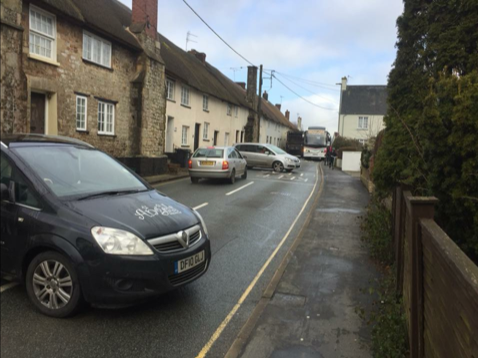
Could Sidford cope with a new industrial site? A 75 minute traffic gridlock says not!

The idea of an industrial complex in Sidford has not died – it could return at any minute.  This was the situation when two large vehicles met on one of the narrowest parts of the road  – vehicles were trapped for more than an hour … imagine if there had been a medical emergency or fire during that time …

Sidmouth DCC councillor Stuart Hughes has responsibility for transport issues in Devon.

A picture is worth a thousand words …

Another day, another council HQ sale mess

Owl says: what is it about councils and HQ relocation that seems it ALWAYS goes pear shaped!!!

“Active Urban Property Group (AUPG) wants to build 100 homes at Suffolk Coastal District Council’s (SCDC) former Melton Hill offices in Woodbridge, sparking residents opposition.

The Ipswich firm won the council contract to redevelop the site in 2016 and its application for the homes was given provisional approval by SCDC’s planning committee in October 2017.

But it needed to satisfy conditions – including affordable housing – before councillors would grant full planning permission.

Since then, nothing has come before the planning committee and critics said the project had stalled, leaving the future of an important site in doubt. …

The proposals had already generated hundreds of objections, many criticising the design of the buildings, which have been described as “cheese wedges”. Public scrutiny has been heightened due to the site’s prominent location and its role in SCDC’s accommodation plan.

The plan, which saw the council move to new £3.9million headquarters in Riduna Park, Melton, in 2016, is hoped to save the taxpayer £8m over 20 years through cheaper running costs.

Although SCDC insists it is still on course to make the savings, the council cannot finalise the sale of Melton Hill until planning permission is granted.

It is understood affordable housing is the main issue to be resolved. AUPG had entered a partnership with Flagship Homes, one of Suffolk’s largest providers of social housing, but the agreement was dissolved in August 2017.

Councillors familiar with the deal claim Flagship’s involvement influenced SCDC’s choice of developer, due to its reputation and financial position. They say Flagship’s withdrawal as a partner in the scheme should have led SCDC to question how AUPG could deliver the project alone.

David Hughes, a director with AUPG, said the partnership’s dissolution was due to a “change in personnel” at Flagship and he expected the planning application to go before the planning committee on April 19.

He insisted the affordable housing would be delivered and said its plans were submitted to the council’s planning department “before Christmas”.

Flagship Homes managing director Tony Tann has not commented on the partnership ending but said Flagship was still involved and “would be pleased to procure the affordable homes”.

He said Flagship was awaiting a response from AUPG regarding its offer.

Much of the criticism of AUPG’s proposals has focused on the difference between its designs and those in a masterplan, released in April 2016.

While the first plans were for 68 homes, retaining two older buildings and the Drummer Boy statue, AUPG’s revisions released last June were for 100 homes and to remove the older buildings.

People at a consultation event last year expressed “shock” at the “radically different” plans, which were “completely unsympathetic” to the surroundings. …”

http://www.eadt.co.uk/news/concern-over-active-urban-property-group-s-homes-plan-for-suffolk-coastal-district-council-s-melton-hill-headquarters-1-5440596

“The Case for Public Consultation Hearings”

“In its latest Briefing Paper, the Institute argues the case for Public Consultation Hearings. In the recommended format, organisations undertaking a consultation will provide the opportunity for selected consultees to appear before decision-makers and give their evidence and their viewpoint – a little like Parliamentary Select Committees.

It is not a new idea, but there are important reasons why the time is right to consider these forms of dialogue:

People are heartily fed up with perfunctory, tick-in-the box forms of dialogue, especially simplistic online surveys with questions like ‘Do you agree with us that we should revise the regulations …. Blah blah.? ‘ Serious stakeholders want a better level of debate that considers issues properly. Public hearings can help.

We have to tackle what can be described on the week of Stephen Hawkins’ death) as the consultation ‘black hole’ It is where respondents make a submission or reply to a consultation but have no idea what happens to their views. Does anyone read them? Are they considered? If so, by whom. It is as if responses disappear down a black home never to reappear. Public hearings are one way to demonstrate that consultors listen!

All the emphasis is now on digital dialogues, and they have many fine features that encourage participation by large numbers who might not have responded using traditional methods. Public hearings can be a welcome antidote to the de-personalisation of electronic media – where real people can be seen to sit down and discuss evidence. Video-streaming can make this visible and transparent to far wider audiences, and be living proof that consultation is really taking place.

The Briefing Paper looks at the role of evidence in public debate, and the need for participants in consultations to evidence their claims and assertions. It then presents the arguments in favour of public hearings, and explores whether they might work in the context of public consultations. For existing public engagement practitioners, the most valuable section may well be on the practicalities of organising a programme of hearings and the challenges that might need to be overcome.

Our conclusion is that where there is a considerable amount of public interest, or where the subject-matter is deeply controversial, they will help convince sceptical communities that decision-makers care enough to explore the issues openly and in public. There is even a case for holding events like this well before a consultation is launched. A pre-consultation exploration of key issues and an opportunity for stakeholder to spell out what they would like to see considered might be a first-rate way of involving the public. Used in this way, hearings can even form part of a co-production approach.

Make your own mind up by reading the latest ‘Briefing Paper 35’ which you can view here if you are member. Alternatively contact Rebecca Wright to request a copy if you are not a member, or would like Institute Associates to help prepare a programme of Public Consultation Hearings for your own organisation.”

https://www.consultationinstitute.org/tackling-the-black-hole-of-consultation/

“Struggling Tory council paid acting boss more than £1,000 a day”

“Tory-controlled Northamptonshire county council, which declared itself effectively bankrupt last month, paid its acting chief executive more than £1,000 a day, it has emerged.

Damon Lawrenson had been interim chief executive at the council since November, having previously acted as temporary finance director at the council since October 2016. Lawrenson left the council this week “by mutual consent”.

Northamptonshire was heavily criticised in a recent government inspector’s report, which identified deep-rooted management and governance failures over the past four years as the prime cause of its financial problems.

The report highlighted what it called the council’s “sloppy” approach to financial management and lack of realism in business planning. It called for a clear-out of the existing leadership in order to restore stability to the council.

A freedom of information (FOI) request by the GMB union revealed that the council paid out £371,000 to DDL Consultancy, owned by Lawrenson, during 2016-17 and 2017-18. His company had earlier been paid a further £540,000 between 2008 and 2011, when he had stints as assistant chief executive and commercial director.

The local government secretary, Sajid Javid, is considering the report’s recommendation that the county be run by a team of Whitehall-appointed commissioners until it can be scrapped, along with seven local district councils, and replaced by two new smaller unitary authorities.

The council, which recently warned that its overstretched adults social care services were “on the verge of being unsafe” issued a section 114 notice in February, signalling that its finances were unsustainable. It banned non-urgent spending, and pushed through £40m of cuts plans, including the closure of 21 out of 36 libraries.

A GMB official, Rachelle Wilkins, said: “For Northamptonshire county council to splurge almost £1m on consultancy while people are losing their jobs and services are being cut is a real kick in the teeth.”

A spokesman for Northamptonshire county council said: “Salaries reflect responsibilities associated with the posts, many of which require highly-qualified, professional staff, while being mindful of the necessity of providing value for money.

“It must be noted that about £560k was incurred in the three years between 2008/09 and 2010/11. Additionally, as a contractor Damon is not eligible for sick pay, holiday pay or pension contributions.” …

https://www.theguardian.com/society/2018/mar/23/struggling-northamptonshire-county-council-paid-acting-boss-more-than-1000-a-day