An interesting Freedom of Information request

Cost of using external law firms and barristers

Date submitted: 24 May 2016

Summary of request

I would like to know the amount of money the council spent on the services of external law firms and barristers over each of the last two years (years ending March 31 2015 and March 31 2016).

Summary of response

External spend on legal fees, including barristers for 2014/2015 = £353,060.78

External spend on legal fees, including barristers for 2015/2016 = £79,053.34

Date responded: 14 June 2016

Just a bit of a jump – and all of it OUR money

Friends of the Earth planning event in Exeter of particular interest to coastal communities

Please advertise this event as widely as possible, particularly to coastal communities – it appears to be free but tickets need to be reserved in advance:

“This is a 3-hour (from 6.30 to 9.30) evening skill-share and Power Up! session designed to better equip you to navigate and influence your local planning and development system – with a focus on coastal towns and communities. The intended outcome of this session is that you will be able to better protect your local communities against unwanted development that will cause environmental and social degredation.

We hope that this event can bring together groups and individuals from the surrounding areas who are either engaged in some way or another with planning concerns or who would like to be.

The evening will be hosted and facilitated by Naomi Luhde-Thompson, Friends of the Earth’s planning specialist.

We look forward to seeing you on the evening of Friday the 7th October!

Please share this with others in your local community you would like to come: https://www.facebook.com/events/152782855158372/

WHEN
Friday, 7 October 2016 from 18:30 to 21:30 (BST)
WHERE
Exeter Community Centre – 17 Saint Davids Hill, Exeter, EX4 3RG

https://www.eventbrite.co.uk/e/friends-of-the-earth-planning-power-up-exeter-tickets-27045439638?invite=&err=29&referrer=&discount=&affiliate=&eventpassword=

PegasusLife – new and bigger plans for Knowle

Revised plans = new consultation?

“Pegasus Life’s latest revised plans for Knowle now submitted.

A string of Pegasus Life’s revised plans and statements for the Knowle, have just been uploaded (10th Aug) to the EDDC Planning portal.

To view, go to https://planning.eastdevon.gov.uk/online-applications/, type in reference 16/0872/MFUL, and search Documents.

Have all the many issues*, not least size, scale and suitability of design, now been addressed?

For two examples of the latter, submitted yesterday, see Document 239415, pages 11-14, showing impact from the south park, and Document 2391414, pages 20-22, impact on upper Knowle Drive.

See information in earlier posts:

*https://saveoursidmouth.com/2016/06/15/knowle-planning-application-breaks-a-raft-of-local-plan-rules-says-vgs/
*https://saveoursidmouth.com/2016/06/13/knowle-drive-after-pegasus-life-plans-a-question-of-perspective/
*https://saveoursidmouth.com/2016/05/30/throwing-away-our-heritage-london-based-save-vehemently-objects-to-plans-for-knowle/

https://saveoursidmouth.com/2016/08/11/pegasus-lifes-latest-revised-plans-for-knowle-now-submitted/

“Nuclear espionage charge for China firm with one-third stake in UK’s Hinkley Point”

Oh dear.

“The Chinese company with a major stake in the proposed Hinkley Point C nuclear power station has been charged by the US government over nuclear espionage, according to the US justice department.

In a 17-page indictment, the US government said nuclear engineer Allen Ho, employed by the China General Nuclear Power Company, and the company itself had unlawfully conspired to develop nuclear material in China without US approval and “with the intent to secure an advantage to the People’s Republic of China”.

CGNPC has a 33% stake in the £18bn Hinkley Point project in Somerset, which Theresa May has delayed partly because of concerns over China’s involvement. The delay prompted a warning earlier this week from the Chinese ambassador to the UK, who said that relations between the two countries are at a “crucial historical juncture”. …”

http://www.theguardian.com/uk-news/2016/aug/11/nuclear-espionage-charge-for-china-firm-with-one-third-stake-in-hinkley-point?CMP=Share_iOSApp_Other

“Greater Exeter” moves on apace – and Greater Plymouth

Local Government is in a particularly fluid and unstable situation at the moment. Brexit is ripping many plans and budgets wide apart, particularly where Local Enterprise Partnerships and local councils were relying heavily on EU funding or EU-based projects, such as Hinkley C.

There have been hints that the new government is not enamoured of some of the devolution bids and that unitary councils (which would see the demise of district councils) may now be back on the table.

Plymouth, the South Hams and West Devon also seem to be working towards a “Greater Plymouth”:

Click to access 201606The_Plymouth_and_South_West_Devon_Joint_Local_Plan_Newsletter_PDF.pdf

Are we seeing the first signs of an anti-unitary move that would allow our two cities to work autonomously rather than Devon-wide? Is it an insurance policy against the increasing powers being grabbed by our LEP?

Whatever it is – it is being done yet again with no consultation and meetings behind closed doors.

Owl wonders what Mrs May thinks of these legacies of Mr Cameron and, more specifically, Mr Osborne.

Here is an up-to-date post on moves towards a “Greater Exeter”:

In a previous post

Whose Vision is it anyway? Part 1

I highlighted the flamboyantly named Greater Exeter Visioning Board, announced with a fanfare of trumpets and then shifted off into the dark shadows of proceedings held behind firmly closed doors. This post reports the uncomfortable outcome of my further investigations.

Having been told by Exeter City Council that the minutes of the Visioning Board were not made public, I asked some more questions. The City Council’s answers are below.

Q1: Under what authority the board was established and who agreed its terms of reference?

A1: A Memorandum of Understanding was agreed by the Leaders and Chief Executives of Exeter City Council, East Devon District Council and Teignbridge District Council in November 2014. The Memorandum of Understanding is not a legally binding document but all parties use all reasonable endeavours to comply with the terms and spirit of the Memorandum of Understanding.

Q2: The reasons for its decision not to publish agendas and minutes?

A2: Many of the issues that are discussed at the Board relate to the growth of the Greater Exeter area. It is considered that the board needs to be able to have open discussions through which they can develop ideas, debate live issues and reach decisions. Disclosure of these discussions may inhibit the imparting or commissioning of advice, or the offering or requesting of opinions for consideration.

Q3: Whether it reports its proceedings to councillors and, if so, what opportunities are open to councillors to scrutinise its work?

A3: Council Leaders and Deputy Leaders from each of the three authorities sit on the board.

Q4: If it does not report its proceedings to councillors, to whom is the board accountable?

So what’s next?

We can at least now speculate what the Visioning Board was up to. On 12 July, the City Council’s Executive (the lead councillors) discussed a report by the Assistant Director City Development which set out proposals for establishing:

“a joint strategic plan for the Greater Exeter area which would be prepared in partnership between East Devon District Council, Exeter City Council, Mid Devon District Council and Teignbridge District Council with assistance from Devon County Council. The plan would cover the geographical area of the 4 partner authorities (excluding the area of Dartmoor National Park) but would be limited in scope to cover strategic issues and strategic allocations within those areas with local issues to be considered through linked local plans prepared by each partner authority for their area.” [1]

This was nodded through and then approved by the full Council on 26 July.

In a future post I will explore the challenges for serious public engagement presented by this form of joint working. For the moment, let’s just say that the gestation of this proposal behind closed doors, and the underlying assumption that joint planning is a technocratic issue rather than something which asks the communities what sort of Greater Exeter we want (if indeed we want one at all) does not augur well.

Or is there another agenda?

Of course, I might be completely wrong, and the Greater Exeter Visioning Board has been discussing something completely different. But if so, what? A Greater Exeter Unitary Authority perhaps? There is an obvious link between the joint strategic plan proposal and the so-called “Devolution” bid for spending powers to be transferred from central government to the “Heart of the South West”, made up of Devon County Council, Somerset County Council, Torbay Council and Plymouth City Council [2]. The district councils like Exeter are at present secondary players in this, a position with which Exeter for one is not comfortable.

NOTES:

[1] The full report is at http://committees.exeter.gov.uk/documents/s52597/EXECUTIVE%20-%20Proposed%20Greater%20Exeter%20Strategic%20Plan%20-%2012%20July%202016%20-%20FINAL.pdf

[2] I will have more to say about the “Devolution” bid in a later post . Meanwhile a useful update is at item 76 of the minutes of the Exeter City Council Executive meeting on 12 July, at http://committees.exeter.gov.uk/ieListDocuments.aspx?CId=112&MId=4469&Ver=4

Source: https://agreeninexeter.com

More on the PCC Hernandez idea for volunteer police drivers

“Devon and Cornwall’s Crime Tsar has come under fire for defending a new police scheme appealing for volunteer drivers to give officers lifts to routine jobs.

The region’s Police Crime Commissioner (PCC), Alison Hernandez, has spoken out in support of ‘police support volunteers’ after Plymouth officers turned to Twitter to find drivers to take them to meetings, police stations and other matters.

The scheme has since been slammed by union bosses, who are concerned about the use of unpaid “amateurs”, while Miss Hernandez’s political opponents have called it “desperate”.

But the Tory commissioner, who was elected earlier this year, insists using volunteers will help “free up” officers on the street.

“It is great that members of the public want to play a part in local policing, and the role of volunteers, while not replacing officers and staff, is important in contributing to our efficiency and effectiveness in Devon and Cornwall,” she told The Herald.

“There are many ways this is demonstrated. The Plymouth volunteer drivers scheme helps to free up officers to be on the streets. That is exactly where people tell me that they want to see officers.

“I support this scheme and urge local residents to put their names forward if they can, or look for other opportunities across the force area.”

But Gareth Derrick, who stood against Miss Hernandez as the Labour candidate in the PCC Devon and Cornwall elections in May, described the scheme as “desperate”.

“This is yet another indication of how far we have fallen in being prepared to accept inadequate funding of key public services under this Tory government,” he said.

I would have expected our newly-elected PCC to be pushing hard for the police funding formula review – not putting into place frankly desperate schemes to keep our police force on the move.”

It comes after Unison bosses expressed concern at the increased use of volunteers to replace paid staff.

In a new report, the trade union found a “bewildering range of police functions” were now being given to “well-meaning amateurs” at a time of massive cuts to the general workforce.

This includes volunteer drivers, stolen goods researchers, intelligence inputters and crime scene investigators – roles which would normally be paid.

Fred Jerome, regional Unison spokesman, said the volunteer scheme in Plymouth was currently “small scale” but he warned against possible expansion in the future.

“From what they [Devon and Cornwall police] are saying, it already happens and has been happening,” he revealed.

“In general, it’s small scale and a lot are retired police force. It seems to be a way for older people to do something helpful.

“But if it were to expand and become a full-time job, it should be treated as a full-time job.

“It is something that seems fairly innocuous at the moment but we are keeping a close eye on it.”

http://www.plymouthherald.co.uk/crime-tsar-under-fire-after-backing-scheme-where-volunteers-drive-police-to-jobs-across-plymouth/story-29607435-detail/story.html

Guess what our new PCC Hernandez has come up with now!

“A cash-strapped police force is appealing for volunteer drivers to ferry its officers to jobs.

Devon and Cornwall Police said helpers, who will use cars from their pool, will cover journeys to community meetings, between stations and “a range of other matters”.

The force said the money-saving scheme in Plymouth is part of a programme to free up officers to spend more time on the beat.

Devon and Cornwall’s Police and Crime Commissioner, Alison Hernandez, said: “It is great that members of the public want to play a part in local policing and the role of volunteers, while not replacing officers and staff, is important in contributing to our efficiency and effectiveness.”

But Gareth Derrick, Labour candidate in the PCC elections, slammed the move as “desperate”. He said: “This is another indication of how far we have fallen in being prepared to accept inadequate funding of key public services under this Tory government .”

Volunteer drivers would work shifts of two to four hours but not work after 6pm or on weekends. They must pass a strict vetting and driving tests. Union Unison has voiced concern at the recruitment of thousands of volunteers to replace axed roles. Devon and Cornwall Police has lost 500 full-time officers since December 2010.

But Jonathan Isaby of right-wing pressure group the TaxPayers’ Alliance said: “Schemes like this can help free up officers’ time and reduce costs for taxpayers.”

Other forces already using volunteer drivers include North Yorkshire.

http://www.mirror.co.uk/news/uk-news/cash-strapped-police-appeal-volunteer-8605307

Hinkley C: conflicts of interest on both sides of the channel

An eerily similar situation to our own, where several members of the Board of our Local Enterprise Partnership will gain for their own companies or establishments from the Hinkley C project. But no abstentions on our side either!

“French firms Bouygues and Vallourec denied that members of their boards who are also on the board of EDF had a conflict of interest when they voted in favour of the French utility’s Hinkley Point nuclear project in Britain.

EDF’s board narrowly approved the controversial 18 billion pound project in a 10-7 vote on July 28. EDF unions argue the project should be delayed because of its financial risk and said on Monday that conflicts of interest in EDF’s board might have impacted the vote.

They say three EDF (EDF.PA) board members are also on the boards of other firms that are EDF customers, which could benefit from Hinkley Point, and should therefore have abstained.

Hours after the EDF board’s decision, the Britgish government announced a surprise decision to review the project, delaying its verdict until early autumn.

EDF board member Colette Lewiner is also on the board of construction firm Bouygues, (BOUY.PA) set to be one of the main contractors for Hinkley Point.

“There was no conflict of interest with regard to Mme. Lewiner,” a Bouygues spokesman said on Wednesday.

He said Lewiner is an independent Bouygues board member with whom management cannot interfere. He added that Bouygues decisions about Hinkley Point are not taken at board level.

Lewiner did not return a request for comment.

In October 2013, a joint venture of Bouygues unit Bouygues Travaux Publics (TP) and British firm Laing O’Rourke said it had been confirmed as preferred delivery partner for the main Hinkley Point civil engineering and construction contract, valued at over 2 billion pounds.

EDF board member Philippe Crouzet is also chairman of the board of Vallourec (VLLP.PA), whose Valinox unit makes tubes for nuclear power plants.

A spokeswoman confirmed Vallourec sells steel tubes for steam generators to Areva (AREVA.PA), which will deliver the two Hinkley Point reactors. She would not reveal sales data for individual clients nor comment on Crouzet’s Hinkley Point vote.

She added that Vallourec’s nuclear activities represent only about three percent of the group’s worldwide turnover.

“It is definitely not core business,” she said.

Vallourec says on its website it has been a partner of France’s nuclear industry from the outset and will play a key role in renovating the country’s nuclear power plants.

Finally, EDF board member Christian Masset, secretary general of the French foreign affairs ministry, is also on Areva’s board. Masset did not respond to a request for comment.

Earlier this year, Areva board chairman Philippe Varin stepped down from his EDF board mandate after unions and the French press raised questions about a possible conflict of interest between the two positions.”

http://uk.reuters.com/article/uk-edf-britain-idUKKCN10L22N

Parliament Briefing Paper on devolution deals – more cracks

This was first published in April 2016 and then updated in July 2016 and shows the cracks appearing in the deals including this paragraph:

“The main subjects of speculation

George Osborne, as Chancellor, was closely associated personally with the agenda. It is not clear whether the new Chancellor, Philip Hammond, will maintain support for the agenda within Government. Lord (Jim) O’Neill of Gatley has indicated that he would leave the Government if he perceived that the agenda was no longer being treated seriously.

Conversely, Greg Clark, the previous Secretary of State for communities and local government, claimed that he had “argued successfully … for English local government to be part of the negotiations on the terms of our exit”.

A number of sector representatives, as well as Mr Clark, have argued for a “radically expanded role for local government” in the wake of leaving the EU.

European Union structural funds have formed a major element of many devolution deals. It is not yet clear if and when structural funds will cease to be paid to UK localities. A number of sector representatives have argued that, if the funds are withdrawn, Government should make good the deficit for the 2014-20 programming period.”

This is how the paper is described:

“This Commons Library briefing paper summarises the main developments regarding the process of devolution of powers to local government within England since 2014. It covers the devolution deals agreed between the Government and local areas up to July 2016, including the powers to be devolved, the procedures required for devolution to take place, and reactions to the policy from the local government and policy-making worlds.”

http://researchbriefings.parliament.uk/ResearchBriefing/Summary/SN07029#fullreport

Cracks in the devolution agenda at national level? And Hampshire starts the discussion

Owl, with its superior hearing, noticed Martyn Oates on Spotlight tonight saying that he had heard that devolution deals were no longer in favour and simpler unitary authorities might now be on the cards again.

Hhhm – Mrs May really is turning the rocks over to see what is underneath.

Well, it was one of George’s more crazy ideas.

But so far, only a rumour.

Hampshire, though, has seen the light:

“HAMPSHIRE County Council is calling on the Government to take a rain check on any plans for devolution while it consults residents on what they think about the idea of combined authorities, elected mayors and unitary options.

Following last month’s EU referendum result and a period of potential economic disruption, county council leader Roy Perry has called on the Government to avoid causing unnecessary instability to Hampshire’s economy – and instead halt plans that he believes would split up Hampshire and erode the strength of vital services to residents across the county.

And despite the change in Government, this message is felt to remain valid.
In a letter to former Prime Minister David Cameron, Mr Perry said that now was not the time to press ahead with proposals to implement a Solent devolution deal, thought to be favoured by East Hampshire District Council, which would break up crucial transport services on which Hampshire’s economy depends, and risk damaging, among other things, significant public investment in essential transport schemes.

And he has called for the resetting of the agenda on devolution.
“The closure of the referendum campaign brings an ideal opportunity to reset the agenda on devolution and refocus on what we’re actually trying to deliver – strengthened local democracy, sustainable local growth and reformed public services.

“The positive energy from Government’s initial announcement to devolve more decision-making powers to local areas has sadly dissipated, as councils up and down the country have divided over two issues – Government’s insistence on having directly-elected mayors, and possible local government reorganisation as the alternative. This is certainly the case in Hampshire and the Isle of Wight where the collective, previously healthy, working relationships have been placed under massive strain by the very process that was supposed to bring us better together.

“We shouldn’t be spending time and resources on these disputes at a time of such uncertainty for the future of the economy and public services.”
Mr Perry said that with the county council needing to save a further £120m by 2019, and most other local authorities also facing similar financial pressures, “there is deep concern across Hampshire about the enormous additional risks of dismantling consistently high-performing services such as child protection, highway maintenance and adult social care, and transferring them to combined or unitary authorities that split the county into several pieces, and cut across the well-established boundaries for the police, fire service and health”.

“That is the inescapable conclusion of the current Solent plans,” he said.
He was heartened therefore when at the Local Government Association conference in Bournemouth, then Secretary of State for Communities and Local Government Greg Clark gave an assurance that the devolution process would not fragment historic boundaries.

In urging the Government to get devolution back on track, Mr Perry repeated his call for proper deals to be delivered in areas that have rejected the Government’s demand for elected mayors as a condition of devolution.
“The Government should also set out the process and timetable for how new unitary councils could be created for areas pursuing local government reorganisation,” he said.

http://www.farnhamherald.com/article.cfm?id=112501&headline=Call%20for%20halt%20to%20devolution%20talks&sectionIs=news&searchyear=2016

Devolution – not in Derbyshire’s back yard if they can help it!

THAT’S HOW YOU DO IT! And Derbyshire doesn’t even have a Local Enterprise Partnership to muddy the waters even further:

“Derbyshire County Council has decided to launch legal action against Sheffield City Region (SCR) Combined Authority over proposals to put some county council services in the hands of the city-region’s new mayor.

The county council’s leader, Cllr Anne Western, said the authority is seeking permission from the High Court for a judicial review of these proposals, outlined in a SCR public consultation exercise that Derbyshire has branded “misleading, flawed and insufficient” – and therefore unlawful.

Cllr Western acknowledged that the council might be criticised for the decision, but stressed it is important to “act now and send out a strong message to help put a stop to these proposals, or risk Chesterfield spending the next 30 years living in South Yorkshire’s shadow”.

SCR’s consultation, which closes on 12 August, could transfer responsibility over some of the county council’s services to the Sheffield mayor, including decisions over major roads, funding for maintenance and road safety on all roads in the borough, public transport and travel concessions, skills for employment and major planning and investment projects.

“If these proposals go ahead, it will affect the people of Chesterfield and Derbyshire for generations to come and yet the consultation doesn’t tell the full story or ask the right questions − so how can people give an informed view?” Cllr Western said.

“The county council has a responsibility to act in the best interests of all its residents and we could not sit idly by and watch South Yorkshire break up Derbyshire without a proper consultation.

“The fact is that if Chesterfield becomes a full member of SCR it will undoubtedly be at a huge financial cost to Derbyshire County Council − and therefore Derbyshire taxpayers − in making our services fit in with new arrangements for Chesterfield, not to mention around £1m in business rates from Markham Vale which would all be transferred to SCR.”

She stressed that if the plans – which the county council is asking to be legally quashed – go ahead, it would be a “big decision with no easy way back” should Chesterfield join the SCR Combined Authority. This would be despite the county council’s own online poll, which received 4,000 responses, showing that 92% of residents reject proposals to join the city-region’s authority.

As well as being a “leap in the dark” given no other council in the country has joined a combined authority outside their county border, which Derbyshire would be forced to do, plans are raising concerns of representation.

The county council said that because Chesterfield is better off than most of Sheffield and South Yorkshire, the new mayor could push its needs to the back of the queue. The mayor could also end up having “little regard” for residents in neighbouring Derbyshire districts, resulting in a potential change to transport services and therefore general borough connectivity.

It also criticised the fact that Derbyshire and Chesterfield councils would only have one vote each in joint decisions, while Sheffield, Barnsley, Rotherham and Doncaster – the members of SCR – would have two each.
The future of Chesterfield would also inevitably be tied to SCR’s 30-year devolution plan, despite only the first few years of investment in the borough having been outlined so far.

“We’ve got a moral duty to fight for our residents and protect them against things we believe will put them at a disadvantage,” Cllr Western continued.
“Chesterfield is Derbyshire’s biggest town, most people who live there also work in Derbyshire and they don’t want to become a suburb of Sheffield − which is effectively what will happen if these plans go ahead.”

According to SCR’S Twitter, the combined authority has received over 2,200 responses to the consultation so far.”

http://www.publicsectorexecutive.com/Public-Sector-News/sheffield-facing-legal-action-over-flawed-and-unlawful-devolution-consultation

Exmouth seafront tenders – time for review?

In response to a Freedom of Information request (below) on 15 February 2016, EDDC refused to divulge any information about the Moirai tender bid for Exmouth seafront.

Owl thinks that now this process has been abandoned, EDDC must divulge this information and that other bidders have no right to keep their bids secret.

Anyone fancy another request?

“Q 1. What information do you hold about any/all organisation that made enquiries in response to JLL’s marketing exercise in respect of the proposals ?
I refer you back to our previous response dated 16th February and quote from this below:

You also asked for the names of the organisations who submitted a bid for this work having been provided already with the number of organisations involved. In considering your request we have contacted the other organisations who submitted a bid and they have confirmed our view that this detail, at this point in time, is commercially confidential to them. We are therefore withholding this detail under Regulation 12(5)(e) of the Environmental Information Regulations.

I confirm that this response still stands and is directly relevant to this question and questions 2, 3, and 4 below.

Q 2. Who were the two applicants who were not chosen at the final interview ?
See above

Q 3.Did any of the two unsuccessful developers include ‘residential’ elements in their proposals? If so details please/
See above

Q 4. Please supply fullest details of the proposals that the two unsuccessful applicants offered.
See above

Q 5. Please provide details of all persons who comprised the selection panel that chose Moirai.
The selection panel was made up of Cllr John Humphreys, Cllr Tim Wood, Cllr Andrew Moulding, Richard Cohen and Alison Hayward

Q.6. Can you kindly confirm that the number of organisations, out of the 4,000 plus that were contacted by JLL, who chose to submit themselves to the final selection process was only three?

4 were initially interviewed and then, in March 2015, we considered 3.

Q 7. Taking into account EDDC’s promise to the public on the non-inclusion of ‘residential’ on the Queen’s Drive site, did any member, officer or advisor ever consider that EDDC’s ‘offer’ to developers had failed to attract a suitable candidate for preferred developer? If so full details please.
No information held”

South West Water – sewage discharge into sea in Devon and Cornwall worst for 2015

“Raw sewage is being pumped into the sea around Devon and Cornwall after heavy rain overwhelmed drainage systems, water bosses have admitted.
Water quality warnings have been issued on beaches in the county because of the problems, South West Water said.

It said intense rainfall leads to run-off from fields and towns combining and affect bathing water quality.

Andy Cummins, Surfers Against Sewage (Sas), said the drainage infrastructure needed to be upgraded. “We need a sewage infrastructure that can cope with the amount of rainfall we get year on year,” he said.

Raw sewage is being pumped into the sea around Devon and Cornwall after heavy rain overwhelmed drainage systems, water bosses have admitted.
Water quality warnings have been issued on beaches in the county because of the problems, South West Water said.

It said intense rainfall leads to run-off from fields and towns combining and affect bathing water quality.

Andy Cummins, Surfers Against Sewage (Sas), said the drainage infrastructure needed to be upgraded. “We need a sewage infrastructure that can cope with the amount of rainfall we get year on year,” he said. “Our infrastructure needs to be able to cope with everything we put down the loo.”

Sas has previously slammed South West Water’s systems after claiming there had been 40 incidents of raw sewage polluting beaches in one weekend last year.

Mr Cummins said many people were not even aware “raw untreated human sewage” was discharged into the sea when the problem arose.

Tourism groups in the area have complained about the sewage, saying it puts people off going into the sea.

Fatos Fida, on holiday from London, said: “I think it is disgusting. As a tourist I had no idea. It puts me off visiting the beach as it isn’t hygienic.”

A South West Water spokesman said they operate an information system telling people about storm water overflows and the risk of pollution affecting quality.

The firm was the only water and sewerage company of the nine operating mainly in England, to have performed “significantly below target” by the Environment Agency’s (EA) 2015 performance assessment. It had 171 category 1-3 pollution incidents per 10,000 km of sewer, 74 more than the next worst-offending firm, the EA reported.

An Environment Agency spokesman said being rated “poor performance” led to “more visits, scrutiny of incidents we attend and increases the number of audits we carry out”.

http://www.bbc.co.uk/news/uk-england-cornwall-36956165

That’s what friends are for …

The “council Chief” has not seen fit to intervene in the closure of any other banks in East Devon but no doubt chats with his high-profile Vice-Chairman Helen Parr (Colyton) at EDDC he has felt he must do what he can to help.

Other towns look forward to a similar intervention by the two of them on their behalf should their remaining banks be threatened with closure.

DCC Councillor Claire Wright recently wrote to Lloyds Chairman begging him not to close the branch in Ottery:

http://www.claire-wright.org/index.php/post/lloyds_bank_chief_executive_urged_to_retain_otterys_branch_in_face_of_cuts

Councillor Hughes (also a DCC councillor with highways responsibility) does not appear to have offered his support there.

“Council chief joins fight to save Colyton bank

East Devon District Council chairman Stuart Hughes has thrown his weight behind Colyton’s fight to save its Lloyds Bank branch from 
closure.

Members of St Andrew’s Parish Church recently wrote to the company’s chairman, Lord Norman Blackwell, appealing to him to reverse his decision to pull out of the town.

In their letter, the rector, the Reverend Hilary Dawson and her two church wardens, Christine Sansom and David Fouracre, said: “It would appear in the world of big business, small is not beautiful. However, to a community like ours, such a facility is crucial.

“We have a predominately elderly population living in a rural location. Many are without private transport, and public transport is infrequent and impractical for those with mobility problems. Many of the elderly are not computer literate, so online banking is not an option for them.

“A large proportion of the Colyton population have banked with Lloyds for many years, primarily because we have a fully functioning bank within the community. Your planned closure of this branch reflects the continued marginalisation of a hitherto thriving rural community.”

Now, in a show of support, Cllr Hughes has echoed parishioners’ concerns in a further letter to Lord Blackwell. He wrote: “Small branches like the one in Colyton are vital for rural communities and I am asking that the Lloyds Banking Group gives serious reconsideration to closing it. Such facilities are absolutely key to the life of our communities and we need to keep them open.”

Colyton district councillor Helen Parr added: “Not only will the loss of Lloyds Bank be a blow to personal customers, it will also hit businesses and many organisations and societies. The loss of our only bank would be a serious threat to the economic prosperity of the town.”

http://www.midweekherald.co.uk/news/council_chief_joins_fight_to_save_colyton_bank_1_4651305

Brexit and the countryside

“Brexit has not yet happened; it is likely to be at least two years before we formally withdraw from the EU. But whilst these policy changes will take years for lawyers and policy makers to wrangle over, more immediate effects are already happening on the ground.

Fundamental to these changes is the element of uncertainty. Depending on which blogs you follow and which papers you read, you will see different degrees of doom mongering. But ultimately uncertainty is bad for business, particularly construction. Indeed in the days after the referendum UK house builders lost as much as 40% of their share value.

July data from the global financial services information company Markit shows that the average drop in house building over the past two months has been the most severe for seven years. Together with the International Monetary Fund reducing its UK 2017 predicted growth figures from 2.2% in April to 1.3% the ingredients seem to be coming together to create the perfect storm for another recession.

Sadly here at Link we know all too well the impact that economic downturns can have on the planning system. Since the last recession started in 2008 there has been a drastic policy shift away from sustainable development towards ‘sustainable economic growth’ –the word ‘sustainable’ seems like an afterthought rather than an integral part of the Government’s vision. This has been manifested in government policy such as the National Planning Policy Framework and also through the systematic stripping back of planning guidance, compounded by the continual drive to cut ‘red tape’. If another recession hits this direction of travel may continue – unless we show policy makers what the effects of these changes would be. We are already hearing, anecdotally, that developers are reconsidering the viability of schemes following the Brexit vote. It is our fear that ‘green infrastructure’, such as the provision of wildlife habitats, will be cut as a part of these re-evaluated deals, along with affordable housing and community facilities, and more and more unsuitable sites will be released for new development.

Whatever happens to the European Directives or the economy, over the next months and years the UK is signed up to the UN’s Sustainable Development Goals. The planning system has a central role in delivering on these goals, particularly goals 11 and 15 – ‘Sustainable cities and communities’ and ‘Life on land’.

So, in these uncertain times whilst continually pushing to maintain robust environmental legislation, we must also be continuing to make the case for nature and the countryside, and the value they add to everyone’s lives, including as part of development projects.

http://www.wcl.org.uk/brexit-promises-more-change-for-the-planning-system.asp

East Devon villages must feed back on EDDC’s plans for their boundaries by 28 September 2016

The expansion of some of East Devon’s most recognisable villages is at the forefront of a new public consultation.

East Devon District Council has begun the eight-week process for its major draft Villages Plan.b The idea is to guide where new developments will go at 14 of the district’s larger villages, as well as the town of Colyton.

Responses will be looked over by the council’s Strategic Planning Committee, before a final version of the plan is produced for yet another consultation.

Locations earmarked for expansion include Beer, Broadclyst, Clyst St. Mary, East Budleigh, Feniton, Kilmington, Musbury, Newton Poppleford, Sidbury, Uplyme, West Hill, Whimple, Woodbury and the town of Colyton.

The Villages Plan will show a black line – the technical term being a Built-up Area Boundary – around the villages.

Within the black line, new houses will generally be acceptable, but outside they will only be acceptable in special circumstances.

The consultation gives the public an opportunity to comment on where the lines should be drawn.

The aim of the council’s planning policy team is to ensure that the main existing built-up areas are included, together with areas that have already been agreed for development – either through planning permission or planning allocations.

A number of alternatives have already been considered, including not having boundaries, drawing boundaries more tightly or drawing them more loosely.

However, none of these options have been progressed, as they differ from the approach set out in the Local Plan which was adopted in January 2016.

Further research has been undertaken to determine whether the boundaries drawn using the council’s existing criteria should be reduced in areas where it is difficult to access local services and facilities on foot.

This approach is being proposed for Beer, Newton Poppleford, Uplyme and West Hill.

Planning permission is less likely to be granted for new housing and industry that fall into areas outside the black line, but this does not mean that these homes and businesses are not part of a village in any other way.

The Villages Plan does not affect any changes that residents could make to their homes without planning permission.

Councillor Andrew Moulding, who is Chairman of the Strategic Planning Committee, said: “We will consider all the comments that are made before producing an East Devon Villages Plan for further public consultation.

“It will then be formally submitted for consideration by an independent Inspector who will decide whether the plan is sound. It is important that we seek the views of the local communities on this plan, which will help in the determination of planning applications.”

Communities and residents have until Wednesday, September 28 to put forward any comments they wish to make on the draft plan. The Villages Plan will then be submitted for examination by a Planning Inspector.

The draft consultation Villages Plan and supporting documents are available at the council offices at Station Road, Sidmouth, in local libraries, with the relevant parish councils or online here:

http://eastdevon.gov.uk/planning/planning-policy/villages-plan/villages-plan-2016-consultation/

http://www.exeterexpressandecho.co.uk/here-s-how-these-14-east-devon-could-expand-and-how-to-have-your-say-on-it/story-29601801-detail/story.html

A lesson in political hypocrisy in Exmouth

Last night, Councillor Bill Nash spoke vehemently at an Exmouth Town Council meeting in favour of the demolition of play facilities in Exmouth to make way for “regeneration” – indeed there was a public spat with another Conservative councillor who was against it.

https://eastdevonwatch.org/2016/08/08/conservative-councillors-in-exmouth-do-not-see-eye-to-eye-it-seems/

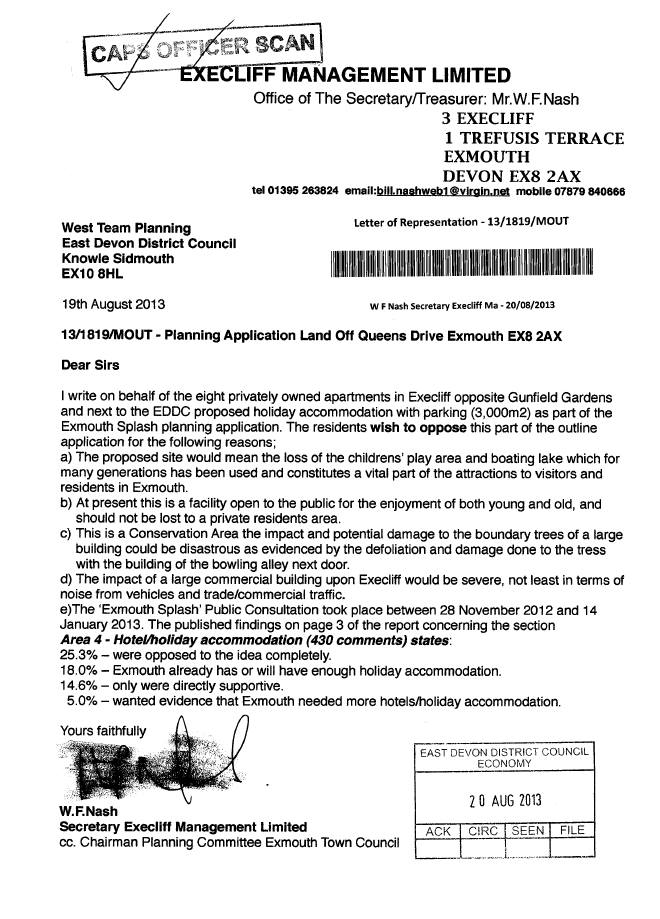
However, in his own interest he raised an objection to these plans:

image

The power of whipping?


Swire does a Trump – Twitter spat with Tim Farron

“The Devon MP nominated for a knighthood in David Cameron’s resignation honours has hit out at Lib Dem leader Tim Farron for his ongoing criticism of the list.

East Devon MP Hugo Swire accused Mr Farron of being “sanctimonious”, following his repeated calls for the list of names to be rejected and the process overhauled.

The less than friendly exchange comes as MPs announce they are investigating Mr Cameron’s chosen recipients, alongside his 13 newly created peers. …

… Mr Farron described it as “so full of cronies it would embarrass a medieval court”. “He is not the first Prime Minister to leave office having rewarded quite so many friends, but he should be the last,” he added.

In an apparent reply to his criticism, Mr Swire sent a tweet stating he “can’t decide who is more tiresome and sanctimonious: [former chairman of the Committee on Standards in Public Life] Sir Alistair Graham or @timfarron”.

Close run thing,” he tweeted.

Mr Farron replied by congratulating the former Foreign Office minister on his award, stating it was “richly deserved”.

Whether this was in sincerity or sarcasm, it prompted one further tweet from Mr Swire: “15 Love to Tim!”.”

http://www.plymouthherald.co.uk/devon-mp-engaged-in-twitter-spat-with-tim-farron-over-honours-list/story-29600423-detail/story.html

Owl thinks that Mr Farron’s choice of the word ‘richly’ might just be giving the game away … subtle Tim … subtle … maybe too subtle for Hugo, though!

Conservative councillors in Exmouth do not see eye to eye it seems

From a correspondent:

This evening, Exmouth Town Council met to discuss the planning application to demolish Jungle Fun and Crazy Golf.

There was a packed public gallery and councillors Fred Caygill (Conservative), Brenda Taylor (Liberal Democrat) and Tim Dumper (Liberal Democrat) did what they should do – spoke to represent the views of residents. Exmouth Town Council then voted 4 to 3 against the application. Councillors Caygill, Taylor, Dumper and Masding (Green) voted against.

However, one councillor – Conservative Bill Nash – caused quite a stir.

Councillor Nash was the first councillor to speak after public speaking ended, first requesting a recorded vote and then speaking in support of the application. He turned to the public gallery to speak in what seemed to be a very heated way, and appeared to have the erroneous idea that all the public were worried about was phase 3 (the final stages of development as planned). He seemed agitated and several people thought he spoke somewhat patronisingly, saying that it was “a straightforward demolition”. He did not seem amenable to any discussion with anyone who did not share this viewpoint.

After the recorded vote, and as the public left the gallery, councillor Nash turned to councillor Fred Caygill (who was sitting next to him) and appeared to say to him, in a very agitated and angry way, that he wanted a quiet word with him for a couple of minutes.

Cllr Caygill, to his credit, did not rise to this but – as Chair Councillor Lynn Elson became aware that members of the public were watching this exchange – she advised them to stop.

It was not clear from the exchange exactly what Councillor Nash wished to discuss with Councillor Caygill after the meeting.

French ruling party has grave doubts about Hinkley C

“The ruling Socialist Party of French President Francois Hollande said on Monday the Hinkley Point nuclear project in Britain is a risk to the survival of state-owned utility EDF and that all doubts about the project must be cleared up before it continues.

The party, which has traditionally been pro-nuclear, said in a statement on its website that the utility’s decision to go ahead with the 18 billion pound ($23 billion) project was a cause for concern.

“The Socialist Party believes that a project that is so important that it could jeopardize the solidity and survival of the national energy company requires that all doubts and hesitations be cleared up before the project continues,” the party said.

It added that it was convinced that the state would do all it can to achieve this aim.

A deeply divided EDF board approved the Hinkley Point project with a narrow 10-7 majority on July 28. Hours later, the British government – which had been expected to sign the contracts the next day – said it needed more time to consider the project and would decide in the autumn.

EDF’s unions are all against the project and the company’s finance director and one of its board members have resigned over it.”

http://www.reuters.com/article/us-edf-britain-socialists-idUSKCN10J27I