East Devon District Council: will the Tory bodies ever be exhumed?

One of the reasons so many Independent councillors were elected was because they were not Tories! People had become sick of the way the district had been run for the last 45 years and demanded change. Part of that change was to see exactly what Tories had been up to in those 45 years when transparency was in short supply.

So, on 3 May, we were presented with:

31 Independents (20 mostly eastern-based/central-based Independents, 11 mostly western-based Independent East Devon Alliance)
19 Tories
8 Lib Dems
2 Greens

An alliance of Independents, Lib Dems and Greens would have produced 41 non-Tories – easily outnumbering 19 Tories.

What we now know happened is that eastern-based Independents (Leader Ben Ingham, Exmouth) refused to work with East Devon Alliance. We assume that Lib Dems (who agreed to work with an Independent majority, but not form a coalition with them), were similarly excluded by Mr Ingham from working with his group.

Instead, Mr Ingham chose to work with the 19 Tories, an ex-Tory (former Tory Leader Ian Thomas) and several so-called Independent councillors whose late-onset Independent roots had never been obvious or put to the test. He gave the job of Chairman of the Council to Stuart Hughes, a Cabinet post to Ian Thomas, one of the jobs representing EDDC at Greater Exeter Strategic Plan meetings to Tory Philip Skinner and several other posts to other Tory councillors. Owl has no idea what the two Green (Exmouth-based) councillors think of this arrangement.

Despite this, CEO Mark Williams presumably decided that there were NOT 31 Independents, but two kinds of totally different Independents (Independent Group, EDA) and declared Tories as the “official opposition” – in spite of them holding Cabinet and other posts. Is this constitutionally correct? How does one decide? One asks the CEO – dead end there, then!

This has led to a Tory (“official opposition”) Alan Dent, being the head of the Scrutiny Committee – the only committee that now has wide investigative powers. The Chair of this committee can say Yes or No to requests for scrutiny of any subject – his word is the only word on what goes on an agenda (as long as the CEO agrees, of course).

So, is there any chance of the Scrutiny Committee holding the previous Tory administration to account? No, zero, zilch, nada in Owl’s view.

So those Tory bodies – lying quietly tucked away for the last 45 years are almost certain to continue enjoying their slumbers.

And all because some Independents can’t or won’t work with other Independents and local Lib Dems are keeping themselves well apart where, in other areas, coalitions of Independents, Greens and Lib Dems is promising real change in formerly true-blue districts.

What is so ironic about this whole story is that, in his political career, Ben Ingham has been a Tory councillor, an Independent Councillor and Leader of the East Devon Alliance!!!

Pitiful and shameful.

“Failure to cut air pollution could land politicians in court, warns UN health “

Unlike other nearby councils and Devon County Council, EDDC had yet to declare a climate emergency for the district, and CEO Mark Williams has already declared himself pessimistic about how and when EDDC can meet clean-up targets:

https://eastdevonwatch.org/2019/05/08/eddc-ceo-puts-new-majority-in-their-place-about-climate-crisis-wants-very-slow-change/

And will the inspector who hears the Sidford Business Park appeal pretend that an increase in heavy goods traffic through the village will not affect those living there, particularly the children and the elderly?

“Politicians could end up in court for failing to protect their citizens from air pollution, according to the UN’s top public health official.

Maria Neira compared the crisis over air pollution to the asbestos scandal, in which governments were accused of failing to act quickly enough to save lives despite knowing the risks.

In an interview with The Times, the director of the World Health Organisation’s Department of Public Health, Environmental and Social Determinants of Health, said that delaying action on the sources of air pollution, such as road traffic and wood burning in urban areas, would cost thousands of lives.

She praised this newspaper’s Clean Air for All Campaign and supported our call for sales of new petrol and diesel cars to be banned by 2030.

Dr Neira said that she was particularly concerned by the damage air pollution does to children’s lungs and brains.

“We know that, 15 years from now, those who have been exposed to high levels of air pollution will suffer major consequences in their immune, digestive and nervous systems and their respiratory systems will be deficient. If this is the society we are preparing for our children we are all very irresponsible.”

She said that toxic air cut short the lives of 40,000 people a year in the UK and 400,000 across Europe and governments and local authorities needed to act quickly to tackle it “even if the measures are not very popular”.

“If you postpone [action] by one day it might be hundreds of lives,” she said.

“If you postpone it by one year it might be thousands of lives plus the cost of the health system and the cost in terms of quality of life from living with asthma.”

She urged politicians to think about the consequences to people’s health of delaying making tough decisions, such as reducing traffic in cities and investing in measures to encourage cycling.

“This is something every politician should ask himself or herself every morning if they say, ‘Instead of 2030 I will do it in 2040’. They should ask the WHO what does that mean in terms of affecting the health of the people and how many new cases of lung cancer. We can calculate that.

“The question here is how many of those lives, or reduction in quality of life, are you ready to absorb. They should inform the public of those consequences and face the risk of losing votes.”

She predicted that politicians who failed to act could be forced to defend their decisions in court.

“Look at the case of asbestos. At one point some politicians were taken to court — the ministry of health in France — because they were accused of [knowing] about the risk of asbestos and [they] didn’t do enough.

“I have the feeling in a few years from now this will be the case [for air pollution] and no politician will be able to say I didn’t know because we all knew and this information has been well-established.”

She added: “There are legal groups already working on this. They have patients and people who lost family members. I can perfectly see the scenario of politicians being accused by our citizens saying, ‘You knew it, you didn’t do anything, therefore you are responsible for the number of deaths that have occurred.’”

She referred to the High Court ruling last month that a new inquest should be held into the death of a nine-year-old girl who suffered a fatal asthma attack believed to have been linked to illegal levels of air pollution near her home in London.

“Look at the case of Ella Kissi-Debrah, this might be a beginning. If you talk to legal groups, the number of cases now going to court is increasing. It might be that in the next few years it increases exponentially.”

The government has already been defeated three times in court by Client Earth, the campaign group which successfully argued that air quality plans were inadequate. The group is now considering bringing new cases against the government and local authorities over illegal levels of nitrogen dioxide pollution on hundreds of roads.

Dr Neira said politicians who believed that taking tough action on air pollution was too expensive should consider the costs of not acting. In 2016 the Royal College of Physicians estimated the costs to individuals, the health service and economy to be more than £20 billion a year in the UK.

“The health system is paying an incredible price at the moment to treat patients because we are talking about chronic diseases and those are very, very costly,” she said. “If you include that cost in your equation then the investment will be recovered immediately by the savings in your health system.”

She urged the car industry to plan a much faster switch to electric cars and suggested they were trying to prolong sales of petrol and diesel cars.

“They are not switching fast enough. They don’t sell fuels they sell the car so they should make the switch as soon as possible. Otherwise they will be responsible for this air pollution crisis.

“If they want to still sell mobility they need to stop selling fossil fuel. They will then be perceived as heroes rather than the guilty ones.”

She urged the public to “keep putting pressure on politicians” to act on air pollution. “That’s the first thing you need to do to protect yourself,” she added.”

Source: Times (pay wall)

“Five million Britons – one in ten of the country – now own second homes worth a total of £1trillion”

The number of Britons with second homes has soared to 5.5million – with their extra properties worth £1trillion.

One in ten own holiday houses, buy-to-lets and overseas properties, according to the Resolution Foundation think-tank.

But the boom comes at the expense of young people, who struggle to get on the property ladder because of rising prices.

Just one in three own a home by the age of 29 – far fewer than the half of baby boomers who had one at the same age.

The Resolution Foundation said property wealth was becoming concentrated among older, richer Britons, with those born in the Fifties more likely to own a second home than any other age group.

It added that younger adults are left boosting the wealth of their parents’ generation by paying significant rental costs.

Spokesman George Bangham said: ‘The rise of additional property wealth is the flipside of falling home ownership. The scale of additional property wealth is an important driver of rising wealth gaps.

‘And as the huge stock of second homes, buy-to-let and overseas properties starts to be passed on to younger generations, Britain risks becoming a country where getting ahead in life depends as much on what you inherit as what you earn.’

The Resolution Foundation’s Game Of Homes report showed that the 5.5million people with additional property wealth had gone up by 53 per cent since 2001, and the value of their second homes increased from £610billion in 2001 to £941billion.

There are 1.9million owners of buy-to-let properties, 700,000 more than a decade ago, making it the most common form of second property. However, the number of people who own overseas property did not change at 970,000.

Since 2002, average house prices have soared from five times income to eight times income, but many believe this is the result of housing supply, not demand from those seeking a second home. …”

https://www.dailymail.co.uk/news/article-7143775/Five-million-Britons-second-homes-worth-total-1trillion-50-two-decades.html?ito=1490

Natural England: “English nature’s ‘jewels in crown’ threatened by cuts, says watchdog”

“The reserves and protected places that are the “jewels in the crown” of English nature cannot be managed properly because of budget cuts, Tony Juniper, the chair of Natural England, has said.

The budget for the government’s conservation watchdog has been slashed in half over five years, leaving it “massively depleted”, according to Juniper, the influential former Friends of the Earth campaigner whom the environment secretary, Michael Gove, appointed earlier this year.

Sites of special scientific interest (SSSIs) cannot be monitored to ensure their wildlife riches are maintained, and on national nature reserves Natural England can only afford to ensure basic health and safety for visitors, he said.

“I’ve inherited an organisation that is depleted, massively depleted,” Juniper told the Guardian in his first national newspaper interview since taking the job. “On a whole range of subjects, we cannot do what society expects of us.

“For example, all we’re able to spend on the management of the national nature reserve estate is for health and safety so visitors don’t hurt themselves.

We’ve got no monitoring capacity on the SSSIs. Our ability to give advice to planning applications and our works on landscapes, national parks and areas of outstanding natural beauty is cut now to pretty much nothing.”

Juniper, visiting Halvergate Marshes in Norfolk, an SSSI and the second largest block of freshwater marshland in Britain, said he had been given no guarantees over budget increases or even an end to cuts so Natural England can revive wildlife and use natural landscapes to help tackle the climate emergency. But he said he had taken the job because he wanted to “reinvigorate the official nature conservation effort in this country”.

Juniper said budget cuts left the watchdog vulnerable to legal challenges. The WildJustice group led by Mark Avery, Ruth Tingay and Chris Packham successfully forced Natural England to scrap the “general licence” that previously allowed landowners to freely kill certain bird species such as crows and woodpigeons.

WildJustice has launched a fresh legal challenge against new temporary general licences, and Juniper invited Avery, Packham and Tingay to meet him.

“They are good friends of mine and I’d be pleased to talk to them about this or anything else, but the involvement of lawyers makes that more difficult,” he said. “I would hope that conservationists could be working together to try to solve these problems in a less time-consuming and confrontational manner because these legal actions do use up a vast amount of resources.”

Juniper appeared to accept that Gove was unlikely to remain environment secretary much longer.

He said: “Michael Gove has been an incredibly energetic, dedicated and effective secretary of state for the environment and it’s very rare we get those. The last one who made that kind of impact was John Gummer back in the early 90s. As was the case with John Gummer we were very surprised how the brief became so passionately owned – Michael Gove has done that and the conservation community has a lot to thank him for, for putting these issues back on the map.”

Juniper said he hoped Gove’s successor would take heed of the public mood, as outlined by recent Extinction Rebellion protests and the school climate strikes. He said: “I would hope no matter what the personal views of the new secretary of state they will come to the role recognising that the voters these days really want delivery on this stuff.”

A spokesperson for the Department for Environment, Food and Rural Affairs said: “Natural England’s work is vital for protecting and enhancing the nation’s natural environment. We have worked closely with Natural England to settle their budget for the coming year.”

https://www.theguardian.com/environment/2019/jun/14/english-natures-jewels-in-crown-threatened-by-cuts-says-watchdog-tony-juniper?

Bit of a headache for Cranbrook councillor who is Chair of Exmouth Regeneration Board

Freedom of Information request which will test the (Independent Group) Chairman’s mettle!

“Dear East Devon District Council,

Please advise what independent advice was sought on the governance of: Queen’s Drive Exmouth Community Interest Company, excluding those individuals and businesses associated with OXYGEN HOUSE GROUP LIMITED Company number 08306319?

Please advise what measures have been taken to ensure that there is a truly independent director on the board?

Please advise why Queen’s Drive Exmouth Community Interest Company was gifted a community asset at the nominal rent of £1 per year for 125 years when East Devon District Council does not hold either a majority share interest or the controlling majority of directors?

Please demonstrate what evidence you hold that ensures that the community asset is protected?

Please demonstrate in what ways Queen’s Drive Exmouth Community Interest Company is a Social Enterprise for the benefit of the local community?

Please clarify in what ways it is not merely an extension of the commercial, private and business interests that Dr Mark Dixon and the companies that he controls including Grenadier already have in place key with tenants Edge Watersports and Michael Caines?”

https://www.whatdotheyknow.com/request/was_independent_advice_sought_on?post_redirect=1

Swire leans on new Indies at EDDC in a way in which he NEVER did on his Tory backers

Excerpt below from Swire’s Twitter feed.

Disingenuous Mr Swire (Owl refuses to call him Sir when he got his knighthood for being Cameron’s bottom pinchee):

– very disingenuous. Hypocritical and frankly rather stupid – it smacks of sour grapes.

The very interesting back story to those painted Sidmouth cliffs …

Owl shares some of the elephant’s characteristics – never forgetting being one of them.

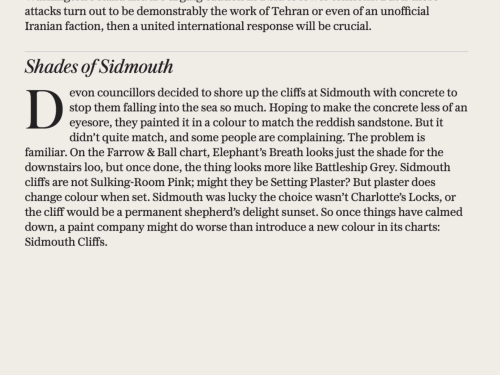
Recently a story appeared in the local press about Sidmouth cliffs being painted a strange colour after stabilising work. Oddly, although this was done by the previous Tory-controlled administration, this was not mentioned in the article – leading to the assumption that it had been made by the new no-overall-control council (or Independent Group and Tory coalition – take your pick). Owl found it odd that this old information had only now been reported to the press.

When Owl saw the name of the geologist who seemed to have broken the story, Dr Alistair Bruce, the name rang a bell. Trawling through its vast archive, it turned up the information that Dr Bruce is none other than the defeated Tory candidate for Yarty ward in the local election last month.

Dr Bruce was chosen instead of long-serving former Leader Paul Diviani – who vented his wrath in a letter to former constituents calling his removal “a [Tory Party] vendetta:

https://eastdevonwatch.org/2019/05/07/diviani-blames-tory-vendetta-for-de-selection-in-yarty/

Diviani was then relegated to finding another vacancy and chose Broadclyst – which he lost. The successful candidate for Yarty was East Devon Alliance Councillor Paul Hayward.

Owl is happy to be putting the record somewhat straighter with this information that has always in the public domain, though the last word has to go to The Daily Telegraph, with its suggestion for a new posh paint manufacturer Farrow and Ball colour – Sidmouth Cliffs Red:

Regional imbalances to be examined by MPs

Bet our Local Enterprise Partnership has some “bigly beautiful” figures to support much more housing – fuelled by nuclear energy probably (bacause, as their hero Trump says – wind turbines cause cancer!).

“A parliamentary inquiry has been launched to examine the impact of regional imbalances in the UK economy.

The treasury committee is to examine the nature and impact of regional imbalances in economic growth across the country and the extent to which these explain poor productivity growth across the UK.

It will establish what regional data is currently available in the UK, how it could be used more effectively in policy development, and whether official regional economic forecasts should be produced.

MPs will seek to learn lessons from other countries on the use of regional economic data and forecasts, and understand how devolution has changed the need for regional data.

The effectiveness of regional bodies, such as combined authorities, in promoting growth will also be considered, as well as the extent to which the devolution of funding can help reduce regional disparities.

Treasury committee chair Nicky Morgan said that disparities between the areas represented by committee members had become “abundantly clear” in her time as chair.

“Whether it be a divide between north and south, towns and cities, or urban and rural, people experience the chasm which exists between various parts of the UK through their day to day lives,” said Ms Morgan.

That included differences not just in economic growth and income, but also in health and educational outcomes and the quality of infrastructure, she said.

“As part of this inquiry, we’ll examine why this is the case, what the effects are in terms of imbalances, such as wages and employment, and how successful regional programmes have been in promoting regional economic growth.

“The treasury committee will seek to identify the disparities and explore how better data can inform policy makers on how best to level the playing field.”

Committee member Alison McGovern said the inquiry would help build an accurate picture of how the economy affected people in different parts of the UK.

“We must understand how regional economic performance shapes people’s lives and their perceptions of where they live and work,” she said.

“It is not sufficient for the government to only offer figures on economic success in aggregate terms. I hope this inquiry can show how the government can get a full picture of the whole of the UK economy in the future.”

Written evidence will be accepted on the treasury committee website until 2 August.”

https://www.publicfinance.co.uk/news/2019/06/mps-investigate-economic-disparities-uk

Teignbridge: “Husband and wife given £200,000 ‘golden handshake’ when they left council”

“Husband and wife duo Neil and Sue Aggett left their posts at Teignbridge in 2018 and details revealed in the statement of accounts that have now been published on the council’s website reveal the pair received more than £200,000 as compensation for the loss of their employment

Two senior council officers who left Teignbridge District Council via voluntary redundancy as part of a major management reshuffle were given a more than £200,000 ‘golden handshake’, it can be revealed.

Husband and wife duo Neil and Sue Aggett left their posts at the council in 2018 after a combined nearly 60 years of service.

Mrs Aggett, who earned more than £80,000 a year, was the business lead for environment, health and wellbeing. She had spent more than 22 years working at the council.

Mr Aggett, who was the monitoring officer and democratic services manager for the council, had worked for the council for 37 years.

Details revealed in the statement of accounts that have now been published on the council’s website reveal the pair received more than £200,000 as compensation for the loss of their employment.

Mrs Aggett, as council director, was paid £123,586 as compensation for the loss of her employment, plus £8,468 as salary for the work she did between April 1 and April 30 when her employment ceased, and £1,236 in pension contributions, for a total of £133,298.

Mr Aggett, as monitoring officer, was paid £81,288 as compensation for the loss of his employment, plus £16,281 as salary for the work he did between April 1 and June 30 when his employment ceased, and £2,377 in pension contributions, for a total of £100,273.

Questions had previously been asked of the council as to the details of their pay-offs, including by Cllr Liam Mullone, leader of the Newton Says No group of councillors, when he called for full public disclosure regarding the reported large payments made to the pair at May’s annual council meeting.

In response, Cllr Alan Connett, the new portfolio holder for corporate resources, said that he could not reveal the details at that stage as the information in relation to exit packages for employees was exempt from disclosure and could not be revealed at that stage due to the agreements signed as part of their departures.

He added though that the details of the exit packages would be provided in the annual accounts under the Accounts and Audit Regulations, which has now taken place.

Cllr Connett at the council meeting also added: “We will be looking at whether in future we can adopt an open approach in Teignbridge and were we to have future instances of to achieving efficiencies via redundancies, we would want there to be public knowledge of those payments upfront.”

He added that if in future they had to say goodbye to more staff in the interest of efficiency and to save money, it would only be done is there would be a long term saving made and that they would try and be open and transparent about payments.

Phil Shears, the council’s managing director, had said last year that he was restructuring the management of the council which in the long term would save money, which would in turn ‘benefit local tax payers by keeping tax increases low.

He took over as the managing director of the council at the start of 2018 following the departure of former CEO Nicola Bulbeck.

She was given a £264,000 pay-off when she left her role after an 11-year stint in June 2017 including an award of £173,000 as ‘compensation for loss of employment’.

Her leaving package was initially kept secret from the public and the council turned down a Freedom of Information request to release the figures, but was revealed in the 2017/18 statement of accounts.

Mr Shears’s salary when he was appointed was in the range between £94,656 – £105,168 – a 25 per cent reduction on the £141,972 remuneration in the 2015/16 financial year that Ms Bulbeck was paid.”

https://www.devonlive.com/news/devon-news/husband-wife-given-200000-golden-2972079

Is our Local Enterprise Partnership attempting to hi-jack housing and infrastructure funding and control?

Yet another attempt by this unelected bunch of conflicted business people to suck up funding meant for local councils:

“…
Recommendations
2.1. 1.
That the Joint Committee pursue an area-based package to accelerate housing delivery which, at headline level, should include:

a. Resourcing of a strategic delivery team (capacity funding)
b. A major infrastructure delivery fund to unlock growth
c. A small schemes liquidity fund to bring forward stalled sites

2. That the proposed package as set out in appendix 1 is agreed as an
appropriate package to accelerate housing delivery across the HotSW
geography.

3. That the proposed package as set out in appendix 1 is used by officers as
the basis for future engagement with central government and its agencies in seeking to secure a bespoke deal for the HotSW area to structurally embed collaboration with central government on housing delivery.

4. That the Task Force seeks to now engage with senior figures within both Homes England and the MHCLG Growth and Delivery Unit to understand their appetite for driving growth and willingness to work with the Joint Committee on some kind of housing deal.

5. That the Task Force brings back any updates or progress to the Joint Committee to consider in due course.”

Click to access HotSW%20JC%20-%20Housing%20Task%20Force%20report.pdf

The appendix on pages 5 and 6 is particularly worrying.

And where does this leave the (stalled due to political changes) Greater Exeter Strategic Plan?

Swire “hated maths”

Well, you don’t need to be numerate or literate or even moderately intelligent to be a Tory MP … just have a party to fund you …

https://www.midweekherald.co.uk/news/mp-hugo-swire-praises-cranbrook-school-s-maths-teaching-1-6105463

Why is Exmouth Regeneration Board chaired by a Cranbrook councillor?

Exmouth Regeneration Board
Membership

Councillor Megan Armstrong (Vice-Chairman [Exmouth Halsdon]
Councillor Kevin Blakey (Chairman, Cranbrook)
Councillor Susie Bond [Feniton]
Councillor Nick Hookway [Exmouth Littleham]
Councillor Chris Wright [Exmouth Littleham]

https://democracy.eastdevon.gov.uk//mgCommitteeDetails.aspx?

“Help to Buy: ‘Most users did not need help report finds’ “

“Almost two-thirds of homebuyers who used the government’s Help to Buy scheme could have bought a home without it, an official report has said.
However, they may not have been able to buy the house they wanted without the help, the report from the National Audit Office (NAO) found.

It also found that one in 25 of participants had household incomes of over £100,000.

The scheme did help boost the profits of building firms, the NAO said.

It was too early to determine if the scheme had delivered value for money for the taxpayer, the report said.

“Help To Buy has increased home ownership and housing supply, particularly for first-time buyers,” Gareth Davies, head of the NAO, said.
“However, a proportion of participants could have afforded to buy a home without the government’s help.

“The scheme has also exposed the government to significant market risk if property values fall, as well as tying up a significant public financial capacity.

“The government’s greatest challenge now is to wean the property market off the scheme with as little impact as possible on its ambition of creating 300,000 homes a year by 2021,” he said.

By 2023, the government will have invested up to £29bn in the scheme, tying up cash which cannot be used elsewhere,” the NAO said.

Bigger firms made the most of the scheme.

Between 2013 and 2018 more than half the sales in England made by Redrow, Bellway, Taylor Wimpey, Barratt and Persimmon involved Help to Buy.

‘Housing bubble’

Persimmon is the biggest beneficiary, with almost 15% of the sales made under the Help to Buy Scheme.

Persimmon saw its annual profits top £1bn last year.

Mike Amey, managing director of global investment management firm Pimco, has told the BBC that profit on a house sold by Persimmon had trebled since Help to Buy was introduced, “roughly from £20,000 to £60,000”.

Fran Boait, executive director of campaigning body Positive Money, said: “It’s now beyond clear that rather than helping those who can’t afford to buy a home, Help To Buy has mainly been a subsidy for a housing bubble, benefiting property developers and existing home owners.”

The government’s investment is expected to be returned from the scheme by 2032 after it closes in 2023. However, the size of the loans mean it is very much exposed to the performance of the housing market.

From April 2021, the scheme will be restricted just to first-time buyers.”

https://www.bbc.co.uk/news/business-48610977

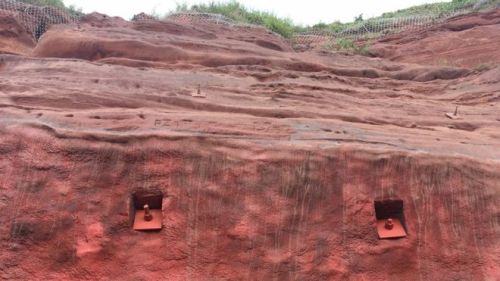
(Former) EDDC accused of “corporate vandalism” – paint cliffs wrong shade of red!

“Sightseers and geologists have slammed a council for painting historic sandstone cliffs in a “weird” red.

Sidmouth rocks are a famous feature of the Devon coast, noted for their natural earthy colouring.

But the decision to paint a section in the “wrong red” during recent stabilisation work has left experts and tourists bemused.

A councillor said reinforcing concrete had been dyed to “help it blend in with the surrounding stone”.

During the works, completed at the end of April, large bolts set in concrete were installed into the cliff to stabilise a large piece of rock.
The work was completed at the end of April.

Geologist Dr Alasdair Bruce said he could only describe East Devon District Council’s effort as “corporate vandalism”.

“They have sprayed most of the cliff. It’s almost like an Eric Sykes film,” he said.

“I’ve seen councils do some strange things with cliffs but this clanger really is at the top of the pile.”

The cliffs at Sidmouth are thought to date back about 220 million years to the Triassic period, which came before the Jurassic period.

Bill Shaw, a metal sculptor from Bideford on holiday with his wife, Peach, said: “It’s a bit weird. It just looks fake.

“It’s the wrong red as well, it should be more of a terracotta colour or would be better just left as it was.”

Geoff Jung, the council’s portfolio holder for the environment, said: “The concrete was dyed to help it blend in with the surrounding stone as opposed to leaving it as a plain concrete finish.”

He said the stabilisation work allowed the council to keep the walkway under the cliffs open and the public safe.”

https://www.bbc.co.uk/news/uk-england-devon-48613244

REAL independence in politics – when ALL independents are in one group

“… As with all the independents I meet, they insist that orthodox party divides have no relevance to politics at the most local level. “If you look at our 16 candidates, we have got leftwing people and we have got a supporter of the Brexit party,” says another DIG councillor, Ged Yardy. “We have not been elected on the basis of our previous politics. Party politics is not in the room.”.

https://www.theguardian.com/society/2019/jun/12/how-to-take-over-your-town-the-inside-story-of-a-local-revolution?

BUT party politics IS in the room when, as in East Devon, Independents from one group appoint Conservatives into positions of power and/or influence in order to give that pairing a majority rather than appointing other independents whose origins differed from theirs.

Swire: obsessed by Raab and Brexit – no time for East Devon

And if you believe this, you will believe anything. Remember, Swire’s party (with Lib Dems and DUP support) has been in power for NINE years – they CREATED the problems they now say should be solved!

Why is the south-west (particularly our LEPs and press) backwards at coming forward on our behalf?

We are reading an awful lot in the press about how the north of England is being discriminated against compared to the south-east and London.

For example:

https://www.theguardian.com/uk-news/2019/jun/10/northern-newspapers-demand-revolution-in-regions-treatment?

Why does our local press and LEPs in the West Country appear to lack the ambition and drive to do something equally bold for our region?

Aren’t we in danger of being left behind (again). Owl thought LEPs were supposed to be leading us somewhere …not just spending our money on vanity projects.

First test of Tiggers planning stance: a fudge on Newton Poppleford

No decision on Clinton Devon’s desire to replace GP surgery with 2 houses at Newton Poppleford – deferred for 3 months to “find a solution”.

One house and half a surgery, perhaps?

Not a good start.

https://www.sidmouthherald.co.uk/news/controversial-newton-poppleford-application-for-three-months-1-6100848