Are Cranbrook’s streets too narrow?

The fire service has already said so:
http://www.devonlive.com/service-issue-warning-inconsiderate-cranbrook/story-29053868-detail/story.html

and a highly critical report mentioned the problem of cars parked in streets – one which has not gone away:
https://eastdevonwatch.org/2015/09/14/what-mainstream-media-isnt-telling-you-about-that-dcc-cranbrook-report/

Now the bus company with the near monopoly in Devon, and which sends only single-decker buses through the town, issues a warning:

“Residents on newly built housing estates are being cut off from the bus network because developers are failing to construct wide enough roads, according to public transport bosses.

One of Britain’s biggest operators warned that buses were being forced to avoid many estates amid concerns over narrow roads, sharp bends, overzealous traffic calming and parked cars.

Stagecoach said that high-density developments were being built with roads only 6m wide, when operators needed 6.5m to allow two buses to pass without clipping wing mirrors.

It blamed planning rules that have cut road widths or pushed the layout of sharp bends to keep car speeds down.

The company also said that national guidelines introduced by Labour 17 years ago intended to clear roads of cars by providing less off-street parking had backfired, with many motorists leaving vehicles on the street.

Stagecoach has issued its own guidance to councils, urging them to build roads at least 6.5m wide, with sweeping bends and off-street parking provided.

It also said that “shared space” schemes that seek to declutter streets by stripping out kerbs, road markings and traffic signs should be redesigned to “avoid buses straying into areas intended mainly for pedestrians”.

Nick Small, Stagecoach’s head of strategic development for the south, said examples included the Shilton Park estate in Carterton, Oxfordshire, where the company could not operate a full-size bus, and the Kingsway development, Gloucester, which had areas “impenetrable by buses”.

Daniel Carey-Dawes, a senior infrastructure campaigner at the Campaign to Protect Rural England, said: “Bad design will lock our towns and countryside into toxic congestion and car dependency for decades.”

Martin Tett, housing and transport spokesman for the Local Government Association, said: “We will be looking closely at this blueprint and continuing to work hard to deliver places where our communities can thrive.”

Source: The Times (pay wall)

Budleigh Neighbourhood Plan group apologises for being unable to save hospital garden after being outmaneuvered by Clinton Devon Estates

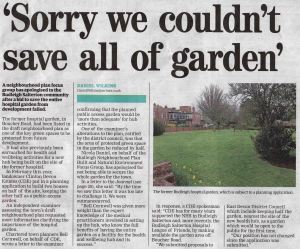
“A neighbourhood plan focus group has apologised to the Budleigh Salterton community after a bid to save the entire hospital garden from development failed.

The former hospital garden, in Boucher Road, had been listed in the draft neighbourhood plan as one of the key green spaces to be protected from future development.

It had also previously been earmarked for health and wellbeing activities for a new hub being built on the site of the former hospital.

In February this year, landowner Clinton Devon Estates (CDE) put in a planning application to build two houses on half of the site, keeping the other half as a public-access garden.

An independent examiner assessing the town’s draft neighbourhood plan requested more information clarifying the importance of the hospital garden.
Chartered town planners Bell Cornwell, on behalf of CDE, wrote a letter to the examiner confirming that the planned public access garden would be “more than adequate” for hub activities.

One of the examiner’s alterations to the plan, ratified by the district council, was that the area of protected green space in the garden be reduced by half.

Nicola Daniel, on behalf of the Budleigh Neighbourhood Plan Built and Natural Environment Focus Group, has apologised for not being able to secure the whole garden for the town.

In a letter to the Journal (see page 20), she said: “By the time we saw this letter it was too late to challenge it. We were outmanoeuvred.
“Bell Cornwell was given more weight than the expert knowledge of the medical practitioners involved in setting up the hub, who know the full benefits of having the entire garden as a facility for the health and wellbeing hub and its success.”

In response, a CDE spokesman said: “CDE has for many years supported the NHS in Budleigh Salterton and, more recently, the Budleigh Salterton Hospital League of Friends, by making available the garden area off Boucher Road.
“We submitted proposals to East Devon District Council which include keeping half the garden, nearest the site of the new health hub, as a garden which would be open to the public for the first time.

“Our position has not changed since the application was submitted.”

Who exactly does EDDC Leader Diviani represent? And who does he consult?

Questions at last night’s Full Council meeting at Knowle shed some light on this. Members of the public pointed out that Councillor Paul Diviani had voted against both his own EDDC council and public opinion, at Devon County Council just two days previously (25th July), by supporting the decision that ‘Your Future Care’ should not be referred to the Secretary of State.

The EDDC Leader’s vote on this occasion could be regarded as crucial, as the decision had been narrowly carried by 7 votes to 6, and was met by cries of “Shame on You” from the public, as reported on BBC Spotlight tv the same evening.

Last night at Knowle, Councillor Diviani replied that he had to vote the way he had at the DCC Health and Adult Care Scrutiny Committee because he was representing the views of the eight Devon District Councils. But when Cllr Roger Giles, Chair of EDDC Scrutiny Committe, then asked him if he had consulted Mid Devon, North Devon, South Hams, Teignbridge, Torridge and West Devon, the answer was no.

So is the oft-repeated phrase from Cllr Diviani and close colleagues, “We are where we are” , the consequence of poor leadership? Fortunately in democratic Britain, our leaders are not permanent fixtures.

Footnote: For reference, one of the questions asked last night, is copied below. All can be heard on the audio recording of the Full Council meeting, soon to be available on the EDDC website.

‘At the 17th May 2017 EDDC Full Council meeting, Councillor Mike Allen said, and the council formally agreed, that care in the community had not yet been proven to work.

Yesterday (25th July 2017), the EDDC Leader voted at Devon County Council Health and Adult Welfare Scrutiny Committee that ‘Your Future Care’ proposals be NOT referred to the Secretary of State. (This decision was made by 7 votes to 6).

Through the Chair, will Councillor Diviani kindly explain how voting against his own Council fits with his leadership of it? ‘

BBC to highlight ‘Save Our Devon Seafronts’ campaign this Thursday (27 July). Port Royal, Sidmouth, will be featured.

“Campaigners from Devon’s seaside towns have united in an initiative to ‘Save Our Seafronts’. Sidmouth is included. This Thursday, BBC Radio Devon breakfast show will include an interview with Sidmouth Councillor Matt Booth, one of the four East Devon District Councillors who are leading the 3Rs campaign for an alternative vision for Por Royal – Retain,Refurbish,Reuse’.

The debate may continue on the radio lunchtime phone in programme (tel 0345 301 1034) and possibly on Spotlight TV on BBC 1 that same day.”

BBC to highlight ‘Save Our Devon Seafronts’ campaign this Thursday (27 July). Port Royal, Sidmouth, will be featured.

Oh dear! Diviani is described as “strong and stable”!

“Councillor Mark Williamson proposed Councillor Paul Diviani as Leader of the Council for the ensuing year. This proposal was seconded by Councillor Brian Bailey.

In proposing, Councillor Mark Williamson spoke highly of Councillor Diviani’s leadership during the many challenges which had faced the Council over the years he had been Leader and of his faith in Councillor Diviani’s ability to lead though future challenges. He undertook the role calmly, purposefully and with intelligence and was a strong and stable leader.”

Click to access 260717-council-agenda-with-minute-book.pdf

page 37

Voting processes need tightening (and scrutiny) urgently

Why shouldn’t our council’s Scrutiny Committee check in its Electoral and Returning Officer’s procedures – even if the Monitoring Officer doesn’t like the idea because it MIGHT be considered political (by him)? A clean bill of health would reassure voters surely?

“The list of Brexit campaigners done for breaking the rules is getting lengthy.

Following the record £12,000 fine for breaches of spending rules, the pair of £1,000 fines for other offences, the company fined £50,000 for illegal text messages and the 11 anti-EU campaign groups struck off for breaking referendum rules, there’s now another £1,500 fine on a different Brexit campaigner:

The Electoral Commission has fined Mr Henry Meakin, a registered campaigner in the EU referendum, £1,500 for failing to submit his spending return on time. It is an offence not to deliver a spending return by the due date.

Though Mr Meakin reported spending of £37,000 in the campaign, the return was received more than 5 months late.”

https://www.markpack.org.uk/150816/henry-meakin-european-referendum-fine/

If YOUR vision for Port Royal isn’t the EDDC vision – you are “scaremongering”

Owl says: Well, that’s rich: who put the 5-storey building into the consultation document? EDDC. So who pre-judged the public consultation? EDDC.

Would the two councils have made such a fuss if it was a Conservative councillor who pointed this out? You decide.

” … Major landowners EDDC and Sidmouth Town Council are exploring options for Port Royal with a scoping study. They have revealed a concept for the site that could incorporate Sidmouth Lifeboat, the sailing club and up to 30 flats in a new building that could stand up to five storeys high.

In a joint statement from both councils, a spokesman said: “We are disappointed by a misleading and scare-mongering petition set up by a local district councillor, Cathy Gardner.

“It is a shame that this petition is pre-judging what the public think and the outcome of consultation with a petition pushing one person’s idea, rather than respecting the opinions of Sidmouth people.

“The councils are asking everyone to express their own opinions instead. The consultation is around the emerging findings of independent experts. There are no plans or proposals being made at this stage.

“We all want to see Port Royal looking as good as the rest of the town’s seafront. Positive ideas and constructive criticism are what we are seeing from Sidmouth people – that is the Sidmouth way.”

Councillor Jeff Turner, who leads the scoping study for the town council, added: “The consultants have not yet produced their final report and, contrary to the misleading statements in this petition wording, there is no fixed plan or proposal as to how Port Royal will be redeveloped.

“We should all wait to see what options emerge from the studies and consultations and how these are received and debated at both town and district councils, before jumping to conclusions.”

He said the study will also take on board the 1,800 responses about Port Royal in the Neighbourhood Plan.

The petition can be found at https://you.38degrees.org.uk/petitions/alternative-plan-for-sidmouth-s-port-royal-the-3r-s.

The campaigners are also staging a public meeting in All Saints Church Hall from 7pm on Wednesday, August 23.”

The councils’ consultation closes on Monday, July 31. It can be found at http://eastdevon.gov.uk/port-royal-consultation/.

Some good news: Manor Gardens, Connaught Gardens and Seaton Wetlands gets prestigious award

… “21 parks across Devon are officially among the very best green spaces in the country. The prestigious Green Flag Award – the mark of a quality park or green space – has been awarded to 21 parks across Devon.”

This international award, now in its third decade, is a sign to the public that the space boasts the highest possible environmental standards, is beautifully maintained and has excellent visitor facilities.”

Award winners in East Devon:
Manor Gardens – Exmouth
Connaught Gardens – Sidmouth
Wetlands – Seaton

http://www.devonlive.com/the-21-best-parks-in-devon/story-30447716-detail/story.html#kjYoSipEqvX4rHJW.99

Owl’s naughty metropolitan cousin

Just to prove that Owl is really quite serfistucated and nice and not at all vile as Swire has intimated, take a look at the blog of one of its cousins in Bristol – where problems are eerily similar to those dealt with by Owl but where said cousin is somewhat more less polite:

https://thebristolian.net

“Cranbrook expansion plans for 1,200 new homes opposed by Cranbrook town council”

“Cranbrook town council voted on Monday night to object to plans for the southern expansion of the new town. Two new applications for the southern expansion of Cranbrook have been submitted to East Devon District Council for the outline planning permission for 27.2 hectares of residential development, 9.2 hectares of employment development, a new primary school, a local community centre, and sport pitches and tennis courts as part of a sports hub.

The plans includes 1,200 new homes, a new primary school, a sports hub, a petrol station, and a site for travellers and were a revision of plans that had been outlined in 2015 but had been deferred while the Cranbrook Development Plan Document was being finalised.

The revised plans would see a reduction of 350 homes, a reduction in employment space by 5,000 square meters to 35,000 square meters, enhanced sports and play areas with all-weather facilities, floodlighting, changing facilities and children’s play, community uses as well as the possibility of gypsy and traveller pitches as an alternative to employment land.

But concerns by the council’s planning committee were raised about the fact that the proposals added land for housing on the eastern edge of the original proposals between Parsons Lane and the Country Park boundary immediately opposite the existing homes in Post Coach Way which front the B3174, and they requested further clarification on the gypsy and/or traveller allocation being provided.

The committee said: “Broadly the planning proposals being considered are in line with East Devon District Council’s Local Plan 2013-2031, which precludes development within the Neighbourhood Plan areas of the surrounding villages. By reducing the application to 1,200 homes, the proposals maintain an acceptable density per hectare and respect the Neighbourhood Plan areas of the two immediate parish neighbours.

“The Committee considered that density of 45 dwellings per hectare as acceptable and reiterated that parking issues associated with that level of density were well recorded.

“The Committee felt that the applications ignored previous pledges about the green wedge contained within East Devon District Council’s Local Plan 2013-2031. Councillors were anxious to preserve the green wedge between Cranbrook and Rockbeare and considered the proposed wedge too narrow.

The proposal added land for housing on the eastern edge of the original proposals between Parsons Lane and the Country Park boundary immediately opposite the existing homes in Post Coach Way which front the B3174 which may raise concerns about visual impact from the village of Rockbeare.

“The inclusion of the “gypsy and traveller pitches” required clarification.The Town Council always maintained a position that it is acceptable for Cranbrook to accommodate a proportionate and reasonable number of pitches particularly to provide permanent homes for gypsy and/or traveller families and this provision should be within the allocation of affordable homes within the scheme.

“The indicative site was, however, shown as an alternative to employment land and had close proximity to the airport. This site was not suitable for settled gypsy or traveller families to be located because of its proximity to the airport and the Committee felt that a possible transition site should be located nearer the main arterial routes and the M5 and not in a residential area

“The Committee also reiterated that there was a need to separate between sites for each group and, traditionally both genuine gypsy and genuine traveller families were not usually content to share sites with new age or caravan travellers.”

They resolved to object to the planning applications.

Since the build of the new town in East Devon began in 2010, 3,500 homes, a railway station, St Martin’s Primary School, play facilities, the neighbourhood centre, local shops, the education campus, the Cranbrook Farm pub, while construction of buildings in the town centre and the sports pitches are underway, while plans for the ecology park in the town have also been submitted.

The application for the southern expansion for Cranbrook would see the town get an additional 1,200 homes, but also a petrol station, a residential care home, employment land, a new primary school, and an all-weather sports facility.”

http://www.devonlive.com/cranbrook-expansion-plans-opposed-by-cranbrook-town-council/story-30445666-detail/story.html

EDDC: (second) postal votes fiasco WILL be scrutinised

“East Devon District Council’s chief executive will be asked to include an explanation of how 9,000 postal votes were sent out without an official security mark ahead of June’s General Election,

The postal vote pack sent out on May 25 to 9,000 voters by the Acting Returning Officer for the East Devon Mark Williams, who is also the council’s chief executive, contained voting slips that did not have an official security mark visible on the front of the ballot paper.

East Devon District Council were responsible for printing the ballot papers but Mr Williams issued a statement reassuring voters that no postal votes had been affected as a result of the error.

The council’s ruling cabinet committee voted on Thursday to agree with the council’s scrutiny committee that his forthcoming report to Cabinet on his two priority areas after the Parliamentary Election must include the explanation of the postal vote issue of May 25 that did not have an official security mark visible on the front of the ballot paper.

Paul Arnott, the chairman of the East Devon Alliance, had previously raised concerns about the fact that the council’s scrutiny committee were not able to investigate what he called the postal voting ‘cock-up’.

He was told that the current legal assessment is that the remit of the Scrutiny Committee does not extend to Parliamentary elections, which is the remit of the Electoral Commission. He queried this and was told that there is nothing laid down about where electoral matters can or can’t be discussed within the framework of local authority governance, and ultimately it is up to the Council and its operation of its scrutiny function as to whether any or all elections or electoral related matters are included in that scrutiny.

He has written to the council, asking them to take on board this advice and for scrutiny to investigate the matter, but in response, Henry Gordon Lennox, the Strategic Lead (Governance and Licensing) and Monitoring Officer of East Devon District Council, said that Mr Arnott had misinterpreted the advice he had been given and said that his query was ‘politically driven’.

Mr Gordon Lennox in a statement said: “In my view, Mr Arnott has misinterpreted the advice from the Electoral Commission, who said that there were no legislative provisions dealing with the role of Scrutiny and elections and therefore it is down to the rules of each authority that will dictate whether or not there is a role for Scrutiny.

“Mr Arnott has taken this to say that the Council’s Scrutiny Committee should be reviewing the conduct of elections. However, what they are saying, and it is my view too, is that effectively it is the Council’s Constitution and the Terms of Reference of the Scrutiny Committee that determine whether they can consider elections or electoral related matters.

“In general terms the role of Scrutiny is to review the actions relating to the various functions of the Council (in whatever form that takes). The role of Returning Officer is not part of the Council, save for the elections relating to towns and parishes and the district. It is for this reason that the Scrutiny Committee do not have the authority to consider the actions and conduct of the Acting Returning Officer / Deputy Returning Officer in the Parliamentary / County elections respectively.

“I think it important to also address the political side of this. I note that Mr Arnott says this is not political. However, Mr Arnott refers to the East Devon Alliance (EDA) report submitted to East Devon District Council following the May 2015 elections.

“Mr Arnott was at the time the Chair of the EDA and therefore a part of the Executive Committee who produced and submitted the report. At the County elections, Mr Arnott was an appointed election agent for the EDA.

“In the correspondence arising out of the postal vote issue during the Parliamentary election, Mr Arnott, when officially signing off his emails, referred to himself as the Chairman and Nominating Officer of the EDA.

“So my perception, notwithstanding what Mr Arnott says, is that his query is politically driven. To that end, the role of Scrutiny is supposed to be apolitical and I would be concerned that even if it were permissible for Scrutiny to be considering this matter, that the purpose for them so doing would be questionable.

“I have explained this matter in some detail in order to ensure that the correct context is understood and to give clarity on the issue. I would further confirm that, despite the above, it is my understanding that the Returning Officer will be presenting a report to Scrutiny at its next meeting on the key priorities he is working on, following what will now be the standard practice of a review process taking place after each election.”

In response, Mr Arnott said: “The independents who campaign under the protective umbrella of the East Devon Alliance have both a right and a civic duty in the public interest to ask questions about this matter without fear of partial criticism from the council’s legal chief.

“Nothing is more serious than questionable practices in a general election, and Mr Gordon Lennox’s boss, Mark Williams, has had since June 6 to the present day to simply explain why he printed the postal ballot papers sent out with no watermark or QR code himself and did not commission them from a professional printers. He has disdained to give a much-needed open answer and his team have focussed on giving reasons why he shouldn’t have to be questioned about it at Scrutiny. Why?

“Mr Gordon Lennox’s time would be better spent persuading his employer to answer councillors about their election concerns than taking swats at me. I am a volunteer while he and his boss are both handsomely paid by council tax payers.

“This matter, and the arrogant manner in which it continues to be dealt with is the essence of why the East Devon Alliance had to be constituted. When we say this issue is not political, what we mean is that Conservatives, Liberal Democrats and Independents alike at EDDC should all be equally alarmed about yet another badly-run election paid for by local people. If they aren’t, they should be.”

http://www.devonlive.com/east-devon-chief-executive-will-be-asked-to-explain-postal-vote-error/story-30443902-detail/story.html

“38 degrees” petition started on plans for Sidmouth’s Port Royal

“To: East Devon District Council c/o P Diviani and Sidmouth Town Council

Alternative plan for Sidmouth’s Port Royal – the 3R’s

Include our alternative plan for Port Royal: Retain, Refurbish, Reuse in your regeneration proposal in place of the current ‘multi-use development’.

Why is this important?

In October this year EDDC will decide on future development for the Port Royal area of our seafront. This follows a scoping study done in conjunction with Sidmouth Town Council. The large-scale development put forward in the consultation (and as proposed in the Local Plan) will have a huge impact on the views, use of the area and change its unique character. People in Sidmouth have been asking why the area can’t remain as it is, with subtle improvements and changes. We now call on EDDC to reconsider their plan for a large new building and adopt our proposal to Retain, Refurbish and Reuse. Retain existing buildings, allow careful refurbishment of the whole area and open up discussions on potential uses for the Drill Hall.

How it will be delivered

Delivery in person, to the Leader and Chair of EDDC and the Chair of STC”

https://you.38degrees.org.uk/petitions/alternative-plan-for-sidmouth-s-port-royal-the-3r-s?source=facebook-share-button&time=1500191579

Claire Wright has grave reservations on Tory Party and Swire’s commitment to environment

“I have submitted a question for the next Devon County Council full meeting prompted by the government’s lack of action and any assurance on moving current EU environmental protections into UK law.

The subject has concerned environmental charities enough for them to establish a coalition of 30 and a pledge for MPs to sign up to to prove their commitment to retaining such protections through the so called Great Repeal Bill, which is when EU law becomes domestic law.

Over 200 MPs have signed this pledge. When I asked Hugo Swire to sign the pledge he refused and wrote this disappointing blog post in response:

https://www.hugoswire.org.uk/news/blog-birds-and-bees-and-brexit

The Great Repeal Bill (coming very soon) gives an option for the government to strip out or amend any laws they don’t like look of.

Very concerned at some of the messages seeping out from senior Conservative ministers on this subject I lodged a motion at the April Devon County Council, as East Devon has some of the most spectacular and precious landscapes and wildlife currently protected under EU legislation and those protections absolutely must be retained.

My motion, which was supported by every DCC councillor bar one, can be found here – http://www.claire-wright.org/index.php/post/devon_county_council_signs_up_to_my_motion_on_protecting_devons_nature_afte

But when I checked up on the response from ministers to my motion I was deeply disappointed.

It contains absolutely no commitment whatsoever on retaining vital environmental protections nor does it even hint at it.

It rather takes the wind out of Hugo Swire’s claims on his blog post!

Ministers need to be urgently pursued on this and Hugo Swire is the route to do it.

I think we need to maintain a healthy scepticism here and if you are reading this blog PLEASE email Hugo Swire and ask him to work HARD and urgently on this issue.

He needs urgent meetings with his ministerial colleagues and he needs to make it clear PUBLICLY where he stands on any such vote. Residents should reasonably require him to speak against and vote against ANY attempt to water down or scrap this legislation.

Mr Swire needs to stop labelling any concerned voices as scaremongerers and actually take some action.

Here is my question scheduled for the full council meeting on Thursday 25 July – and the response from government to my motion that was backed by full council in April:

“Is the leader content with the reply from Kevin Woodhouse of DEFRA, dated 5 June, to my notice of motion approved almost unanimously by this council on 27 April, which called on government ministers to retain the same environmental protections as we leave the EU, as currently exist under EU legislation.

“The reply from Mr Woodhouse states: “The environment is a natural asset that provides us with numerous benefits such as clear water, clean air, food and timber, flood protection and recreation.

““Regarding future policy, until exit negotiations are concluded, the UK remains a full member of the EU and all right and obligations of EU membership remain in force.””

Here is more information about the so-called Great Repeal Bill – http://www.bbc.co.uk/news/uk-politics-39266723

Email Hugo Swire at hugo.swire.mp@parliament.uk

If you care about this, fight for it. Please. Before it is lost forever.

http://www.claire-wright.org/index.php/post/government_lack_of_commitment_on_environmental_motion_prompts_further_quest

“Transformation plans” – a mortal danger to the public?

Our council talks a lot about its so-called “transformation plans” which are supposed to make it leaner and meaner – doing more with less. Except, of course, for its relocation plans, which get more and more bloated with every passing week (“doing the same with more”?).

It trumpets its plans – nay strategy, here:

Click to access transformation-strategy.pdf

There are objectives in it such as “WorkSmart”, “centred”, “clear”, “simple”, “fast”, “organised” and “rational”. As if our council was currently WorkDumb, off-centre, opaque, complex, slow, disorganised and irrational was the alternative. Hhhmm – let’s not go there!

But one word is missing – SAFE.

In the light of the Grenfell Tower disaster, we have seen that ALL of the above can impact directly on council tax payers to make them less safe – as cost-cutting (the REAL meaning of transformation plans) is the major driver.

The London Borough of Newham is so concerned that it has paused its transformation plans on hold saying:

“… Inevitably…in a programme of this scale there are certain areas which have associated risks to delivery both in timing and quantum. Due to the sheer complexity and scale of what the transformation programme is trying to achieve, there are risks attached with the programme being able to deliver fully against its target. Therefore, an adjustment of c£2m has been made to recognise potential non-delivery of savings/income shortfall for 2018/19.”

http://www.room151.co.uk/151-news/news-roundup-borrowing-to-increase-cash-needs-newhams-transformation-savings-residents-audit-lambeth-cipfas-ethics-update/

So, we (and EDDC) must ask: how far is too far?

And is the council’s relocation being done at great expense, when that money ought to be ploughed back into services that have been cut to the bone and may be much less safe for us all? In its race to be bottom of council tax bills has it also been a race to the bottom for our safety?

This is, of course, a national problem – driven by austerity cuts. But have our councils (DCC and EDDC) and other institutions such as the NHS been too passive or even too welcoming of these cuts and too conveniently blind to see their consequences?

EDDC officer accuses East Devon Alliance chairman of “point scoring” over (second) postal vote cockup

Owl says: if the point IS scored, surely that speaks for itself! And anyone reading this supposedly “neutral” officer’s report is bound to wonder if it is, er, political!

“East Devon District Council’s monitoring officer has accused the chairman of the East Devon Alliance of political point-scoring after he raised concerns that the council’s scrutiny committee were not able to investigate a postal vote ‘cock-up’ ahead of the General Election.

Packs that were issued on May 25 contained voting slips that did not have an official security mark visible on the front of the ballot paper were issued to more than 9,000 voters in the constituency.

East Devon District Council who were responsible for printing the ballot papers but Mark Williams, the council’s returning officer, issued a statement reassuring voters that no postal votes had been affected as a result of the error.

The ‘cock-up’ has left Paul Arnott, chairman of the East Devon Alliance, furious, and said that he would have more confidence in a village raffle than in Mr Williams running the forthcoming election and asked the council’s scrutiny committee at their last meeting in June to interrogate the reasons why 9,000 unmarked Parliamentary ballot papers were issued to postal voters.

But in response, he was told that the current legal assessment is that the remit of the Scrutiny Committee does not extend to Parliamentary elections, which is the remit of the Electoral Commission.

Mr Arnott queried this advice with the Electoral Commission, and says he was told that there is nothing laid down about where electoral matters can or can’t be discussed within the framework of local authority governance, and ultimately it is up to the Council and its operation of its scrutiny function as to whether any or all elections or electoral related matters are included in that scrutiny.

He has written to the council, asking them to take on board this advice and for scrutiny to investigate the matter, but in response, Henry Gordon Lennox, the Strategic Lead (Governance and Licensing) and Monitoring Officer of East Devon District Council, said that Mr Arnott had misinterpreted the advice he had been given and said that his query was ‘politically driven’.

The scrutiny committee have recommended to the council’s ruling Cabinet that the Chief Executive’s pending report on the election does includes explanation of the postal vote issue of May 25 that did not have an official security mark visible on the front of the ballot paper.

Mr Gordon Lennox in a statement said: “In my view, Mr Arnott has misinterpreted the advice from the Electoral Commission, who said that there were no legislative provisions dealing with the role of Scrutiny and elections and therefore it is down to the rules of each authority that will dictate whether or not there is a role for Scrutiny.

“Mr Arnott has taken this to say that the Council’s Scrutiny Committee should be reviewing the conduct of elections. However, what they aresaying, and it is my view too, is that effectively it is the Council’s Constitution and the Terms of Reference of the Scrutiny Committee that determine whether they can consider elections or electoral related matters.

“In general terms the role of Scrutiny is to review the actions relating to the various functions of the Council (in whatever form that takes). The role of Returning Officer is not part of the Council, save for the elections relating to towns and parishes and the district. It is for this reason that the Scrutiny Committee do not have the authority to consider the actions and conduct of the Acting Returning Officer / Deputy Returning Officer in the Parliamentary / County elections respectively.

“I think it important to also address the political side of this. I note that Mr Arnott says this is not political. However, Mr Arnott refers to the East Devon Alliance (EDA) report submitted to East Devon District Council following the May 2015 elections.

“Mr Arnott was at the time the Chair of the EDA and therefore a part of the Executive Committee who produced and submitted the report. At the County elections, Mr Arnott was an appointed election agent for the EDA.

“In the correspondence arising out of the postal vote issue during the Parliamentary election, Mr Arnott, when officially signing off his emails, referred to himself as the Chairman and Nominating Officer of the EDA.

“So my perception, notwithstanding what Mr Arnott says, is that his query is politically driven. To that end, the role of Scrutiny is supposed to be apolitical and I would be concerned that even if it were permissible for Scrutiny to be considering this matter, that the purpose for them so doing would be questionable.

“I have explained this matter in some detail in order to ensure that the correct context is understood and to give clarity on the issue. I would further confirm that, despite the above, it is my understanding that the Returning Officer will be presenting a report to Scrutiny at its next meeting on the key priorities he is working on, following what will now be the standard practice of a review process taking place after each election.”

The scrutiny committee have recommended to the council’s ruling Cabinet that the Chief Executive’s pending report on the election does includes explanation of the postal vote issue of May 25 that did not have an official security mark visible on the front of the ballot paper.

East Devon District Council’s Cabinet committee will consider the recommendation on Thursday, July 13.”

http://www.devonlive.com/east-devon-alliance-chairman-accused-of-politically-driven-query-over-postal-vote-scrutiny-request/story-30434940-detail/story.html

“Watchdog concern over “inherently complex” structures of combined authorities”

“The introduction of combined authorities has meant that inherently complex structures have been added to England’s already complicated local government arrangements, the National Audit Office has said.

The evidence that investment, decision-making and oversight at this sub national level was linked to improved local economic outcomes was “mixed and inconclusive”, it added.

In a report, Progress in setting up combined authorities, the watchdog did acknowledge that the Department for Communities and Local Government had worked “speedily” to make sure combined authority areas were ready for the mayoral elections in May 2017.

It also accepted that there “is a logic to establishing strategic bodies designed to function across conurbations and sub-regional areas, and there is a clear purpose to establishing combined authorities especially in metropolitan areas, as economies and transport networks operate at a scale greater than individual local authority areas.”

The report also found:

There was a risk that local councillors would have limited capacity for the overview and scrutiny of combined authorities.

In May 2017, six mayors were elected to combined authorities in England, with candidates having campaigned on manifestos which frequently made policy commitments beyond the current remits of these organisations. “This raises the question of whether mayors can be credible local advocates if they only deal with the limited issues under the remit.”

Combined authorities were not uniform, and varied in the extent of the devolution deals they had struck with government.

If the United Kingdom’s departure from the European Union resulted in reductions in regional funding, the economic regeneration role of combined authorities would become more pressing. “Combined authorities are generally in areas which receive the most EU funding,” the NAO noted.

The NAO highlighted how a number of authorities had been unable to bring local authorities together to establish combined authorities, while areas with a long history of working together had often found it most straightforward to establish combined authorities.

“The capacity of most combined authorities is currently limited and the lack of geographical coherence between most combined authorities and other providers of public services could make it more problematic to devolve more public services in the future,” the watchdog warned.

The NAO’s recommendations were:

The DCLG should:

(a) continue to support combined authorities as they put in place their individual local plans for assessing their impact, including demonstrating the value they add;

(b) review periodically all frameworks and guidance in place for combined authorities and other bodies with joint responsibilities, to ensure that accountability for the delivery of services is clear to stakeholders in local communities; and

(c) continue to work with combined authorities as they develop sufficient capacity to:

deliver the functions agreed in the devolution deals;
support economic growth and the government’s industrial strategy; and
provide sufficient scrutiny and oversight to their activities.
Combined authorities should:

(d) work with the DCLG to develop their plans for assessing their impact, including demonstrating the value they add; and

(e) develop and maintain relationships with key stakeholders in delivering economic growth and public services in their areas.

Areas planning to establish combined authorities should:

(f) make sure they have and can clearly articulate a common purpose;

(g) form an area with a clear economic rationale, mindful of existing administrative boundaries; and

(h) develop relationships across areas where there is no history of joint working.

Amyas Morse, head of the National Audit Office, said: “For combined authorities to deliver real progress and not just be another ‘curiosity of history’ like other regional structures before them, they will need to demonstrate that they can both drive economic growth and also contribute to public sector reform.”

http://localgovernmentlawyer.co.uk/index.php?option=com_content&view=article&id=31779%3Awatchdog-concern-over-inherently-complex-structures-of-combined-authorities&catid=62&Itemid=30

“Inspector to decide if developer should pay more Sidmouth community cash”

Recall that PegasusLife is calling it’s plans for the Knowle “assisted living accommodation”. Why? Because it doesn’t then have to contribute to affordable housing.

Does anyone recall EDDC making a fuss about that? No – they left it to local objectors to point it out!

“A government planning inspector will decide whether a developer will have to pay a share of its profits from 36 proposed sheltered apartments to the public coffers.

The matter was the subject of an inquiry this week after Churchill Retirement Living and East Devon District Council (EDDC) could not agree terms for an ‘overage’ clause.

Churchill hopes to demolish the former Green Close care home in Drakes Avenue to make way for the development. The firm launched an appeal due to non-determination of its application.

The delay in EDDC deciding the fate of the scheme was due to officers trying to apply an ‘overage’ clause that would require Churchill to pay up if its profits exceed current expectations.

EDDC documents argue plans to create the apartments for the elderly should be worth nearly £1million to the Sidmouth community – but the developer has shown it is ‘unviable’ to pay more than £41,000.

Churchill’s five-figure offer towards off-site ‘affordable’ housing was last year slammed as an ‘insult to Sidmouth’ by town councillors, who suggested the developer should pay at least £360,000.

Papers submitted to the appeal process from EDDC say there is a policy expectation that half of the site should be provided as ‘affordable’ housing and that there is a ‘substantial’ need for one- and two-bedroom units in Sidmouth.

If 18 ‘affordable’ homes cannot be provided on-site, a payment of £935,201 would be expected so the properties can be built elsewhere.

Churchill said a viability assessment showed building ‘affordable’ homes on the site was ‘impractical’ and ‘unrealistic’.

It added: “It has been demonstrated that the application development is not sufficiently viable to permit the imposition of any affordable housing or planning gain contributions above £41,208.”

An EDDC spokeswoman said: “Unfortunately, the development is not sufficiently viable to pay this [£935,201] sum and, following an independent assessment of the viability of the scheme, it was reluctantly accepted that the scheme could only afford to pay £41,208 towards affordable housing.

“Under government guidance, we are required to reduce our requirements where a development is unviable and so we have no real choice but to accept this position.”

EDDC also expected Churchill to pay £22,536 for habitat mitigation, plus an £18,400 public open space contribution. The total is nearly £1million.

At the hearing on Wednesday, a representative for the developer said a viability report showed it could not offer more than £41,208 if it wanted a competitive return of 20 per cent.

He argued such developments, both locally and nationally, did not have an ‘overage’ clause like the one proposed and added that it was not in line with national guidelines.

“We need to ensure there are competitive returns for the developer and the landowner,” said the representative.

“If the developer, through his own skill or from fortuitous circumstances, makes a larger profit than intended, then the council wants to have a proportion of it and, if they are not so fortunate and make less than 20 per cent, the entire downside is to be borne by the developer.”

Town councillor Ian Barlow argued that the £41,208 contribution was only agreed to because councillors were told it was subject to an ‘overage’ clause. He added: “If they make an obscene amount of money from our community, then they should put it back into the community. They are now saying it is not plausible.

“We only deal with common sense.

“Theoretically, if someone builds a £5million-ish place and they are only giving around £41,000 back, at the end of the day, that does not seem right.”

Cllr Barlow argued that he found it hard to believe such a successful company would make an investment which was not financially viable.”

http://www.sidmouthherald.co.uk/news/inspector-to-decide-if-developer-should-pay-more-sidmouth-community-cash-1-5100503

South Hams and West Devon district councils consider merger

Owl says: presumably this is not an option open to East Devon District Council, as no council would want to merge with one that is going to take out a big loan for its own new headquarters.

“Two Devon councils are considering a merger into one authority in a bid to save money – but the move could see your council tax increase.

South Hams and West Devon councils are considering joining forces, with a formal proposal to be put to councillors later this month, to make up for a budget shortfall of £1.9million each year after 2020.

South Hams leader John Tucker says there would be “severe consequences” if he cannot produce a balanced budget, suggesting his council could “run out of money”, reports plymouthherald.

“We know that there are some key concerns that the public will have, and in the proposal you will see how we plan to address those concerns,” he said.

“The biggest one for our residents in South Hams is likely to be the difference between our council tax rate and West Devon’s, which is approximately £63 a year on a band D property.

“If the proposal goes ahead we would need to bring the two council tax charges to the same level and this may mean that South Hams residents will see an increase over the next few years, until they are at the same level.

“In the proposal we have laid out some different options for how this could be dealt with.

“If we do not do this, there is a risk that South Hams will run out of money after 2020, due to the lack of funding, we therefore want to make sure we consider all options to continue funding those services we know are vital to our local communities.”

The merger could save up to £500,000 every year, excluding extra income from council tax.

“These savings would not be made through cuts to services, but because a single council will cost less to operate,” a spokesman said.

“Over the last few months a working group of councillors from both authorities, with representatives from across the political parties in South Hams and West Devon, have been exploring if the creation of one new council would be possible.”

http://www.devonlive.com/average-63-council-tax-hike-for-devon-residents-as-councils-plan-to-merge/story-30433679-detail/story.html

Local government lawyers: powerful are more important than the powerless

“Local government lawyers should make sure they have access to the ‘top table’ and that they are listened to rather than necessarily feel the need to be “at every meeting”, the former Head of the Civil Service and Permanent Secretary at the Department for Communities and Local Government has suggested. …”

http://localgovernmentlawyer.co.uk/index.php?option=com_content&view=article&id=31773%3Aaccess-to-top-table-more-important-than-being-at-every-meeting-lord-kerslake&catid=59&Itemid=27

“Golden Triangle” and “Greater Exeter Strategic Partnership” – anyone had an update?

The “Golden Triangle LEP” comprising of Exeter, Plymouth and Torbay appears to have disappeared into a Bermuda Triangle – see here for some not-so-encouraging old information on it:

Politics South West: pigs ears, economy with the truth and foxes

However, word reaches Owl that someone, somewhere, has dredged it up from the deep again and it might be resurfacing some time later this month. Watch this very empty space.

As for the “Greater Exeter Strategic Plan”, in which East Devon is a partner, now that the initial “consultation” has ended, that seems to have returned to the bowels of the basement of Exeter City Council until “early 2018” (maybe):

https://www.gesp.org.uk/consultations/stage-2-draft-greater-exeter-strategic-plan-pending/

The initial consultation was on “Issues”. There is now an issue on if/when the issues feedback turns up.