“Businessman who lent Boris Johnson his £9.5 million flat given job as government adviser”

Here we go …

“LONDON — Boris Johnson has been accused by opponents of allowing friends to “buy influence” after a business executive who loaned the incoming prime minister his lavish £9.5 million home was offered a job in Johnson’s new administration.

Andrew Griffith has stepped down from his role as chief financial officer at broadcasting giant Sky to work as a “corporate adviser” to Johnson.

It came after Johnson and his campaign team were handed Griffith’s lavish Westminster property for the past few weeks as he fought Jeremy Hunt in the Conservative leadership contest, according to a Guardian report.

Labour’s Shadow Cabinet Office minister Jon Trickett said: “Before he is even appointed Prime Minister, one of Boris Johnson’s first acts is to dish out a powerful job in Number 10 to his super-rich pal who lent him his luxurious house in Westminster for the Tory leadership campaign.”

“The public would be forgiven for coming to the conclusion that Johnson’s friends can buy influence within the new administration.”

“It’s blindingly obvious — Boris Johnson and his government will act only in the interest of the wealthy elite.”

Johnson previously worked from the flat belonging to his partner Carrie Symonds located in Camberwell, south London. But the pair were forced to move out of the flat after police were called to the property following a row from the pair, which drew protests outside.

The couple have been living in Oxfordshire but Johnson’s sizeable campaign team reportedly needed a property near Westminster from which they could operate.

Griffith is a former Conservative election candidate who worked at Sky for twenty years, before standing down.

Chief executive Jeremy Darroch told Sky News: “Over the course of his twenty years at Sky and since 2008 as a member of the Board as CFO (chief financial officer) and then as chief operating officer, Andrew has played a fundamental role in many of our proudest collective achievements.”

“Whilst Andrew will be missed, he leaves behind a business that is performing well, has an ambitious set of growth plans and a strong team of colleagues,” he said. …”

https://www.insider.com/businessman-who-lent-boris-johnson-95-million-westminster-appointed-business-executive-by-the-new-prime-minister-2019-7

“State schools choose ‘posh’ uniforms to exclude poor pupils, says MP”

“Some schools are deliberately pricing school uniforms beyond the means of poorer families so “only posh kids go there”, MPs have been told.

Emma Hardy, the Labour MP for Kingston upon Hull West and Hessle, has written to the education secretary, Damian Hinds, asking him to tell schools to stop forcing parents to buy branded school uniforms.

She said that academies in particular were “emulating grammar schools and private schools” in prescribing prohibitively expensive uniforms – including branded blazers and even socks.

She had also been told that some academies deliberately chose expensive suppliers in order to put off parents of lesser means, and that some schools received a cut from suppliers given the exclusive contract for their uniforms.

“People have told me confidentially that schools get money from suppliers,” said Hardy. …

A survey from the Children’s Society last year found families were shelling out more on school uniforms with an average of £340 per year for each child at secondary school – an increase of 7% or £24 since 2015. Parents of primary school children spent on average £255, an increase of 2% since 2015.

The research found nearly one in six families said school uniform costs were to blame for them having to cut back on food and other basic essentials compared to one in seven in 2015.

In England, local authorities and academy trusts may choose to provide school clothing grants or to help with the cost of school clothing in cases of financial hardship.

In Wales, a Pupil Development Grant can provide £125 to buy school uniform, equipment, sports kit and kit for activities outside of school. In Scotland, parents may be able to get financial help with their child’s school clothing and shoes through a school clothing grant, available from local councils.”

https://www.theguardian.com/education/2019/jul/23/state-schools-choosing-expensive-uniforms-to-exclude-poor-pupils-says-mp?CMP=Share_iOSApp_Other

Talk: The Impact of Climate Change on East Devon Wildlife (Seaton)

The Impact of Climate Change on East Devon Wildlife
Hosted by Extinction Rebellion Seaton

Wednesday, 14 August 2019 from 19:00-21:00

Tickets by Eventbrite

No venue stated and tickets seem not yet to be available.

“Sidmouth rated as one of the most expensive holiday spots in UK”

https://www.sidmouthherald.co.uk/news/hotel-prices-in-sidmouth-among-highest-in-uk-1-6173376

Midweek Herald asks: where IS Cranbrook town centre?

Good question!

https://www.midweekherald.co.uk/news/cranbrook-town-centre-investigation-part-one-1-6175614

Made all the more relevant by Exeter City Council refusing ALL THREE applications for out-of-town developments aroundHoniton Road last night,citing, in part, the need not to stand in the way of the development of a town centre in Cranbrook.

Sick, elderly people ripped off – government pockets £31 million fine for it

“Standard Life Assurance Limited has just been fined £30,792,500 by city watchdog the Financial Conduct Authority.

What did they do to deserve it? Sold people the wrong pensions that would have seen them miss out on money every single year for the rest of their lives.

Worse, it was the people with health problems that were mis-sold.

Announcing the fine, the FCA’s Mark Steward said staffs were offered incentives to sell policies over the phone without checking they were suitable “which led to unfair outcomes for some customers”.

Significant numbers of staff received bonuses that doubled their salary for making these sales, which saw thousands of customers miss out on an average of more than £1,500 each as a result. …”

https://www.mirror.co.uk/money/city-firm-fined-31million-mis-18668642

Read and weep – unless maybe you live in Kingston (London) or Kingston-upon-Hull

Ivanka Trump, Twitter:

Congratulations @BorisJohnson on becoming the next Prime Minister of the United Kingston.
— Ivanka Trump (@IvankaTrump) July 23, 2019

New Lib Dem leader voting record – not what you might expect

Presumably, this information in a Guardian comment comes from the theyworkforyou website which tracks all parliamentary votes by MPs. She has already bedn dubbed “Yellow Tory” – oh dear!

On The Environment

Consistently voted for selling England’s state owned forests

Generally voted against financial incentives for low carbon emission electricity generation methods

Generally voted against greater regulation of hydraulic fracturing (fracking) to extract shale gas

On Education

Voted for raising England’s undergraduate tuition fee cap to £9,000 per year

Almost always voted for academy schools

Consistently voted for ending financial support for some 16-19 year olds in training and further education

Consistently voted for university tuition fees

Generally voted for reducing central government funding of local government

Economic Policies

Almost always voted for increasing the rate of VAT

Consistently voted against increasing the tax rate applied to income over £150,000

Generally voted against a banker’s bonus tax

Almost always voted against an annual tax on the value of expensive homes (popularly known as a mansion tax)

Almost always voted for reducing the rate of corporation tax

Almost always voted against restricting the provision of services to private patients by the NHS

On Austerity

Almost always voted for reducing housing benefit for social tenants deemed to have excess bedrooms (which Labour describe as the “bedroom tax”)

Consistently voted against raising welfare benefits at least in line with prices

Consistently voted against paying higher benefits over longer periods for those unable to work due to illness or disability

Consistently voted for making local councils responsible for helping those in financial need afford their council tax and reducing the amount spent on such support

Almost always voted for a reduction in spending on welfare benefits

Almost always voted against spending public money to create guaranteed jobs for young people who have spent a long time unemployed

Democratic Policies

Generally voted against a more proportional system for electing MPs

Generally voted for fixed periods between parliamentary elections

Generally voted for requiring the mass retention of information about communications

Others

Consistently voted against slowing the rise in rail fares

Generally voted against greater regulation of gambling

Generally voted for the privatisation of Royal Mail

Generally voted for restricting the scope of legal aid

Generally voted for use of UK military forces in combat operations overseas”

How has Devon fared under Theresa May?

Badly – crime, education, homelessness and health and social care have all got much worse, only unemployment has improved with the gig econony and zero hours contracts:

https://www.devonlive.com/news/devon-news/how-devon-changed-under-theresa-3123246

Government agrees plan with EDF for cost overruns on nuclear plants – we lose, French and Chinese win

It’s OK – our Local Enterprise Partnership (for whom it is their flagship project) will just pump more of our Devon and Somerset funds into it. After all, after many if them were chosen for their nuclear business connect, they at least will be amongst the few who prosper.

“Energy consumers and taxpayers could have to pay for cost overruns at new nuclear plants after the government backed a funding model proposed by EDF.

The business department said last night it believed the “regulated asset base” model that the French energy giant wants for its proposed Sizewell plant in Suffolk could reduce consumer bills compared with the subsidy contract used to back the £20 billion Hinkley Point plant EDF is building in Somerset.

A consultation document published last night confirms that consumers would, however, be asked to start paying for the plants on energy bills while they were still under construction and to share in the risks of cost overruns.

In the case of an extreme overrun, the government — effectively the taxpayer — could either have to step in and pay the extra cost or scrap the project and pay compensation to investors.

Nuclear power provides about a fifth of the UK’s electricity needs but all bar one existing plant is due to close by 2030. Hinkley Point is the only new project under construction and over the past year developers have abandoned plans for new plants in Cumbria, Anglesey and Gloucestershire amid difficulties securing financing.

Under the regulated asset base model, the developer would receive a regulated price to give it a return on its investment expenditure, including during the construction period, and this would be levied on energy bills.

By contrast, EDF and its Chinese partners CGN are paying upfront to build Hinkley in return for a guarantee that consumers will pay them a fixed price for electricity when it eventually starts generating. The contract, well above current market prices, was widely criticised as poor value for money.

The government said the subsidy contract had been “appropriate” for Hinkley because at the time it was awarded, the reactor technology “was not operational anywhere in the world” and similar projects had suffered from significant delays and cost overruns.

The government said that construction at Hinkley, due to start operating in 2025, was on schedule and the same design of reactor had started up in China. It said that financial investors remained unwilling to put money in “during the construction phase”.

Source:Times (pay wall)

Report on Sidford Business Park Planning Inquiry

Owl says: an excellent summary – but particularly pay attention to one interesting point in it:

QUOTE: …it transpires that after their 2016 application was refused by the District Council the appellants representatives met with the Council’s Chief Executive where he encouraged them to appeal the decision. UNQUOTE

Since when did the CEO give planning advice to appelants – and who (if anyone) was with him at that meeting. And to whom, who, if anyone did he/they subsequently disclose it?

“Apologies for this lengthy Update but we wanted to provide the full flavour of the Planning Inquiry.

As we are sure you all are aware last week there was the Planning Inquiry into the appeal lodged by Tim and Mike Ford, trading as OG Holdings Retirement Benefits Scheme, into the planning application to build a Business Park in Sidford that was refused by East Devon District Council at the end of last year. The Inquiry was held in public in front of a Planning Inspector.

The District Council was represented by a very competent barrister and had one of its planning officers and a highways officer from Devon County Council as their witnesses. On the other side, the Fords, known throughout the Inquiry as the appellants, were represented by a QC and had a plethora of witnesses.

Four representatives from this Campaign were present continuously at the Inquiry from the very moment when it commenced and over three days until the moment that it concluded. Indeed, three of the Campaign’s representatives gave evidence to the Inquiry, were cross examined by the appellants’ QC and were able to direct questions to be put to witnesses, as well as participating in several “round table” discussions on specific issues related to the matters under consideration.

The three Campaign representatives who gave evidence were District Councillor Marianne Rixson, Keith Hudson and John Loudoun. There were also three other witnesses, all speaking against the proposed Business Park. These were – Town Councillor Jeff Turner, County Councillor Stuart Hughes and Sidford resident Jackie Powell. In reality, and for all other appearances, this Campaign’s representatives were treated as, and able to participate as, full participants alongside the Council and the appellants.

At all stages of the Inquiry it was pleasing to have a number of members of the public in attendance for what on a number of occasions must have been a rather dry affair, particularly when legal arguments were being exchanged and technical data argued over.

The bulk of all of the evidence and legal arguments centred primarily, as one would expect, around the issue of the suitability and safety of the highway (the A375 through Sidford and Sidbury) as this had been the grounds upon which the District Council had refused the latest planning application. Its worth recalling that for the appellants the planning application which was the subject of this Inquiry was the latest on for that site, with the first one being back in 2012, whilst the Fords submitted their first in 2016, which as we know was refused in the same year.

On the final day of the Inquiry this Campaign’s representatives were able to make strong interventions on what could become an important set of issues. As in any such Inquiry the Inspector, whilst they have all the parties together, go through what planning conditions would apply should the Inspector uphold the appeal. None of this is meant to signify that the Inspector has made a decision one way or another, but rather makes good use of everyone’s time.

We were able to put arguments on behalf of local residents for some of the main planning conditions. These conditions include important matters such as the days and hours when noisy machinery could be operated, the days and times when deliveries or collections could be made to businesses using the Business Park, having an agreed site lighting scheme which would include the use of illuminated advertising, the days and times of when the construction can take place and when construction vehicles can access the site.

Both parties agreed that if the site becomes operational there will be provision made at it for a cycle/footpath through it. This would link to the existing cycle/footpath that goes from Two Bridges Road down to the Byes and is meant to be an additional link to join through to the centre of Sidbury. The only problem here is that the County Council appears to have made no progress in developing the route into Sidbury.

This Campaign argued that the appellants, if successful at the appeal, should agree to fund the full cost of the cycle/footpath from Sidford to Sidbury and that such a condition should remain for the next 10 years. The appellants, not unsurprisingly, did not accept that this should be a condition that either legally or voluntarily should be applied!
We were very pleased to hear from the Inspector that the day before the Inquiry started, he had visited the site, as well as key areas within Sidford and Sidbury.

At the end of the Inquiry the Inspector invited both parties and this Campaign to identify sites that we wanted him to revisit. We are pleased that our proposed locations were accepted by the appellants representatives.
During the Inquiry we were able to persuade the Inspector to pay five videos that we had submitted as part of our evidence. These videos, we argued illustratively show the effects on the A375 in both Sidford and Sidbury of traffic problems given the current level of traffic, and we argued that with the additional traffic that would be generated by the Business Park this would only get worse. Links to each of these videos are set out at the end of this Update.

Interestingly, three new pieces of information came from evidence provided on behalf of the appellants.

The first is that the appellants argued that the planning application as it currently stands is the least that would make the site financially viable for them. In other words, if the appeal is lost then there is no point in the appellants submitting another application as it wouldn’t make them enough money.

Secondly, it transpires that after their 2016 application was refused by the District Council the appellants representatives met with the Council’s Chief Executive where he encouraged them to appeal the decision.

The third was that even if the appeal is successful and the appellants are able to build the Business Park, they would not be intending to build a phase two development in the neighbouring field as was expected.
The documents that both parties, this Campaign and members of the public have submitted to the Inquiry, and which the Inspector assured us he has diligently all read are available via this link –

https://planningapps.eastdevon.gov.uk/Planning/lg/dialog.page?Param=lg.Planning&org.apache.shale.dialog.DIALOG_NAME=gfplanningsearch&SDescription=18/1094/MOUT&viewdocs=true

NHS privatisation : follow the money – £9.2 billion to be precise

On the back of this article saying £9.2 billion has already gone from the NHS to private companies:

https://www.theguardian.com/society/2019/jul/21/private-firms-nhs-budget-matt-hancock-promise?CMP=Share_iOSApp_Other

It’s good to be reminded of this oldie:

Adult social care vastly underfunded in Devon

“A new report has found that Devon County Council to be one of the lowest spenders on adult social care.

Most adult social care spending in England is paid for by local councils.

The report, commissioned by the Salvation Army, examined nationwide social care spending of rural and urban councils and concluded that Devon was among the worst.

The charity calculated the “spending potential” for over-65s with a disability of every local council and unitary authority.

In Devon, the theoretical per person spending was approximately £6,900, a fraction of the £32,000 that Lambeth Council in London can spend.”

https://www.bbc.co.uk/news/live/uk-england-devon-48987369

“Dorset council faces a legal fight over housing development in Area of Outstanding Natural Beauty”

“DORSET Council is facing a legal battle over plans to build a large housing estate on countryside immortalised in Thomas Hardy novels, after locals complained of its “devastating” impact on rural communities.

The proposals would result in almost 1,000 homes on Vearse Farm in Bridport, the largest ever development permitted on an Area of Outstanding Natural Beauty in England.

But residents now hope to overturn the council’s decision in the courts after raising more than £30,000 through crowdfunding to finance a judicial review.

The challenge is backed by the Campaign to Protect Rural England (CPRE) and the Thomas Hardy Society, whose members described the plans as a “nail in the coffin” of Hardy Country, an area named in honour of the Victorian author.

Outline planning permission was first approved by West Dorset District Council, which has since amalgamated to Dorset Council, in November 2017 but proposals were only finalised in April.

The development, which covers an equivalent of 63 football pitches, would see the population of Bridport increase by an estimated 25 per cent.

But residents objected on the grounds the scale of the housing estate was “inappropriate” and raised fears the surrounding countryside would be spoiled.

A specifically-created campaign group, called ADVEARSE, was created to set up a crowdfunding campaign to raise £34,000 in order to fund a solicitor and barrister to launch a judicial review.

Barry Bates, chairman of the group, said: “If we do not take this action now, nothing further can ever be done to challenge a development of this devastating scale on this site.”

Overlooking the development site is the distinguishable Colmer’s Hill, a beloved landmark in Dorset that is said to be an inspiration for artists and novelists including Hardy, who mentioned it in his 1880 short story Fellow Townsmen.

Dr Tony Fincham, chairman of the Hardy Society, said: “This proposal is just the kind of over-development which irretrievably destroys part of Hardy’s Wessex.

“So often West Dorset (Council) doesn’t realise the value of its very special landscape in both literary and tourism term.

“This plan is just another nail in the coffin of Hardy Country.”

Elizabeth Sims, the widow of eminent violinist Neville Marriner, known as one of world’s greatest conductors, has also put her name to the cause. …

Dorset Council is under pressure to build over 15,000 new homes in west Dorset – one of the worst areas in Britain for affordable housing – by 2036.

The average price of property in the area now stands at £318,000, well beyond the means of most people born and brought up there.

David Walsh, Dorset Council’s head of planning, said: “We are confident in the way the Vearse Farm application was considered.

“As this is a legal process, it would not be appropriate to comment further at this moment in time.”

https://www.telegraph.co.uk/news/2019/07/19/dorset-council-faces-legal-fight-housing-development-inarea/

Swire’s old job opens up as current occupant resigns rather than work with Johnson

No such qualms for Old Etonian Swire, one assumes, working with yet another Old Etonian boss, and Old Etonian Cameron having appointed him and knighted him. Swire did support unsuccessful candidate Raab, who has since sucked up to Johnson – but he’s not an Old Etonian!

“Sir Alan Duncan, the Foreign Office minister, has resigned today because he is not willing to serve under Boris Johnson, the Times’ Steven Swinford reports. Number 10 has confirmed that Duncan has indeed gone.

That is not especially surprising. Duncan has been fiercely critical of Johnson in public, including recently accusing Johnson of “contemptible negligence” for his failure to back Sir Kim Darroch, at the time the US ambassador to Washington, in the face of attacks from President Trump. If Duncan was not resigning, he would almost certainly be sacked later this week.

But what is unusual is the way Duncan, along with the cabinet ministers Philip Hammond and David Gauke, have decided to resign pre-emptively rather than let Johnson dismiss them. This is unusual, and illustrates quite how strong the opposition to Johnson is in some parts of the parliamentary Conservative party. …”

https://www.theguardian.com/politics/live/2019/jul/22/brexit-tory-leadership-boris-johnson-dismisses-boris-johnsons-claim-moon-landing-style-can-do-spirit-will-solve-brexit-live-news?CMP=Share_iOSApp_Other

Political poetry

By Peter Jukes:

The MARCH of LOOT

As the contest finally creaks
Into its last corrupted weeks,
So much is owed to the people who
Were robbed so often by so few.

Bombasts, blowhards, sound your horn,
Herald this disastrous dawn,
Moguls, oligarchs, raise a glass
As your chumps and champions pass.

In a bus, emblazoned in red,
Farage and Bannon at its head,
Inside he waits for Trump to tweet:
This is the triumph of deceit.

Piffle, kippers, dead cats, whey –
The land of Shakespeare blown away,
Famed for gravity and honour,
Led by a dunce to ruin and squalor.
*
Far away, in warmer water,
Kitts and Nevis, Cyprus, Malta
Lucre glitters, laughs and flies
Back to London where it buys…

Lawyers, bankers, spooks and hacks,
Shorting, leaking, legal attacks.
On the road to Downing Street,
All these frauds and chancers meet.

Stolen rubles, hedge fund debt
All double down on this last bet
To bribe, blackmail, and take power
In Britain’s most inglorious hour.

Churchill, Cromwell, pale with shame
Freeze with horror at his name.
Rooks are silent, lions mute,
At the vainglorious March of Loot.
*
Land of honour and fair play
Never saw a darker day.
As the doors of Number Ten
Close behind the hollow men
Who whistled up the dogs of race
And brought a nation to disgrace.

Weep Britannia, weep in grief.
Hope your neighbours bring relief.
Tell the truth – this cannot last.
Hold the faith, and hold it fast,
As clown, liar, cheat and fool,
Boris Johnson starts his rule.

“England’s seaside towns where young people might disappear”

Does our Local Enterprise Partnership – which could but does not invest in coastal regeneration – care? Not one jot.

“Analysis by BBC News of population projections has found seaside towns in northern England could see the biggest decline in under-30s.

The Parliamentary Group for Coastal Communities said funding cuts meant seaside towns were “being left behind”.

The government said it had invested more than £200m in coastal communities.
The coastline in England is home to some of the most beautiful but also poorest places in England. …

BBC News has analysed the population projections made by the ONS for 75 local authorities in England with a coastline.

More than half of the local authorities could see a fall in the number of residents under the age of 30 by the year 2039.

The biggest decline in the number of under-30s could be in the north of England, where every local authority with a coastline, except Liverpool, might see a fall in the number of young people.

Collectively northern seaside communities might see a reduction of 200,000 under-30s over the next two decades.

In contrast, coastal authorities in the south, such as Bristol (+13%), Canterbury (+6.4%) and Southampton (+4.7%) could see substantial rises in the number of young people …”

https://www.bbc.co.uk/news/uk-england-48995925

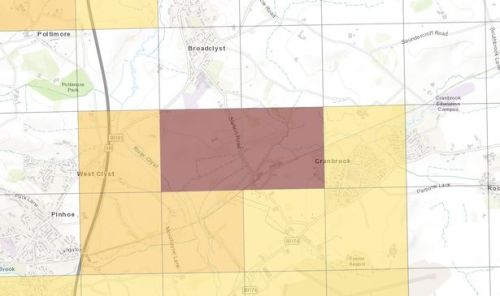
Area around Science Park and western Cranbrook has high radon levels

“Radiation: You would imagine it’s more of a concern for those living near the Chernobyl and Fukushima nuclear disaster exclusion zones.

But in truth Devon is notably radioactive and one of the worst affected parts of the UK as our soil and rock constantly seeps decaying uranium gas: Radon.

Above average levels of radon in Devon and Cornwall remains a silent killer in the rural parts of the county – and some residents are sat in homes that pose a greater risk of radiation absorption than working in a nuclear plant.

A map by Public Health England shows starkly how bad it is in comparison to other places. Even in the same county. For example, Exmouth shows little sign of radiation whereas Cranbrook has high than average levels.

Sobering facts also reveal thousands of deaths in the UK are linked to radon induced lung cancer, as the government works to help those impacted by it by ‘making safe’ their homes and workplaces. …”

https://www.devonlive.com/news/devon-news/devon-surprisingly-radioactive-parts-worst-3111033

EDDC Leader promises consultation on Phase 3 of seafront development

https://www.exmouthjournal.co.uk/news/door-open-for-meeting-about-exmouth-seafront-1-6167223

Hinkley C may kill 250,000 fish per DAY

“It has been described as a giant plughole under the sea, sucking in 130,000 litres of water a second along with vast numbers of fish.

The twin inlet tunnels stretching two miles out into the Severn estuary are so big that a double-decker bus could drive through them. The system will cool a new nuclear power station being built at Hinkley Point in Somerset but conservation groups say it will kill up to 250,000 fish a day and must be altered or scrapped.

They say that EDF, the French state-owned energy group, has grossly underestimated the system’s impact on marine life in the estuary, a special conservation area.

A 5mm mesh will be installed to prevent larger fish being swallowed but the groups, including the Blue Marine Foundation, Wildfowl & Wetlands Trust and Somerset Wildlife Trust, say many fish will be fatally injured when pressed against it. Small fish, eels and the fry of many species, such as salmon, whiting and cod, will be sucked through the mesh and into the cooling system. The groups say it could damage the population of twaite shad in the UK, a small herring-like fish that used to spawn in the estuary by the millions but has dwindled to tens of thousands.

EDF says the system will kill about 650,000 fish a year. It has asked to vary its original permits and planning permission for the power station to allow it to remove an “acoustic fish deterrent” from the cooling system. It argues that, even without it, the impact of the system on fish populations will still be “negligible”. EDF says fish will be adequately protected by other measures, one which will slow the water entering the system and another which will return to the sea the fish sucked in.

Conservation groups argue that scientific analysis they obtained of the cooling system shows far greater harm to marine life. This analysis is partly based on measurements of fish swallowed by the cooling system of Hinkley Point B, a nearby nuclear power station which consumes a quarter of the sea water that will be extracted to cool Hinkley C. They want the government to reject EDF’s application and, if the company cannot mitigate the damage, force it to use other ways to cool the station, such as cooling towers or ponds.

James Robinson, of the Wildfowl & Wetlands Trust, said: “The authorities must decide if it’s worth building a giant plughole to suck millions of sea animals to their deaths, in one of our most important protected marine areas, in order to produce electricity.”

Charles Clover, director of Blue Marine Foundation, said the groups would also challenge plans by EDF for a similar system at its proposed new nuclear power station at Sizewell in Suffolk.

Michele Bowe, Somerset Wildlife Trust director of conservation, said: “It is of grave concern that EDF is seeking to cancel one third of the measures originally imposed to protect fish numbers when construction work of the tunnel systems is well under way.”

Chris Fayers, head of environment at Hinkley Point C, said: “Studies have shown the power station would have a negligible impact on local fish stocks with the proposed fish protection measures in place. These are a fish return system and water intakes specially designed to slow the water coming into the cooling pipes. Hinkley Point C will be the first power station in the Bristol Channel with fish protection measures.”

Source: Times (pay wall)