“Councils made to give £225k BACK to developers – often because they didn’t spend it quickly enough”

Could it, has it happened here? Only a Freedom of Information request will tell …

“More than £225,000 of Section 106 money has been handed back by councils – mainly because they did not spend it in time.

The money, paid to councils by developers, is meant to go on road improvements, public transport and community facilities at new housing estates.

S106 contributions are often included as a way to overcome objections and as a condition of planning approval.

But on a number of occasions in the last five years the money was returned because Suffolk councils had not spent it within a five-year limit, Freedom of Information requests from this newspaper show.

While the sums are a fraction of total S106 contributions made, councillors said they showed deep failings within local government.

Andrew Stringer, leader of the Liberal Democrat, Green and Independent group at Suffolk County Council (SCC), said it was “perverse” that developer contributions were going unspent during a time of austerity.

Much of the returned funding was down to SCC’s failure to carry out highways projects. …”

https://www.eadt.co.uk/news/section-106-ipswich-saxmundham-haverhill-housing-developers-1-5866556

Greater Exeter Strategic Plan – where are we? In trouble!

All change on the Planning Front for East Devon.

Ever since David Cameron’s coalition government’s efforts to provide local communities with a say in local planning decisions with the “Localism Act” in 2011 (giving communities the power to draft “Neighbourhood Plans,” designed to provide a degree of self-determination to how local communities could be developed in the future) the powerful developers and landowners lobby has been active to reclaim their powerful grip on developing our communities.

First was the new National Planning Policy Framework (NPPF) in 2012 which threw out the old planning regulations and provided a “developer-driven” new planning policy, with just a “nod” to the Localism Act, Neighboured Plans and District wide plans.

The new NPPF introduced a policy that if the District or Neighbourhood Plan was not “up to date” then there would be a presumption of allowing any proposed development from a developer. Therefore, Councils and local communities quickly set about drawing up their Neighbourhood Plans and District Plans to plug the gap created by the new 2012 NPPF policies.

East Devon District Council who had been dragging their feet for years to complete their Local Plan, finally managed to obtain the approval of the Planning Inspectorate in January 2016 to cover the period up to 2031. Lympstone had got its Neighbourhood Plan approved in 2015 and since then over 30 Neighbourhood Plans are either approved or in the process of being drafted by community groups within East Devon.

It was therefore thought that East Devon and its communities had substantial protection from greedy landowners and developers up to 2031 and with the extra protection of the East Devon Villages Plan, approved in July 2018 (which gave further defined policies for larger Villages and some large Business Parks) residents and developers appeared to understand where development would or would not be allowed.

However, in late 2016 Exeter City Council, whose Chief Executive Karime Hassan (previously East Devon’s District Council officer who created and developed the concept of the new town of Cranbrook) proposed a joint “Strategic Plan”, along with neighbouring councils East Devon, Teignbridge, and Mid Devon.

The four councils then started a joint over-riding masterplan for Exeter and the surrounding area known as the GESP (the Greater Exeter Strategic Plan).

It was clear that Exeter was almost completely built-out and the infrastructure in roads and transport required for further city centre and commercial growth was urgently required if the continued success known as the “Exeter Growth Point” was to continue. Without a joint plan for infrastructure, the commute into the City would become intolerable and hinder the targeted housebuilding requirements set by the Government for each of the 4 separate councils.

In October 2018 the Government draw up yet another updated version of the NPPF (National Planning Policy Framework) very much on the lines of the 2012 Policies, but with various tweaks to assist in the over-riding government strategy of encouraging developers to build many more dwellings.

The new 2018 NPPF provided clearer guidance that if an individual Council was unable to provide enough development land for extra dwellings required by the government’s growth targets, neighbouring councils may be allowed to build out extra housing for their partner and other neighbouring authorities.

According to East Devon District Councils Strategic Planning Committees agenda item 12 for discussion on the 29th January 2019:

“Timetable for production of a new East Devon Local Plan”

Within the introduction to the agenda item it states:

“…given changing circumstances and other factors, that a “light touch” review of the currently adopted local plan is unlikely to be a practical option for a new local plan.”

What the changing circumstances and other factors are, is not explained but it is clear from the report it is clearly in relation to GESP.

Because the GESP Strategic Plan policies will over-ride the East Devon Local Plan policies, the report seems to suggests that the “changing circumstances and other factors” relate to the new GESP policies which override the Local Plan, Village Plan and probably most Neighbourhood Plans – affecting a large area of East Devon! So much so that, rather than the GESP plan dovetailing into the 3-year-old approved East Devon Local Plan and 1-year-old Villages Plan with all the years of public consulting, Council debate and literally years of work by the planning team, it will be jettisoned for a brand-new Local Plan to dovetail into the strategies of the GESP plan!

Although the GESP plan has been in preparation for 2 years, no formal discussion or meeting has been held at any Council Chamber at any of the four Councils involved. Meetings have taken place to consider the 700 plus sites throughout the Greater Exeter area submitted for assessment by what is known as the “Housing and Economic Land Availability Assessment (HELAA) panel” The Panel is made up of “key stakeholders”, with a recognised interest in the development of land for housing and employment, and housing and economic development sector, including housebuilders, social landlords, local property agents and other related professionals together with local community representatives and other agencies. The membership of these meeting has been confidential and there has there been no publication of their deliberations or recommendations.

To be clear: meetings between two lead councillors from each Authority, plus officers have kept the draft policies and site options totally under lock and key – with none of the meetings been reported or minuted.

However, all is to be revealed AFTER the local council elections in May 2019 – consultation has always been scheduled to begin no earlier than June 2019.

This suggests that the draft policies and site options affecting East Devon will be so radical and so totally at variance to the East Devon Local Plan and Villages Plan that they will all require total re-writing, with a brand-new Local Plan (subsidiary to GESP) and all the costs and uncertainties this will bring.

Why have these Councils been so secretive on the GESP proposed development site considerations for proposed strategies for commercial and housing development for this part of Devon? Could it be that Tory controlled East Devon, Teignbridge, and Mid Devon Councils have elections on May 2nd this year (Labour Exeter elects only one-third of its council this year) and a brand new super-growth plan – superseding their Local Plans – will not be considered much of vote-grabber?

Don’t say you weren’t warned!

Community group sues council over secret contract

“A community group is taking Gloucestershire County Council to court over the award of a £600m incinerator contract. Community R4C, a non-profit mutual society which has had support from celebrities including Jeremy Irons, Jonathon Porritt, Hugh Fearnley Whittingstall and Kevin McCloud, claims the contract was unlawfully awarded, resulting in a massive rise in costs to taxpayers and a breach of procurement law. They filed a lawsuit with the High Court on Friday.

Campaigners have been opposing the waste incinerator at Javelin Park for years, saying the project wasted taxpayers money, was bad for health and the environment and that there were cheaper and better alternatives. Requests to see the contract, the largest the county has ever entered into, were consistently refused until a tribunal forced its disclosure in 2017, by which time a revised contract had been signed. This was only released on 20th December 2018.

“It was a very difficult decision to take this course of action when so much taxpayer money has already been spent on legal battles”, says Patricia Watson, a waste consultant and volunteer director of the group. “The underhand behaviour of the council and contractor has led to a far higher price than anywhere else in the country for the lowest possible environmental benefit.”

Board member Sue Oppenheimer says: “The contract has increased by a staggering £150m making it 30% more expensive. By law, it should have been retendered. Instead Gloucestershire County Council has spent around half a million pounds keeping this information secret. With the support of the community, we had been working on a much cheaper waste processing plant and would have bid for the contract. Our plant would have increased recycling, reduced pollution and would have been a better deal for the environment and the taxpayer.”

Tom Jarman, another board member says: “There is a strict 30 days limit to bringing this sort of claim and it seems to us that the council timed the disclosure of the relevant information strategically, just before Christmas, so to make it almost impossible for anyone to bring legal action in time. Keeping a 30% increase in cost secret from the public and its own audit committee is not the way we expect a public authority to conduct itself.”

https://www.unitynews.co/people-of-gloucestershire-have-to-sue-their-own-council/

Hat-Gate: disgraced Seaton ex-Mayor Peter Burrows scandal update

“Calls have been made for the former mayor of Seaton to immediately resign as a town and district councillor after he called for residents to avoid a local business on what purported to be a Tourist Information Centre Twitter account.

At Monday night’s full council meeting, Seaton town council unanimously voted for a motion calling for the immediate resignation of Cllr Peter Burrows as a Seaton town councillor and as an East Devon District Councillor, where he represents the Seaton ward.

Cllr Burrows had stepped down as Mayor at a town council meeting on January 7 as he brought the office into disrepute when he called for residents to avoid a local business on what purported to be a Tourist Information Centre Twitter account, but continued in his role as a councillor.

The Tweet, posted by Cllr Burrows, had said: ‘Here in Seaton, Devon, we have a local business who badmouths the Mayor. Please Avoid’.

It had followed a public argument about fox hunting on the Facebook page ‘Seaton Views’, to which Cllr Burrows took exception to being called a ‘very naughty word’.

The business that Cllr Burrows had then called on residents to avoid on Twitter, The Hat, was not involved in any way in the argument, other than the individual involved in the argument occasionally frequenting the pub.

Gary Millar, proprietor of The Hat, had not been involved in the altercation and was therefore an entirely innocent party.

Cllr Burrows did not attend the meeting and has not responded to requests from the Local Democracy Reporting Service for comment.

Speaking at Monday’s meeting, Mr Millar said that it was inexplicable of Mr Burrows to make a direct attack on him using his title of mayor, and it was a grossly stupid response from any public official and it still not clear why he chose to attach The Hat.

He added: “I have yet to receive a proper apology from Mr. Burrows. His statement of resignation last week did not make it clear that I was not the person who insulted him, then he justified his actions, and finally boorishly he ended with him giving himself a pat on the back for a job well done. Unfortunately, any apology at this time now sounds hollow.”

Mr Millar added: “On the afternoon of New Year’s Day, Mr. Burrows had a very public argument about fox hunting with a private individual on the Facebook page ‘Seaton Views’. This escalated to a robust exchange of views between the two protagonists and Mr Burrows, who is surely used to the rough and tumble of political debate, took exception to being called a very naughty word.

“His inexplicable reaction was to use his title of Seaton Mayor to make a direct attack on me, accusing me of being disparaging to the mayor, and to tell thousands of subscribers to a Twitter page called @SeatonTIC, to avoid my business. On the face of it this was the official Seaton Tourist Information Centre page. This is a grossly stupid response from any public official in any circumstances. You could not make it up.

“It is not at all clear why Mr Burrows chose The Hat as opposed to the many other local businesses that his detractor frequents. Surely, as a public official involved in my various applications, he would have known who I was?”

Mr Millar said that he does not use social media for anything other than professional reasons, and said that although both @SeatonTIC and Seaton Views are ostensibly neutral and exist for the benefit of the people of and visitors to Seaton, it is disturbing that they are administered by a public official without a clear declaration of interest.

He added: “For example, Mr Burrows selectively deleted his unsavoury exchange on Seaton Views and blocked his detractor from the site. Yet he also closed the @SeatonTIC page entirely, not at the request from the Council as reported, but unilaterally overnight on January 1 after legal action was threatened against the then unknown poster.

“This had two effects. First, we are unable to see how many people viewed his tweet to assess the damage caused. Secondly, imagine the impression given to thousands of potential holidaymakers following what they would reasonably have considered the formal Seaton Tourist Information Twitter page. A strange tweet from the town Mayor attacking a local small business, followed by an unexplained blackout. This cannot be good for either my business or the image of the town as a whole.

“I would argue that these actions were not a selfless act by Mr. Burrows, or in the interests of myself or Seaton, but a means of covering tracks.”

Mr Millar said that he views both the local and district councils legally culpable for his actions, regardless of these being rogue or not, and expects them both the local and district council to do their legal duty and mitigate any damage against him.

He added: “This includes a full and open investigation of Mr Burrows’ conduct in office, including on social media, and disciplinary or legal action wherever possible. This motion of no confidence, and the complaint to the East Devon Monitoring Officer is a positive response by the Seaton Town Council.”

Mr Millar, who opened The Hat last year, added: “Despite undoubted damage to my business, the support of my regulars, and other public support helps me believe that moving to Seaton to open up a new and innovative business was the right decision. My sincere thanks to you all and I hope to continue to serve you real ales, ciders and other fine beverages in a friendly environment for many years to come.”

A motion debated at the meeting, which was unanimously agreed, said: “This Council condemns the actions of Cllr Burrows, as behaviour not befitting someone holding public office, and calls for his immediate resignation as a Seaton Town Councillor and EDDC District Councillor.

“In a personal capacity he posted defamatory statements about a local business on social media, but used an account purported to be an official account and referring to himself in the capacity of Mayor. Cllr Burrows has admitted his actions were unacceptable and that the target of his comments was an entirely innocent party. He has shown he lacks the integrity to remain a Councillor and to represent the people of Seaton and East Devon.”

At the previous meeting, Cllr Burrows had unreservedly apologised for his remarks that he made after what he said were ‘disgusting personal comments’ that had been made against him and said that he deeply regretted writing the Tweet.

A town council spokesman had previously said: “Seaton town council wishes to make it clear that despite using the term “Mayor” and using what purported to be a Tourist Information Centre account, Cllr Burrows was not authorised to use his title for personal matters, nor was he authorised to represent the TIC.

“He was acting in a purely private capacity and the Council dissociates itself from his actions.”

The council has reported Cllr Burrows to the Monitoring Officer at East Devon District Council for breaching the code of conduct.

An East Devon District Council spokesman said they were unable to comment.”

https://www.devonlive.com/news/devon-news/former-mayor-should-resign-immediately-2470917

How to regulate the home rental markets? An idea from (wait for it) Brussels!

“Types of properties and contracts in Brussels

Belgian rental contracts have some quirks, particularly the standard of a nine-year contract (often known as a 3-6-9 contract as the landlord can only increase the base rent every three years). Read more about regulation and contacts in our guide to renting in Belgium.

Short or long term?

In Belgium, a short-term contract is three years or less, however, the standard contract of nine years can actually be more flexible. Short-term contracts impose a penalty for giving notice before the end of the contract; in many cases, you will be charged for the full duration of the contract if you leave early.

Longer contracts – from nine years to the long-term contract of up to 25 years or ‘for life’ – impose penalties (up to three months’ rent) for giving notice in the first three years; after four years, no penalty applies for breaking a contract. Even where penalties apply, the tenant can give three months’ notice at any time.

On the other side, landlords will also have to pay a penalty of several months’ rent to the tenant if they give the tenant notice to leave.”

https://www.expatica.com/be/housing/renting/renting-in-brussels-445862/

Party discipline? Not in our party’s backyard!

A little bird tells Owl that an East Devon resident is having trouble making a complaint about a local councillor who represents a mainstream political party in East Devon.

The councillor’s party seems to want to wash its hands of any involvement by saying that, as it has no whip (smirk) at a local level, so its hands are tied, and suggests waiting out a Monitoring Officer complaint before even thinking about action within its own party at a higher regional or national level.

But, as we all know, Monitoring Officers can take months and months to investigate complaints.

How convenient then that waiting several months for a Monitoring Officer report would allow any councillor who is the subject of a serious complaint to stand for their party in the next district election in May 2019 – with voters unaware that a such complaint is being investigated …

“Academy schools ‘not accountable enough’ “

“Academy schools are not “sufficiently transparent or accountable to parents and local communities”, MPs have said.

Half of all children in English state-funded schools are educated by academy trusts, the Public Accounts Committee noted, in a report out today.

Academies have greater freedoms than local authority-maintained schools and can set staff pay and conditions, determine their own curriculum and are directly responsible for financial as well as educational performance.

But the PAC report said that parents and local people “have to fight to obtain even basic information” about trusts, and they do not explain decisions on how they are spending public money.

PAC chair Meg Hillier said: “When things go wrong in schools, pupils can be badly affected. We have seen the troubling consequences of poor governance and oversight of academy trusts government must raise its game to ensure the failures of the past are not repeated.

“Parents and the wider community are entitled to proper access to transparent information about their local academy schools. They must have confidence that when issues arise, robust measures are in place to deal with them.”

Academies have been criticised in recent years for paying excessive salaries to members of staff.

The Education and Skills Funding Agency had tried to tackle this issue, on the PAC’s advice, the committee noted.

The ESFA wrote to 29 single academies in November 2017 asking for justification of salaries over £150,000.

But, the committee said, the ESFA action alone would not prevent academy staff being paid excessive salaries.

The PAC also noted that Ofsted and ESFA are not able to assess the impact of funding pressures on the quality of education and the outcomes schools achieve.

It recommended the ESFA should require academy trusts, in the academies financial handbook 2019, to make financial information more readily available. The guidance should also require academies to be more transparent about governance and decision-making at all levels. …”

https://www.publicfinance.co.uk/news/2019/01/academy-schools-not-accountable-enough

“What It’s Like To Lose Your Local Post Office”

Another in the Huffington Post series of the effects of local authority cuts:

“Mole Meade is dedicated to the Post Office. The trade union rep has spent half of his life working as a clerk, while also representing its thousands of employees.

But after 30 years, his expresses his loyalty to the firm in a different way. He now frequently fights alongside councillors and community leaders to halt the disappearance of post offices from British high streets, as branches are closed across the country.

“I’ve seen it go through rack and ruin,” says Meade, who is now an executive at the Communication Workers Union.

Last year, Lewisham in London lost the last two Post Offices branches directly controlled by the company, known as “crown” sites, as Sydenham and New Cross pulled down their shutters for good in a move local councillor Alan Hall described as a “national scandal”.

But the Post Office has been under immense pressure to shut down those branches. Crown post offices now make up just 2% of the national postal network, having fallen from 373 branches in 2009, to 262 in March last year. Mostly, they have been subsumed into local news agents, or WHSmiths.

The closures are particularly poignant in light of rising concerns about the death of the high street, and discussions about how to draw more customers in as numbers continue to fall nationwide. Forecasters predict some 175,000 jobs could be lost as footfall declines again this year.

“You’ve got a government currently banging on about ‘oh, we’ve got to do something about the high street’, and they’re the ones killing it off,” Meade said.

The Sydenham closure was “probably one of the most offensive” closures, he said. It wasn’t just a place to post a letter or a package – as a full service site it was also where people could apply for work permits, or sort out issues with their immigration status.

“What happened in Sydenham, this happens in every office that’s got UK border agency facilities. People who come to Britain for economic, political, asylum reasons have to get UK border agency facilities at some point and with the closure of Sydenham, those facilities evaporated,” he told HuffPost UK.

But like so many decisions driven by austerity over the past few years, the closure made sense on paper. Services were not withdrawn completely, and people could go to WHSmith stores for some of the things the post office provided them with. But as with similar cuts across the UK, there was a quiet but profound impact on the people who relied on it.

The slow decline of the post offices is just one of the cuts that we have been examining in our new series, What It’s Like To Lose. After nearly eight years of shrinking local budgets, HuffPost UK has been focusing on the disappearing bus routes, leisure centres, clinics and job centres that together paint a picture of what life is like for millions of people who rely on public services in the age of austerity.

Now, the shuttered branch in south London’s New Cross stands vacant. “This was a post office that was very well used – always queues out the door. So there was very much a need in the neighbourhood, and we didn’t want either of them to go,” says Laura Wirtz, a local resident.

Wirtz was an instrumental figure in the campaign against the New Cross closure, heading up the petition of 3,000 signatures which was eventually presented to Downing Street last February.

She told HuffPost UK: “When I started the campaign and started taking the petitions around the pubs, I would hear comments like ‘Oh, we’re going to lose that as well?’.”

“We’d already lost the bank, and the library was only kept open for two days a week but then volunteers are running it. We’re just losing all of our essential services and the only things that still exist are private, promotional spaces.

“There’s nothing owned by us, nothing that’s for the community and so there’s just a general feeling that the amenities we depend on, they’re not going to be open for us, and there’s nothing we can do about it.”

But this is not simply a story of one post office being closed, says Lewisham councillor Joe Dromey, who opposed the closure of the New Cross crown site. This was a whole constellation of pressures. “It’s part of a wave of closures of Crown post offices we’ve seen in recent years which has been an effort by the post office to save money and cut costs,” he told HuffPost UK.

“The reason why it delivers big savings for the Post Office is because it replaces decent, well-paid union organised jobs on secure terms, with low-paid, insecure work. The savings are on the back of undermining decent, quality work,” he said.

Grievances were aired at local council meetings last year, with local residents fearing the economic impact of the closure, as well as longer queues and poorer service. Consultations were even held between residents and Post Office bosses, which councillor Liam Curran labelled a “cosmetic exercise”.

A campaign was launched online, adopting the #SaveOurPostOffice hashtag. Their action culminated in a number of petitions being presented to Downing Street. But it didn’t stop the closures.

Curran told HuffPost UK: “They all closed down one by one. Last year, there was about just under 300 that were crown branches. But before that, there was thousands and thousands of them. Now they’re closing, despite all the lobbying a petitions from people up and down the country, they’re being ignored.”

Founded in 1986, Post Office Ltd now has a network of 11,500 branches across the UK, directly employing 8,000 employees in its Crown branches, and 50,000 in its sub-post offices. It broke off from the privatised Royal Mail in 2012 to become an independent, state-owned firm as part of the Postal Services Act 2011.

But it has weathered challenging conditions, and faced questions over its viability as it began to report losses reaching £108m in 2007.

In a bid to overhaul the brand’s fortunes, the government provided a £1.7bn cash injection in 2007, in hopes that it could become profitable again by 2011. Part of this deal saw 85 Crown sites close, most of them sold to retailer WHSmith.

The 2007 government subsidy was followed up in 2010 with £1.3 billion in funding to help the firm further. As part of efforts to modernise, it introduced two new types of shop – open plan ‘main sites’ with longer hours and more services, and ‘local style’ post offices which are housed within corner shops and are open during retail hours.

Simultaneously, the number of Crown sites fell, with figures showing that by the end of March, there were 262, making up 2% of the entire network, compared with 373 in 2009. A 10-year deal was drawn up between Post Office Ltd and WHSmith, in which 61 sites are to be sold to the high street giant until 2026.

Curran said he fears that the government is set on privatising the Post Office completely. “It’s the equivalent to a national service like the railways, water, power, that actually should be under the ownership of the public through the government, and that provides a service that benefits people.”

He said it is part of “the story of wider privatisation, and government priorities.”

The Post Office told HuffPost UK it does not take branch changes lightly.

“The Post Office is not immune to the pressures facing all retailers, and we must respond to the unprecedented change taking place on high streets and adapt to changing customer needs.

“We want our services to remain at the heart of communities, including in Lewisham, in a way that’s financially sustainable, not just for today’s customers but tomorrow’s too. 98% of the Post Office network is run in this way, on an agency or franchise basis. It’s a model that works through delivering the benefits of shared overheads and footfall.”

The company reassured customers that they would still be able to rely on the facilities they expect, adding that there are “very rarely changes” to services over the counter.

“We do not make changes to our branches lightly – but we need to make them if we are to ensure that our services remain at the heart of towns and cities, not just in the short term, but for the long term too.”

It is clear that, amid the changing face of New Cross high street, the loss of the Crown post office signifies the fall of yet another constant, a reliable community nerve centre.

Meade said: “It affects the very fabric of our high streets and our society, because what you can’t put a price on is a person, whether young or old, can go to the post office weekly, and that’s probably the only people they speak to.

“You can’t put a price on that.”

https://www.huffingtonpost.co.uk/entry/what-its-like-to-lose-your-post-office_uk_5c46f58ae4b0bfa693c6e267?guccounter=1

“Outgoing NHS digital chief wrote ‘puff piece’ for future employer in ‘jaw-droppingly inappropriate’ behaviour”

“NHS England’s outgoing chief digital officer has been criticised for “jaw-droppingly inappropriate” behaviour after she announced her departure for a health technology start-up she had praised in a “puff piece” article without disclosing she was joining its payroll.

Juliet Bauer is currently serving out her notice period after announcing she was departing from NHS England last week, and faced criticism for leaving the NHS to join a health tech firm— days after the long-term plan called for a major NHS expansion in the sector.

Bauer, one of the top officials who worked on the NHS Long-Term Plan, is accused of a conflict of interest after she wrote a high-profile article in The Times newspaper praising Kry, a video appointment app, without disclosing she had been hired by the company.

In the article last week, and under her NHS title, Bauer wrote that data provided by “Europe’s biggest video GP consultation provider” showed “high levels of patient and GP satisfaction.”

She said that from April she would taking up a new job at “one of the largest and most trusted digital healthcare providers in Europe,” but did not specify that she would be joining Kry, leading to NHS England distancing themselves from the article.

Speaking to the Financial Times (FT), Meg Hillier, chair of the public accounts committee (PAC), labelled the article a “puff piece advert for the new employer,” and said she was “shocked at the lack of judgement.”
“This revolving door of senior officials going into businesses they have worked with has long been an issue but this is brazen,” Hillier added, arguing that the move was “jaw-droppingly inappropriate.”

As reported in the FT, the chief clinical information officer for health and care Simon Eccles defended his former colleague and said she was a “fantastic” during her time at the NHS, but acknowledged that the article had been inappropriate.

He said: “I think muddling that (view) with any individual commercial provider, which that piece did, was a mistake.

“There’s nothing wrong with saying ‘I now work for a company who’s trying to do this and I think that this company will do great things’ once you’ve left us, but that’s not what happened.”

Bauer announced her departure days after the long-term plan she helped to develop was published, but Eccles emphasised that she could not have had any undue influence over the tech-focused NHS Long-Term Plan.”

http://www.nationalhealthexecutive.com/Robot-News/outgoing-nhs-digital-chief-wrote-puff-piece-for-future-employer-in-jaw-droppingly-inappropriate-behaviour

“David Davis Reveals £3,000-An-HOUR Job With Firm Led By No-Deal Brexit Champion”

“David Davis has landed a £3,000-an-hour job with JCB, the multi-national construction giant led by a billionaire who has championed a no-deal Brexit.

Theresa May’s former Brexit Secretary disclosed his lucrative role as ‘external advisor’ for Lord Anthony Bamford’s firm in the official MP register of interests on Thursday.

It was revealed the Tory MP will make £60,000-a-year in 2019 and 2020 working just 20-hours-a-year for the firm. …”

https://www.huffingtonpost.co.uk/entry/david-davis-lands-ps3000-an-hour-job-with-firm-led-by-no-deal-brexit-champion_uk_5c48aa5ee4b025aa26bf5e22

Councillor AND an ex-councillor headache for Seaton Town Council on social media

Statement by recently-elected town mayor Ken Beer:

“I am issuing the statement below on behalf of Seaton Town Council and it’s staff because of recent comments on social media

Complaints have been made to the Monitoring Officer at EDDC about both former Councillor Richard Webster and Councillor Peter Burrows. There are no double standards, since the Monitoring Officer is investigating the complaints against both individuals. Seaton Town Council has made it very clear that it does not condone Cllr Burrows’ behaviour towards Mr Gary Millar of The Hat Micropub. Equally it deplores Mr Webster’s behaviour towards the Town Clerk and Council staff who have behaved in a wholly professional manner, and his latest comments only seem to aggravate his offence. The Council is concerned about councillors misusing social media and will be discussing new proposals to ensure that all members use social media in a responsible manner.

Ken beer-TOWN MAYOR”

Newton Poppleford bus fares: Claire Wright has constructive meeting with Stagecoach (says Stagecoach)

Owl wonders when Swire last got on a bus … or cared about bus fares.

“The Stagecoach South West managing director has agreed there is work to do after a ‘constructive’ meeting with the Ottery Ward councillor. …

The issue of high bus fare prices in Newton Poppleford was highlighted by resident Helen Buttery.

She helped organise a protest in the village in November and said prices in the area were ‘crazy’.

The protest was joined by parents and children from the local school as well as the chair of the Newton Poppleford Parish Council, Hazel Jeffery, who said that the increase of housing means the need for affordable travel is growing.

The protest sparked a meeting between councillor Claire Wright along with Helen and the Stagecoach South West managing director Bob Dennison in December to discuss the issue.

Claire noted that the disproportionately expensive fares were caused by historical zone charges.

In the meeting, Claire said the managing director agreed to look at these zones with a view to making the situation fairer for Newton Poppleford and to also check whether numbers had altered since the scrapping of the ‘child add on’ fare in May last year.

Mr. Dennison told The Herald: “I had a very constructive meeting with Councillor Wright and one of her constituents in December and agreed to look into a number of points she raised about our Newton Poppleford services.

“We have since been analysing current patronage levels and trends in the area and also included information from a focus group and survey focussing on broader issues.

“However, there is still some work to do and the feedback will then require detailed analysis and discussion before we will be in a position to make any firm proposals.”

At the price of £16.60, five adults travelling across Devon for the day costs the same as one adult and two children purchasing a return to Sidmouth.

At the protest, Helen said the removal of the £1 child add on fare, which was available when bought with an adult ticket, means it now costs £4.80 for a child to travel from Newton Poppleford to Sidmouth. …”

https://www.sidmouthherald.co.uk/news/bus-protest-newton-poppleford-1-5855783

“Asthma rising among ‘generation rent’ as damp and mould boost emergency hospital visits, experts say”

Eat or heat …

“Generation rent” is suffering worsening levels of asthma because of the deteriorating quality of housing, a new report suggests.

A survey of 10,000 sufferers found that “millennials” – those aged between 18 and 29 – are now twice as likely to be hospitalised as a result of the respiratory condition than those in their 60s.

Experts at Asthma UK, who compiled the report, said younger people with asthma are now at greater risk because of increased difficulties finding good-quality housing without mould and damp problems.

Figures from the charity indicate a deteriorating picture for millennial asthma sufferers, of whom only 25 per cent where receiving basic care in 2016 …”

https://www.telegraph.co.uk/news/2019/01/23/asthma-rising-among-generation-rent-damp-mould-boost-emergency/
(pay wall)

EXCLUSIVE: Seaton Mayor resignation: business owner’s statement last night

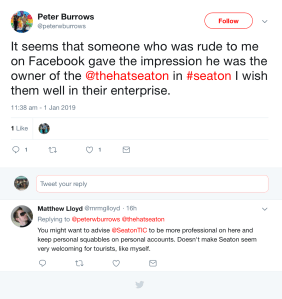
This is the full statement by Mr Gary Miller (owner, The Hat micropub) as given to Seaton Town Council last night, along with a screenshot and transcript of the now deleted tweets to which he refers:

THE TWEETS:

Transcript:
Twitter @peterburrows 1 January 2019 11.38 am
Burrows tweet:
It seems that someone who was rude to me on Facebook gave the impression that he was the owner of @thehatseaton in #seaton I wish them well in their enterprise.

Comment on above Tweet
Matthew Lloyd @matthewlloyd 16 hr
replying to @peterburrows @thehatseaton
You might want to advise @seatonTIC to be more professional on here and keep personal squabbles on personal accounts. Doesn’t make Seaton seem very welcoming to tourists like myself.

THE STATEMENT BY MR MILLER LAST NIGHT:
(verbatim)

“Good evening. I am Gary Millar, the sole owner of The Hat Micropub in Queen Street. I am addressing the issue of Mr. Peter Burrows, the then Mayor and current Councillor on both a local and district level, attacking my livelihood and business.

On the afternoon of New Year’s Day, Mr. Burrows had a very public argument about fox hunting with a private individual on the Facebook page ‘Seaton Views’. This escalated to a robust exchange of views between the two protagonists. (Amusingly both share the same perspective on the matter). Mr. Burrows, who is surely used to the rough and tumble of political debate, took exception to being called a very naughty word. His inexplicable reaction was to use his title of Seaton Mayor to make a direct attack on me, accusing me of being disparaging to the mayor, and to tell thousands of subscribers to a Twitter page called @SeatonTIC, to avoid my business. On the face of it this was the official Seaton Tourist Information Centre page.

This is a grossly stupid response from any public official in any circumstances. You could not make it up.

It is not at all clear why Mr. Burrows chose The Hat as opposed to the many other local businesses that his detractor frequents. Surely, as a public official involved in my various applications, he would have known who I was?

I do not use social media for anything other than professional reasons. If social media users followed the guidelines given in the Hat including “No nasty opinions” and “Be respectful and remember there are other people around you”, the internet would be a kinder place.

Both @SeatonTIC and Seaton Views are ostensibly neutral and exist for the benefit of the people of and visitors to Seaton. However, they are administered by Mr. Burrows which gives him the control over their content. Reportedly, other supposedly impartial social media sites revolving around Seaton are also administered by him. Personally, it disturbs me that a public official has such a domination of information without a clear declaration of interest.

For example – Mr. Burrows selectively deleted his unsavoury exchange on Seaton Views and blocked his detractor from the site. Yet he also closed the @SeatonTIC page entirely, not at the request from the Council as reported, but unilaterally overnight on the 1st/2nd January after legal action was threatened against the then unknown poster. This had two effects – first; we are unable to see how many people viewed his tweet to assess the damage caused. Secondly; imagine the impression given to thousands of potential holidaymakers following what they would reasonably have considered the formal Seaton Tourist Information Twitter page – A strange tweet from the town Mayor attacking a local small business, followed by an unexplained blackout.

This cannot be good for either my business nor the image of the town as a whole. Surely, directing subscribers to the official Tourist Information Site would at least have been a productive step.

I would argue that these actions were not a selfless act by Mr. Burrows, or in the interests of myself or Seaton, but a means of covering tracks. A clear case of canting.

I have yet to receive a proper apology from Mr. Burrows. His statement of resignation last week did not make it clear that I was not the person who insulted him, then he justified his actions, and finally boorishly he ended with him giving himself a pat on the back for a job well done. Unfortunately, any apology at this time now sounds hollow.

Mr. Burrows was high profile in his role as Mayor and councillor on both local and district levels. As such I view both the local and district councils legally culpable for his actions, regardless of these being rogue or not. I expect both the local and district council to do their legal duty and mitigate any damage against me. This includes a full and open investigation of Mr. Burrows conduct in office, including on social media, and disciplinary or legal action wherever possible. This motion of no confidence, and the complaint to the East Devon Monitoring Officer is a positive response by the Seaton Town Council.

Despite undoubted damage to my business, the support of my regulars, and other public support helps me believe that moving to Seaton to open up a new and innovative business was the right decision. My sincere thanks to you all and I hope to continue to serve you real ales, ciders and other fine beverages in a friendly environment for many years to come.

There is however still much to do from both Councils to support the current small traders and promote the opening of new dynamic, interesting small shops in Seaton. Encouraging visitors to move to the traditional trading area, now called The Cultural Quarter, from the lower end of town is an urgent requirement to start. Regrettably, after a year of trading in Seaton and having contributed in various forums, I have yet to see any concrete or effective steps to this end by the Council. This is an opportunity for both the Council and traders to reset and have a fresh start.

In conclusion I would urge all councillors to support this motion of no confidence. What most surprises me is that Mr. Burrows has not recognised his position as being untenable and has not resigned already on his own volition.

Thank you for your time and attention.”

Failed police merger cost £250,000

Owl says: A quick check of the members on the police oversight committee’s views first might have saved a lot of money!

“Devon and Cornwall Police Commissioner Alison Hernandez confirmed that the project to explore a potential merger had cost the two forces £200,000.

That was split on a 70:30 basis between her force and Dorset’s, with the Home Office providing an additional grant of £50,000.

Questions about the cost of the abandoned merger were raised after Dorset’s Police and Crime Commissioner Martyn Underhill said directly it had cost about £500,000 when he appeared at the Dorset County Council Safeguarding, Overview and Scrutiny Committee.

The figure for the move preparations was later revised by Mr Underhill’s office.

But both police and crime commissioners’ offices have now confirmed the total figure was £250,000.

[Hernandez said] The two police forces have a combined budget of well over £4m and employ more than 7,000 people, so it was right and proper that we explored in detail the implications of a potential merger on them and, importantly, the public that they serve.” from Alison Hernandez Police and Crime Commissioner for Devon and Cornwall”

The two police forces have a combined budget of well over £4m and employ more than 7,000 people, so it was right and proper that we explored in detail the implications of a potential merger on them and, importantly, the public that they serve.”

Ms Hernandez stopped the merger plans in October, saying at the time there would not be enough benefit to communities in Devon and Cornwall to justify a resulting increase in council tax.”

https://www.bbc.co.uk/news/live/uk-england-devon-46864649

Enterprise Zone “gazelle” companies (some in Devon) have unintended consequences

“Britain’s fastest-growing businesses could be contributing to job losses, according to research that claims the government’s policy of backing entrepreneurial companies “may be fundamentally at odds” with tackling regional inequalities.

A study of the performance of more than six million companies over a period of 17 years found that high-growth businesses had a “spillover” effect that could damage local employers.

Fast-growing companies, sometimes dubbed “gazelles”, have been identified in recent years as a way of boosting job creation and improving the nation’s productivity. Despite accounting for less than 5 per cent of businesses, these companies create about half of all new jobs and typically show higher levels of productivity.

However, the study, conducted by the Enterprise Research Centre, found that companies with the fastest employment growth — 20 per cent growth every 12 months for three consecutive years — tended to grow by “hoovering up” jobs from slower- growing businesses in the same region, in what the researchers called a “crowding-out competition effect”.

A 1 per cent rise in the incidence of high-growth businesses in a region was found to actually slightly cut employment, by 0.35 per cent on average — equivalent to a net loss of about 122,000 jobs UK-wide over the period studied, 1997-2013. The worst affected regions included the Scottish Highlands, Cheshire, the North East, Lincolnshire and Devon. In contrast, many urban areas in the South East and Midlands saw a net jobs gain.

Negative effects were most pronounced in the manufacturing sector and rural parts of the UK, where competition for skilled workers was most intense, the researchers said.

The fastest growing companies often attract the most skilled workers in a region where such staff are scarce, leaving slower-growing rivals struggling to attract employees and having to pay more to keep existing team members. As a result they hire fewer people and could be forced into job cuts.

Mike Harding, director of Inspira Digital, said that his ecommerce agency based in Barnstaple, Devon, competes with a London-based agency with a satellite office in north Devon. “If you have someone offering London wages here, that is a black hole that sucks up the local talent,” he said.

The issue can be exacerbated by large companies being offered tax breaks to open an office in Devon in the name of local development, Mr Harding said.

Professor Jun Du of Aston University, one of the authors of the research, said that “while encouraging clusters of fast-growth firms can bring productivity benefits to whole supply chains, some regions and industries with acute skills shortages could see unintended consequences”.

Source: The Times (pay wall)

“This Is What It’s Like To Lose Your Sunday Bus Service”

In a new series, HuffPost UK is examining how shrinking local budgets are affecting people’s daily lives. These are stories of what it’s like to lose, in a society that is quietly changing. If you have a story to tell, email basia.cummings@huffpost.com.

“When Staffordshire council announced on April 1 that they were cutting the local Sunday bus service – a lifeline for many of its regular passengers – people thought it was a bad joke.

The route was a thread connecting the local community, linking Stafford and Cannock in the West Midlands. But it was no April Fool’s Day prank.

Like so many decisions taken by local authorities in the era of austerity, it made sense on paper. Staffordshire County Council said it could no longer keep the buses running because numbers had dropped so much, the subsidies needed to make up for the loss in fares were “simply not sustainable”.

The local bus operator, Arriva Midlands, said at the time that “cuts to funding” were forcing them to withdraw the subsidised service. According to county council cabinet member Mark Deaville, “some journeys are costing taxpayers £10 a time”.

On its own, of course, the cutting of this one bus route is not worthy of a national news report. It is, at best, a local story affecting a relatively small number of people. But it is in paying closer attention to thousands of small financial decisions like this that we see the reality of government-led austerity, and the way it is quietly changing Britain.

In our HuffPost UK series, What It’s Like To Lose, we are exploring how these changes at a local level link up to paint a national portrait of austerity – from the closures of community libraries, or the centralisation of medical services or job centres, to the disappearance of affordable leisure centres or local post offices. As local authorities find themselves picking off the “low-hanging fruit” of services that have seen their use go down in recent years, what does it mean if you are one of the people for whom that still really matters?

When we visited Cannock on a grey December day, standing at a bus shelter was 80-year-old Jocie Lucas, taking refuge from the driving rain. For her, the cut was a blow to her sense of freedom. “I have a free bus pass, but I’m so confused these days as to when the buses are running that I hardly use it now,” she said. “I’ve lost some of that independence to travel where and when I want, and now I have to rely on lifts from family.”

What has happened to the residents of Cannock is happening across the country. Buses remain by far the country’s most popular form of public transport – 4.65 billion journeys are made each year, two-and-a-half times more than on the train.

But despite their levels of use, almost 17,000 bus routes have disappeared over five years across the UK, according to the Traffic Commissioner’s annual report. Tightened council budgets have made services that were under-used, but previously considered essential, vulnerable to cuts. The Campaign for Better Transport says there has been a £182m – or 45% – cut in local authority-supported bus services since 2010.

In Staffordshire, like in many councils across the UK, the changes came following a funding consultation last year. Tanya Dance, who runs the Copper Kettle cafe overlooking Cannock’s bus depot, was particularly hard hit by the decision – she had become a bus ticket vendor just months before the Sunday services were cancelled.

“There used to be queues of passengers on a Sunday, which was one on my busiest days,” she said. “A lot of the old folk with their free bus passes would only venture out on a Sunday and spend time shopping and in my cafe.”

Dance said the move has seen her takings halve in the last eight months. And the disruption, she thinks, has mainly affected her elderly customers.

For them, the service was vital. It was the only opportunity many of them had to go out and socialise, or visit church, she said. “To stop all buses on a Sunday seems way too drastic. Cannock isn’t exactly isolated but its pretty rural and buses are a lifeline for many around here,” she said.

Jocie Lucas echoes this, saying she used to enjoy travelling into town on a Sunday. “Now and I’m in other people’s hands, so that takes away some of the fun.”

But it’s not just the elderly who have had to adjust. Teenagers Alicia Slyde and Dean Mayo, both from a suburb of Cannock, said they now have to walk 45 minutes to get to town. “Sunday is the only day I can go shopping because of work commitments in the week and neither of us drive or can afford a cab, so we walk it to town and back now,” Mayo said. “It’s hard work carrying all the shopping home but we have no choice. “

Slyde added: “The bus service around here is dreadful during the week and then non-existent on a Sunday. Even getting to college every day is hit-and-miss as far as buses go. But stopping the Sunday service just doesn’t make sense. That’s the one day people get to themselves and want to travel.”

More than 2,000 people have signed a petition started by local campaigner Lee Murphy, asking the council to reverse its decision. Some of those who have signed mentioned nurses and staff working at local care homes needing to get to work.

Murphy told HuffPost UK that a regular user of one of the Cannock services relies on it to reach his brother, who is disabled. “He still requires the same care on Sundays, but how is he able to travel to him? Both Cannock and Stafford hospitals are cut off – neither train station are close enough,” the campaigner said.

“In addition to this, users paying as much as £520 a year for a Cannock/Stafford region bus pass will receive less value for money. This is unfair to hard-working commuters who deserve to use their pass for evenings and weekends too.”

Kevin Chapman, a spokesman for the Better Transport campaign, said the vast majority of the lost routes serve rural communities, like Cannock. “When the local bus service goes this often results in people in these areas becoming more isolated,” he said. “We are faced with a nasty cocktail of reduced funding for councils and operators cutting routes, while in the middle of it all we have vulnerable people who may rely on the bus to get out and about.”

But as always, decisions to cut services are complex. Staffordshire County Councillor Mark Deaville said the money saved had been directed to the services people use the most. “Our changes affect only four subsidised Sunday services from the Cannock depot, and the decision to stop all of its other Sunday bus journeys is a commercial decision for Arriva and not the county council.”

In Staffordshire, one local MP is the defence secretary and former government chief whip, Gavin Williamson, who said he is extremely concerned about the removal of the Cannock service, which he described as a “lifeline”.

Speaking to HuffPost UK, the senior Tory said it is “deeply damaging for the elderly who may rely on the buses to get them to the shops or to and from church on a Sunday,” he said. “It is important we do all we can to fight these cuts and I hope Arriva reconsider their decision.”

Teenage commuter Esme Walker, agrees. She said living in Cannock already felt “like being out in the sticks”, and losing the Sunday bus service has isolated her further.

“Me and my friends looked forward to catching a bus on Sunday and spending the day in Birmingham or Stafford,” she said. “It was really nice because we’d often meet elderly people from the town on the bus who seemed just as bored as us and we’d end up travelling together.

“I think the buses helped bring local people together in that way.”

https://www.huffingtonpost.co.uk/entry/how-it-feels-to-lose-your-sunday-bus-service_uk_5c20ef40e4b08aaf7a8b3bcc

BREAKING NEWS:Seaton’s disgraced ex-Mayor fails to turn up to meeting about his behaviour

Seaton’s disgraced ex-Mayor Peter Burrows failed to turn up to a meeting this evening which called him to further account for his recent behaviour and to hear a statement from the businessman he (mistakenly) maligned on a Twitter account since deleted:

https://eastdevonwatch.org/2019/01/11/seaton-disgraced-ex-mayor-peter-burrows-town-council-responds-names-names/

The meeting confirmed councillor Ken Beer as mayor and Councillor Jack Rowlands as his deputy.

The person originally and erroneously maligned by former Mayor Burrows (Garry Miller of The Hat micropub) made a personal statement.

It is believed that the ten remaining councillors voted unanimously for a resolution calling on Burrows to stand down as both a town and District councillor for bringing both councils into disrepute.

Owl gathers that, as well as a complaint to the EDDC monitoring officer, there will also be a complaint made to the regional Liberal Party about Burrows’s behaviour within the next few days