See your Police and Crime Panel in action – in Plymouth – and how to ask a question

Owl thinks the Police and Crime Commissioner is getting an easy ride when it comes to accountability. And thinks the Police and Crime Panel (which can make recommendations to her but cannot do anything else if she disagrees with them) is getting an even easier ride.

It is very hard for people in East Devon to get to Plymouth, where the panel always meets (time for an Exeter venue?) but for anyone who wants to attend and ask questions of the panel, here is the relevant information:

Devon and Cornwall Police and Crime Panel
Next meeting: Friday 18 August 2017 10.30 am

The agenda will be displayed in the week before the meeting

Proposed venue: Council House (Next to the Civic Centre), Plymouth

How to ask the panel a question

Members of the public can attend panel meetings (except where confidential or exempt information is likely to be discussed) and may ask questions at each meeting (up to two questions per person per meeting and up to 100 words per question) that are relevant to the Panel’s functions.

At the start of each meeting 30 minutes will be allocated to questions asked by members of the public. Responses may be oral or written.

Questions must be put in writing to the Democratic and Member Support Manager at Plymouth City Council at least 5 clear working days before the panel meeting.

Democratic and Member Support Manager
Plymouth City Council
Civic Centre
Plymouth
PL1 2AA
democraticservices@plymouth.gov.uk

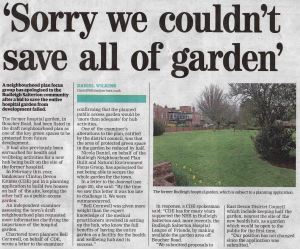
Budleigh Neighbourhood Plan group apologises for being unable to save hospital garden after being outmaneuvered by Clinton Devon Estates

“A neighbourhood plan focus group has apologised to the Budleigh Salterton community after a bid to save the entire hospital garden from development failed.

The former hospital garden, in Boucher Road, had been listed in the draft neighbourhood plan as one of the key green spaces to be protected from future development.

It had also previously been earmarked for health and wellbeing activities for a new hub being built on the site of the former hospital.

In February this year, landowner Clinton Devon Estates (CDE) put in a planning application to build two houses on half of the site, keeping the other half as a public-access garden.

An independent examiner assessing the town’s draft neighbourhood plan requested more information clarifying the importance of the hospital garden.
Chartered town planners Bell Cornwell, on behalf of CDE, wrote a letter to the examiner confirming that the planned public access garden would be “more than adequate” for hub activities.

One of the examiner’s alterations to the plan, ratified by the district council, was that the area of protected green space in the garden be reduced by half.

Nicola Daniel, on behalf of the Budleigh Neighbourhood Plan Built and Natural Environment Focus Group, has apologised for not being able to secure the whole garden for the town.

In a letter to the Journal (see page 20), she said: “By the time we saw this letter it was too late to challenge it. We were outmanoeuvred.
“Bell Cornwell was given more weight than the expert knowledge of the medical practitioners involved in setting up the hub, who know the full benefits of having the entire garden as a facility for the health and wellbeing hub and its success.”

In response, a CDE spokesman said: “CDE has for many years supported the NHS in Budleigh Salterton and, more recently, the Budleigh Salterton Hospital League of Friends, by making available the garden area off Boucher Road.
“We submitted proposals to East Devon District Council which include keeping half the garden, nearest the site of the new health hub, as a garden which would be open to the public for the first time.

“Our position has not changed since the application was submitted.”

Prince Charles gets his own (beautiful?) way with his new south-west town

Owl says: bet this wouldn’t happen in the Republic of East Devon! And wonders if a “zombie town” of which they speak might be on our own doorstep!

Jerome Starkey
http://www.thetimes.co.uk

“Three of Britain’s biggest housebuilders have lost an attempt to change the plans for a garden town designed by Prince Charles’s architects, amid claims that the builders’ proposals would have created a “zombie town”.

The Sherford Valley, on the outskirts of Plymouth, had been earmarked for 5,500 new homes and was designed by the Prince’s Foundation to create an eco-friendly pedestrian community like Poundbury in Dorset.

Bovis Homes, Linden Homes and Taylor Wimpey, which bought the site in 2014, had applied to Plymouth council to water down the design rules and change Prince Charles’s plan so that they could build cheaper homes more quickly.
Councillors said that the move would have created a “zombie town” with “years of planning thrown out of the window” and rejected their application.
The builders had built fewer than 300 of the homes when they applied to amend the town code and master plan.

“Instead of having the highest standard of new homes, we will instead have a rather large housing estate,” Vivien Pengelly, a councillor, said.
The housebuilders said that they were asking for minor changes that would not have affected the quality of homes. However, Ben Bolgar, a director of the Prince’s Foundation, said that they were trying to strip out commitments to quality.

He said that Sherford was designed to prove that Prince Charles’s model village of Poundbury, near Dorchester, could work on a larger scale but that the builders were determined to “build their normal boxes”.

The design code meant that the builders had to produce a range of houses, built from local materials, which were not more than 500m from the shops. Cars had to be parked in hidden courtyards rather than on the street to encourage people to walk.

Mr Bolgar said that the builders’ plans would have transformed Sherford into a “rubbish housing estate”.

Jonny Morris, a councillor, said that he did not want Sherford to end up like the sort of place you would see “in the aftermath of a zombie apocalypse”.

Housing companies applied to ditch a town code drawn up 13 years ago and replace it with a set of “fundamental principles” which they said allowed them greater flexibility over materials and construction methods.

“This is simply far too premature to take such a radical act, disregarding all those measures that allowed permission to be granted in the first place,” Nick Kelly, the deputy lord mayor, said. “We want development but everybody thinks, ‘This is what we’re going to get’, and at the stroke of a pen years of planning and assurances go out of the window.”

Lord Taylor of Goss Moor, who wrote a report in 2015 calling for dozens of new garden villages, said that Sherford had an excellent town plan and was “overwhelmingly supported by the local community” because of its commitment to quality. “The housebuilders knew what they were signing up to. There should really be no question about what will be delivered,” he said.”

Times (paywall)

Hinkley C: more bad, bad news – and they are moving to renewable energy!

Not looking like a good idea …

“Earnings at energy giant EDF have plummeted by a fifth in the first half of this year due to ongoing woes in its French fleet of nuclear reactors and lower profits from those in the UK.

The French state-backed group behind the UK’s first new nuclear plant in a generation, Hinkley Point C, has suffered a major setback to its domestic reactors, some of which have been closed for safety checks since October.

French nuclear power output fell by 3.9pc from the first half of last year to 197.2TWh in the six months to June 30, the group said. Despite a 4.2pc rise in UK EDF’s nuclear generation to 32.2TWh, the fleet of reactors were still a drain on earnings due to the weaker market price for electricity.

The slump in its two core markets wiped more than 20pc from its underlying earnings before interest, tax, debt and amortisation to €7bn (£6.3bn) but the group has assured investors that it remains on track to meet its guidance of between €13.7bn to €14.3bn for the year.

Jean-Bernard Lévy, EDF’s chairman and chief executive, underlined the “unfavourable market context” but said the group’s move towards renewable energy was accelerating.

The roll-out of subsidised renewables in the last decade has effectively driven the wholesale price of power down, cutting revenue for existing nuclear power plants, which sell their electricity into the market.

The decline in income highlights the need for a guaranteed set price for the new Hinkley Point plant in order to recover its eye-watering costs.

Earlier this month EDF confirmed that the cost of developing Hinkley had gone from £18bn to £19.6bn but was quick to point out that this would not be borne by customers because of the fixed price of £92.50 per megawatt-hour already agreed with the Government.

However, the declining wholesale market price means the top-up payment needed to meet this set price, which is paid by consumers, has spiralled to £50bn over the lifetime of the project from the £6bn bill estimated in 2013.”

http://www.telegraph.co.uk/business/2017/07/28/edf-profits-dented-nuclear-woes/

Seaton DCC Councillor on that shameful DCC Health Scrutiny meeting – and Diviani’s disgraceful behaviour

“Councillor-Sara-Randall-Johnson (from this article):

Why did Devon’s Health and Adult Care Scrutiny Committee block the proposal to refer the closure of our beds to the Secretary of State?

The idea that the Chair, Councillor Sara Randall Johnson (left), was settling an old score with Claire Wright makes a nice story but overlooks the concerted Conservative position. The collusion between Randall Johnson and Rufus Gilbert – who rushed to propose a ‘no referral’ motion before Claire could move her motion to refer – was obvious to all, as was her keenness to persuade her colleagues not to have a recorded vote.

Equally striking, however, is that only one out of 12 Tories on the Committee – Honiton’s Phil Twiss – voted against Gilbert’s motion. The other 7 Tories who voted were all for allowing the beds to be closed; 2 who had reservations abstained; 2 more were (diplomatically?) absent. Whipping is not allowed on Scrutiny committees, but this gives a strong impression of a Tory consensus. Members who were uncertain of their support were unwilling to defy it beyond abstention. Twiss was obviously a special case, as the one committee member whose hospital will lose its beds.

Clearly the Conservative Group on DCC gave their East Devon members the main role in dealing with the Eastern Locality hospital beds issue when in May (with its return to Scrutiny looming) they made Randall Johnson chair and nominated two Exmouth members, Jeff Trail and Richard Scott, as well as Twiss as members of the Health Scrutiny Committee. With East Devon Tory leader, Paul Diviani, representing Devon’s district councils, 5 of its Tory members were from East Devon and only 7 from the other five-sixths of the Tory group.

East Devon Tories on the committee certainly lived up to their role on Tuesday. All except Trail voted, making half of all Tory votes cast on the committee and 3 out of 7 on the pro-CCG side. In contrast, only 4 of the 8 Tories from elsewhere in the county cast a vote on this crucial issue: East Devon’s Tories may have convinced themselves, but not their colleagues.

Paul Diviani spills the beans

With Randall Johnson preoccupied with timekeeping (except when the CCG were speaking), Scott silent and Twiss asking questions, it was left to Diviani to express the Tory rationale. He claimed to speak for Devon district councils as a whole, but has acknowledged that he had consulted none of the others. He was happy to defy his own Council, which has voted to keep hospital beds, and spoke for himself – and East Devon Conservatives.

Diviani’s caustic little speech deserves more attention than it has been given.

He started by saying that those who decide to live in the countryside expect diminished service, and must cut their cloth accordingly in current times – forgetting that many have lived here all their lives, or moved here long before the present Tory government arrived to savage the NHS.

‘Costs will always rise without innovation’, Diviani continued, forgetting that the ‘costs’ of community hospitals are rising particularly because of the Tory innovation which gave them over to NHS Property Services and its ‘market rents’.

‘Local decisions should be made locally’, he averred, overlooking the fact that Sustainability and Transformation Plans, Success Regimes and NHS property sales are all national initiatives forced on the local NHS – while NEW Devon CCG is so unrepresentative even of local doctors that only full-time managers (Sonja Manton and Rob Sainsbury) are allowed to present its case in public while its ‘practitioner’ figurehead, Dr Tim Burke, hides in a corner.

When, however, Diviani warned that ‘attempting to browbeat the Secretary of State to overturn his own policies is counter-intuitive’, he expressed the truth of the situation. The closure of community hospitals results from the determined policies of the Conservative Government. (Referral would have served the purposes of delaying permanent closures, embarrassing the Government and forcing its Independent Reconfiguration Panel to give an assessment of the issue.)

East Devon Tories are the Government’s faithful servants. ‘Don’t trust East Devon Tories’ over the hospitals, I warned during the County elections. How right have I been proved.”

East Devon Tories were central to ditching Seaton and Honiton hospital beds

Claire Wright’s report on the shameful behaviour of DCC Health Scrutiny Committee Tories

“The Conservatives on Devon County Council’s health and adult care scrutiny committee on Tuesday, torpedoed local people’s views and any possibility of a referral to the Secretary of State for Health for a decision to close 71 community hospital beds.

I will keep this blog post short and instead post three articles that explain things just as well as I could have explained them.
Suffice to say that I am deeply disappointed.

Not just with the behaviour of chair, Sara Randall Johnson, who appeared to do her utmost to prevent any referral, both at the previous meeting last month and at Tuesday’s meeting.

But also with the attitude of the majority of the Conservative group, who used a variety of ill-informed views and remarks, to justify their determination not to refer, refusing to hear or see any member of the public’s distress, frustration and disbelief at the proceedings.

The chair’s attitude made me angry and led to a protracted row where I repeatedly asked her why she had allowed a proposal to be made and seconded at the very start of the meeting by her conservative colleague, Rufus Gilbert, NOT to refer to the Secretary of State for Health, when I already had a proposal that I had lodged with her and the two officers, before the meeting.

I had been indicating to speak since the start of the meeting, yet, Cllr Randall Johnson chose to call four councillors before me.

When I was finally called to speak I challenged her on why she had not made my proposal, which she had a copy of in front of her, known to the committee at the start of the meeting, which is the usual practice.

Cllr Gilbert’s seconded proposal before questions or the debate had even started had nullified my proposal, which was why I was so angry.

Cllr Randall Johnson admitted that it was her decision not make my proposal known to the committee and her decision on who is called to speak.

When they did what they did at Tuesday’s health scrutiny meeting, the Conservatives betrayed thousands of local people.

As I said in my final speech, local people had written letters, organised petitions, replied to public consultations, attended meetings, spoken at meetings, attended demonstrations, some had even spent significant sums of money on a legal challenge.

Time after time, month after month, the committee has asked questions which have not been properly answered on issues such as evidence that it will work, the staffing required, the finances, care of the dying. Local GPs are up in arms, staff have objected… yet the Conservative group knew best.

The vote was agonisingly close – six votes to seven, with two abstentions. All those who voted with Cllr Gilbert’s motion were conservative. Cllr Randall Johnson also voted with Cllr Gilbert – another unusual move at such a highly charged and significant meeting.

I am quite certain, that with a different approach by the chair, that the outcome would have been different. And local people’s views would have been respected and acted upon.

Councillors are elected by local people to represent their views.

Why was it so important to the chair and her colleagues that my proposal failed on Tuesday?

A whip at scrutiny committees, much least a legally constituted committee such as the health and adult care scrutiny committee of Devon County Council is strictly forbidden.

Yet to the members of the public present, who were repeatedly shouting “fix” it certainly appeared that way.

Since the meeting I have been inundated with messages from people who are disgusted at what happened.

Alongside two other councillors, I am seeking advice on what took place at Tuesday’s meeting.

The debate can be viewed on the webcast here – https://devoncc.public-i.tv/core/portal/webcast_interactive/293466

Seaton councillor, Cllr Martin Shaw, wrote an excellent account of the meeting here – https://seatonmatters.org/2017/07/26/the-health-scrutiny-committee-which-didnt-scrutinise/

My row with Cllr Randall Johnson has led to a local newspaper running a story about revenge… – see http://www.devonlive.com/tory-sara-randall-johnson-derails-claire-wright-s-health-campaign-six-years-after-election-defeat/story-30457493-detail/story.html”

http://www.claire-wright.org/index.php/post/conservatives_torpedo_local_peoples_views_on_community_hospital_bed_closure

“[Devon County] Council announces ‘harmful’ special needs funding cuts without consultation”

“Cuts which will affect children with special needs in Devon’s schools and colleges have been described as “harmful”.

On Wednesday – just two days before many schools break up for the summer holidays – Devon County Council (DCC) announced from September 1, significant funding cuts are being implemented for pupils with special educational needs and disabilities (SEND) across Devon.

Devon Live asked DCC why the cuts have been made; why it was announced two days before the start of the summer holidays; why there was no consultation; what alternative provisions will be in place for the children affected by the cuts, if any, and how much the cuts will save the council.

“We therefore have to ensure that the high needs budget does not continue to overshoot. In consultation with headteachers and governors, a decision was made in the past week to concentrate our support from January 2018 on vulnerable children who have a statutory plan in place. All schools will be able to choose to apply for a statutory assessment of each child’s needs and no funding will be withdrawn until any non-statutory school plans have been reviewed. This means that by December 2018 we expect to have a single, transparent system of funding our most vulnerable children.”

The announcement has sparked anger not just because of the impact it will have on children’s education and job losses, but also because of the timing of it just before schools and colleges break up for six weeks.

In a letter sent to headteachers of all Devon mainstream schools by Dawn Stabb, DCC head of education and learning, it states that to date, Devon has been unique in providing a non-statutory route for schools and colleges to access SEND funding. However, due to increased need and entitlement it need to bring its high needs spend back within budget and that the continuation of the element three funding is “no longer sustainable”.

Hannah Rose, a teacher at Bradley Barton Primary School, said: “These changes will affect all children in all schools in Devon. Furthermore, there has been no consultation regarding these changes with any party, least of all those who matter most, the families of, and children with, special educational needs.

“The local authority’s duty is to, ‘when carrying out their functions, to support and involve the child and his or her parent, or the young person, and to have regard to their views, wishes and feelings’, as stated in the SEN code of practice, section 8.3.”

Hannah Rose is calling for the changes to be independently reviewed and, if necessary, legally challenged.

Dawn Stabb from DCC said: “The local authority recognises, following discussions at Schools Finance Group (SFG), that this has been a difficult but necessary decision if we are to avoid the budgetary challenges of last year. We ask for your support and understanding in implementing this new way of working to avoid ongoing significant overspend within the High Needs Block.”

https://www.consultationinstitute.org/consultation-news/council-announces-harmful-special-needs-funding-cuts-without-consultation/

Does our LEP have a plan B to replace European funding? And will it be a “functional economic area”?

“The Conservative manifesto earlier this year promised the government would use structural fund money that comes back to the UK following Brexit to create a UK “shared prosperity fund”.

However, deep concerns have been voiced about the replacement of EU structural funding. This week, Humber Local Enterprise Partnership chairman Lord Haskins aired doubts about the scale of the proposed fund.

He told the Hull Daily Mail that “so far, there is no indication it will match the sort of money we are currently getting from Europe”.

He added: “Long-term, I think we will have to start looking at other sources of funding for vital infrastructure work.”

The LGA also wants a new approach to distributing Westminster money that replaces EU regional aid, calling for a “single pot” for all domestic growth funding.

The association outlined three options for the future of funding currently sourced from the European Union. Its preferred method would see European Union structural funding, all other European funding streams and 70 UK funding streams supporting growth and regeneration pooled together.

The document said: “Under the single pot principle, local areas would be afforded maximum flexibility to target need and tailor provision, to stimulate growth in local areas and contribute to the national economy .”

The pot would be most effectively distributed to regional “functional economic areas” (FEAs) in England, and “appropriately identified” bodies in the devolved nations, the report said.

“In England, the FEAs could arguably follow the funding distribution geography of the current European Structural and Investment Funds (ESIF) programme,” the report added. It argued this would offer “much greater control over funding decisions , which would be devolved to all local areas.” …”

http://www.room151.co.uk/resources/billions-needed-to-match-eu-funding-for-local-communities-after-brexit/

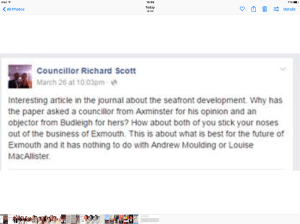
Exmouth DCC councillor ignores his own rule about “keeping your nose out and sticking to your own business”

Councillor Richard Scott yesterday voted for closure of Honiton and Seaton hospitals.  Yet on 26 March this is what he wrote about councillors from outside an area voting on matters that had “nothing to do with them”:

Is money spent on free schools at expense of local authority schools good value?

Would a school under local authority governance have got to this level unnoticed?

“A free school in north Devon has been put in special measures after inspectors rated it “inadequate”.

Route 39 Academy at Higher Clovelly received the worst Ofsted rating in all four categories including “quality of teaching” and “pupils’ outcomes”.
The school opened in 2013 and has 131 pupils aged 11 to 18.

Route 39 has complained to Ofsted saying: “We strongly refute the judgement and the manner in which the inspection was handled.”

Ofsted’s report on its June visit said the school had not entered any pupils in Year 11 for exams and was “in breach of statutory requirements and the school’s own funding agreement”.

“Teaching has not prepared pupils in Year 11 well enough for the next stage of their education” and pupils’ progress across Key Stage 3 was “inadequate”, the report said. …”

http://www.bbc.com/news/uk-england-devon-40730622

“Being ethical puts people off government service”

Owl remembers the case of disgraced ex-councillor Graham Brown and other scandals close to home:

http://www.telegraph.co.uk/news/politics/9920971/If-I-cant-get-planning-nobody-will-says-Devon-councillor-and-planning-consultant.html

and wonders if the world will ever change.

“White House counselor Kellyanne Conway on Thursday suggested that filling out financial disclosure forms and having them released to the public discourages qualified people from serving in government ― despite the fact that the procedure is a basic measure of transparency in government.

Appearing on “Fox & Friends,” Conway aimed to defend new White House communications director Anthony Scaramucci, after he falsely claimed that his financial disclosure form was leaked to Politico.

“There are so many qualified men and women who wanted to serve this president, this administration and their country who have been completely demoralized and completely, I think, disinclined to do so, based on the paperwork that we have to put forward, divesting assets, the different hoops you have to run through,” Conway said. “This White House is transparent and accountable, and we’ve all complied with those rules, but it has disincentivized good men and women. I hope it doesn’t disincentivize Anthony.”

http://www.huffingtonpost.com/entry/kellyanne-conway-anthony-scaramucci-leaks_us_5979dfa0e4b02a4ebb734573

Who exactly does EDDC Leader Diviani represent? And who does he consult?

Questions at last night’s Full Council meeting at Knowle shed some light on this. Members of the public pointed out that Councillor Paul Diviani had voted against both his own EDDC council and public opinion, at Devon County Council just two days previously (25th July), by supporting the decision that ‘Your Future Care’ should not be referred to the Secretary of State.

The EDDC Leader’s vote on this occasion could be regarded as crucial, as the decision had been narrowly carried by 7 votes to 6, and was met by cries of “Shame on You” from the public, as reported on BBC Spotlight tv the same evening.

Last night at Knowle, Councillor Diviani replied that he had to vote the way he had at the DCC Health and Adult Care Scrutiny Committee because he was representing the views of the eight Devon District Councils. But when Cllr Roger Giles, Chair of EDDC Scrutiny Committe, then asked him if he had consulted Mid Devon, North Devon, South Hams, Teignbridge, Torridge and West Devon, the answer was no.

So is the oft-repeated phrase from Cllr Diviani and close colleagues, “We are where we are” , the consequence of poor leadership? Fortunately in democratic Britain, our leaders are not permanent fixtures.

Footnote: For reference, one of the questions asked last night, is copied below. All can be heard on the audio recording of the Full Council meeting, soon to be available on the EDDC website.

‘At the 17th May 2017 EDDC Full Council meeting, Councillor Mike Allen said, and the council formally agreed, that care in the community had not yet been proven to work.

Yesterday (25th July 2017), the EDDC Leader voted at Devon County Council Health and Adult Welfare Scrutiny Committee that ‘Your Future Care’ proposals be NOT referred to the Secretary of State. (This decision was made by 7 votes to 6).

Through the Chair, will Councillor Diviani kindly explain how voting against his own Council fits with his leadership of it? ‘

“How Tory Sara Randall Johnson took down rival Claire Wright’s health campaign”

Owl says: So, Honiton and Seaton hospitals sacrificed to Randall-Johnson’s anger?

By P Goodwin, Western Morning News

“As the old saying goes: revenge is a dish best served cold.

For Conservative county councillor Sara Randall Johnson the wait to gain the upper hand on old rival Claire Wright stretched to six years.

When she did, the result was painful and public.

At this week’s bad-tempered and rowdy council health scrutiny meeting, Ms Randall Johnson used her new power of chairmanship to thwart the independent rebel and stamp her authority on the newly-elected authority.

In a move which prompted jeers and cries of “fix” from the public gallery, Randall Johnson ignored a tabled motion to halt hospital bed closure plans and instead allow a fellow Tory, Rufus Gilbert, to seize the momentum by kick starting the debate and swiftly proposing the exact opposite.

She then dismissed Ms Wright’s protest by telling her the power to choose was entirely at her discretion as chair, before moving to a vote against referring the proposals, which was won by a majority of one, with one abstention.

It was a swift and brutal piece of politics. The result: bad headlines averted, no need to trouble Jeremy Hunt with the protests of a rebellious council and the upstart put firmly in her place.

Former Lib Dem county council leader and respected political veteran Brian Greenslade remarked after the meeting that the move had been highly unusual.

He considered that not mentioning or circulating a table motion – one submitted before the meeting begins – was rare: not against procedure but definitely a departure from protocol.

In other words: a low blow but not quite below the belt.

It was clear from the tetchy exchanges during the meeting that there is little love lost between the two women and this is perhaps no surprise.

Wright pulled off a shock victory when she ousted Randall Johnson from her East District Council seat and her position as leader, relegating her into third place in a race for two seats, by the slender margin of just 25 votes.

The defeated leader put on a brave face, claiming she had got her life back after 20 years of public service, but this hardly sounds like the words of a woman who just two years earlier was vying with Sarah Wollaston to become MP for Totnes.

Since that victory, Wright, an outspoken independent campaigner, has become a painful thorn in the side of local Tories at district and county level, particularly around the NHS, where she worked in PR before launching her political career.

She has led the opposition ever since, including two general election campaigns in which she gave MP Hugo Swire a run for his money.

But the campaign to halt bed cuts and hospital closures has been a major factor in her rallying call to local people, the jewel in her campaigning crown.

The recent background to Tuesday’s meeting went like this:

Plans by the Northern, Eastern and Western Devon Clinical Commissioning Group to axe 71 beds across four cottage hospitals sparked anger in the Eastern locality.

Amid fears the NHS is planning to sell off the hospitals, relations between the public and NHS officials deteriorated with many accusing executives of lying about their true intentions.

Campaigners, angry that the case has still not been made for the Your Future Care model of home visits, labelled the consultation a sham and turned to the Health and Wellbeing Scrutiny Group for help.

It could refer to Mr Hunt though in reality it the plans would have gone to an independent reconfiguration panel who would make recommendations.

What many people wanted was a change in the way the CCG operates and communicates. they wanted a more open approach and they felt this might give the health trust a jolt.

Under the chairmanship of veteran Labour councillor Richard Westlake, the scrutiny group was poised to refer the plans to the Secretary of State if 14 documented points were not addressed.

But he stepped down at the election and Ms Randall Johnson took up control.

At the first meeting of the newly constituted committee in June, it became clear that she did not intend to let this happen.

Ms Wright had proposed to the last meeting that it was time to vote to refer to the Health Secretary and the chair repeatedly came under fire for not putting this to a vote.

There was a lack of clarity among one or two members about the whole process and eventually, members were persuaded to defer a decision until yesterday to get more information.

It appeared that the Conservatives had their ducks in a row on Tuesday.

Wright cried foul when her tabled motion was ignored, claiming she had never seen it happen in six years of committee meetings.

Unfortunately, the legal advice from the council backed Randall Johnson: Motions needed to be proposed and seconded in the meeting.

Would it have changed the vote? Maybe not. It was close though. East Devon leader Paul Diviani rebelled against his members and voted not to refer and one Tory did admit he was wavering.

The way the meeting was handled did little to foster good relations between the council and the community.

Ms Randall Johnson may have done nothing wrong but she certainly didn’t make any new friends in the public gallery.

As for old foes among the membership – no change there.”

http://www.devonlive.com/tory-sara-randall-johnson-derails-claire-wright-s-health-campaign-six-years-after-election-defeat/story-30457493-detail/story.html

Housing crisis still – 10 years after original crash it’s still shaping “the market”

“Britain’s housing market remains distorted 10 years on from the global financial crisis, with first-time buyers struggling to scrape together the much bigger deposits they need today, existing owners unable to “climb the ladder” and a gaping price divide between London and regional cities, according to a report out today.

The average house price has grown to £478,142 in London compared with the national average of £209,971. A decade on from the 2007 crash, prices have only just started gaining ground in Wales, Yorkshire and Humberside and the north-west, while values in the north-east are down 9%, according to analysis by the real estate company Savills.

Nationally the typical deposit has doubled to £26,224 while in the capital it has quadrupled to nearly £100,000. In the year to the end of March, about £4bn out of £10.2bn in first-time buyer deposit money came from either the “bank of mum and dad” or government help-to-buy schemes. Interest-only mortgages – which were key to going up the housing ladder – have become a thing of the past, and owners are staying put rather than selling.

The market has slowed overall with a “dramatic slump” in transactions. The HomeOwners Alliance says little more than a third of houses put on the market in London are selling. Those that do sell are taking longer, and owners are having to accept a bigger cut to their asking price. Overall the 2007 crash is “still shaping the UK housing market” and will for years to come, Savills predicts.”

https://www.theguardian.com/world/2017/jul/27/thursday-briefing-house-of-cards-britains-broken-property-market

BBC to highlight ‘Save Our Devon Seafronts’ campaign this Thursday (27 July). Port Royal, Sidmouth, will be featured.

“Campaigners from Devon’s seaside towns have united in an initiative to ‘Save Our Seafronts’. Sidmouth is included. This Thursday, BBC Radio Devon breakfast show will include an interview with Sidmouth Councillor Matt Booth, one of the four East Devon District Councillors who are leading the 3Rs campaign for an alternative vision for Por Royal – Retain,Refurbish,Reuse’.

The debate may continue on the radio lunchtime phone in programme (tel 0345 301 1034) and possibly on Spotlight TV on BBC 1 that same day.”

BBC to highlight ‘Save Our Devon Seafronts’ campaign this Thursday (27 July). Port Royal, Sidmouth, will be featured.

Bed closures at Honiton and Seaton – the final stitch-up by Tory Councillors

Councillor Martin Shaw (EDA, Colyton and Seaton) reports:

[Names of those voters have been amended – it does not affect the result]

“The 7 councillors who voted NOT to refer the decision to close Honiton and Seaton hospital beds were:

Sarah Randall-Johnson
Paul Diviani (Leader of East Devon District Council, representing Devon district councils), and county councillors
Richard Scott (Exmouth),
Rufus Gilbert,
Sylvia Russell,
Paul Crabb and
Ron Peart.

The 6 councillors who voted against this motion, i.e. to refer the decision, were Claire Wright (Otter Valley, Independent), Brian Greenslade and Nick Way (Liberal Democrat), Hilary Ackland and Carol Whitton (Labour) and Phil Twiss (Honiton, Conservative).

Jeremy Yabsley (Conservative) abstained as did John Berry. Two other Tories,
Jeffrey Trail (Exmouth) and
Philip Sanders, gave their apologies.

Six public speakers, Cllr Roger Giles (Chair of East Devon’s Scrutiny Committee), Paul Arnott (Colyton), Cllr Jan Goffey (Mayor of Okehampton), Cllr Mike Allen, Bob Sturtivant and Stephen Craddock (Honiton), spoke eloquently against the closures for two and a half minutes each. County Councillor Ian Hall (Axminster) and I also addressed the committee for five minutes each.

Three representatives of NEW Devon CCG and the RD&E (who run the hospitals and are working with the CCG) were then allowed to make a very lengthy Powerpoint presentation and contribute freely to the discussion – which none of the public speakers, Ian Hall or I were allowed to do.

Claire Wright had prepared a detailed motion to refer the closures and had submitted it to the Chair before the meeting. However when debate began, Cllr Randall Johnson chose not to call Claire to speak but called Rufus Gilbert who immediately proposed the motion not to refer, which was quickly seconded by Sylvia Russell.

This blatant manoeuvre by the Chair meant that the committee never considered point by point, as Claire’s motion would have required it to, the 14 questions on which it had asked the CCG to satisfy it. Despite an excellent report from Hilary Ackland which concluded that the CCG had failed to convince, the Committee basically abdicated its scrutiny role and blocked a referral without discussing most of the objections which we had raised.

Claire and I are planning to complain about the way the meeting was handled. If you want to watch it, it’s online at

https://devoncc.public-i.tv/core/portal/webcast_interactive/293466.

Thank you all for your support for the hospitals over the last 9 months. Be assured, however, that this is not the end of the matter, since the CCG and RD&E are both developing ‘estates strategies’ which will centre on what to do with space freed up by the closures. “

UK – tax avoidance hot spot

“Almost 40% of corporate investments channelled away from authorities and into tax havens travel through the UK or the Netherlands, according to a study of the ownership structures of 98m firms.

The two EU states are way ahead of the rest of the world in terms of being a preferred option for corporations who want to exploit tax havens to protect their investments.

The Netherlands was a conduit for 23% of corporate investments that ended in a tax haven, a team of researchers at the University of Amsterdam concluded. The UK accounted for 14%, ahead of Switzerland (6%), Singapore (2%) and Ireland (1%).

Every year multinationals avoid paying £38bn-£158bn in taxes in the EU using tax havens. In the US, tax evasion by multinational corporations via offshore jurisdictions is estimated to be at least $130bn (£99bn) a year. …”

https://www.theguardian.com/world/2017/jul/25/netherlands-and-uk-are-biggest-channels-for-corporate-tax-avoidance

The “care outside hospital” check list – cut out and keep

In December 2016, East Devon Watch published this article::

https://eastdevonwatch.org/2016/12/07/the-30-plus-questions-to-be-answered-before-care-at-home-is-authorised/

“Owl has been passed a copy of the “30 [plus] questions” that must be asked BEFORE care at home can be implemented:

Pre-implementation

The model of care:

• Does the new model of care align with our overriding ambition to promote independence?
• Is there clinical and operational consensus by place on the functions of the model and configuration of community health and care teams incorporating primary care, personal care providers and the voluntary care sector?
• Is there a short term offer that promotes independence and community resilience?
• Is there a method for identifying people at highest risk based on risk stratification tool?
• Are the needs of people requiring palliative and terminal care identified and planned for?
• Are the needs of people with dementia identified and planned for?
• Is support to care homes and personal care providers, built into the community services specification?
• Is support for carers enhanced through community sector development support in each community?
• Has the health and care role of each part of the system been described?
• Have key performance indicators been identified, and is performance being tracked now to support post implementation evaluation, including impact on primary care and social care?

Workforce:
• Is there a clear understanding of the capacity and gaps in the locality and a baseline agreed for current levels and required levels to meet the expected outputs of the changed model of care?
• Is there a clear understanding of and plan for any changes required in ways of working:
o thinking
o behaviours
o risk tolerance
o promotion of independence, personal goal orientation

• Have the training needs of people undertaking new roles been identified, including ensuring they are able to meet the needs of patients with dementia?
• Do we have detailed knowledge with regards to investment, WTE and skill mix across the locality and a plan for achieving this?
• Are system-wide staff recruitment and retention issues adequately addressed with a comprehensive plan, and where there are known or expected difficulties have innovative staffing models been explored?

Governance, communications and engagement:
• Is there a robust operational managerial model and leadership to support the implementation?
• Has Council member engagement and appropriate scrutiny taken place?
• Is there an oversight and steering group in place and the process for readiness assessment agreed?
• Have providers, commissioners and service users and carers or their representative groups such as Healthwatch agreed a set of key outcome measures and described how these will be recorded and monitored?
• Is there a shared dashboard which describes outcomes, activity and productivity measures and provides evaluation measures?
• Is there an agreed roll out plan for implementation, which has due regard to the operational issues of managing change?
• Is there a comprehensive & joint communications and engagement plan agreed?
• Is there a need for a further Quality or Equality Impact Assessment?

Implementation
• Is there a clinical and operational consensus on the roles of each sector during the implementation phase including acute care, community health and care teams, mental health, primary care, social care, the voluntary care sector and independent sector care providers?
• Is there an implementation plan at individual patient level describing their new pathway, mapping affected patients into new services?
• Are the operational conditions necessary for safe implementation met?
• Have the risks of not implementing the change at this point been described and balanced against any residual risk of doing so?

Post Implementation
• Is there a description of the outcomes for individuals, their carers and communities?
• Are the mechanisms for engagement with staff, users of services and carers in place and any findings being addressed appropriately?
• Is there a process in place for immediate post implementation tracking of service performance including financial impact to all organisations?
• Is longer term performance and impact being tracked for comparison against pre-implementation performance?
• Have we captured user experience as part of the process, and have findings been addressed and recorded to inform the planning of future changes?
• Are there unintended consequences or impacts (e.g. on primary care or social care) which need to be addressed before any further change occurs?
• Is there a clear communication plan for providers and the Public describing the new system and retaining their involvement in community development?

Source: http://www.newdevonccg.nhs.uk/about-us/your-future-care/publications-and-evidence-sources/102085
( point 14, page 94)”

https://eastdevonwatch.org/2016/12/07/the-30-plus-questions-to-be-answered-before-care-at-home-is-authorised/

Tories sacrifice Honiton and Seaton hospitals to party dogma

“By 7 votes (all Conservative) to 6 (2 Liberal Democrats, 2 Labour, 1 Conservative and Independent, Claire Wright), Devon County Council’s Health Scrutiny Committee today sealed the fate of the beds in the two hospitals (and Okehampton) by voting not to refer the closure of beds to the Secretary of State for Health.”

Tory majority sacrifices Seaton and Honiton hospitals at Devon Health Scrutiny

Tory voters – this is totally down to you.

School funding cuts – now you see them, now you don’t

“Last week Justine Greening fudged her own figures – and challenged ours.

Following her announcement, she dared us to update the numbers on schoolcuts.org.uk

But by deliberately announcing an incomplete school funding formula, Justine has made it impossible to do a school-by-school calculation.

The Department for Education is withholding the final school funding formula until September.

Without the full picture, we don’t have enough information to show the real impact of the latest announcement on your school.

As teachers we know that statistics can be used to obscure the truth or to reveal it.

That’s why we will never release numbers until we are sure they are right – and it’s why we must keep scrutinising the Government’s numbers too.

In her school funding announcement, Justine Greening claimed there’s “additional investment” for schools. But the Chancellor hasn’t agreed any new money.

We know that to cover the shortfall in school spending, we need much more than what’s been promised.

And until Philip Hammond announces extra funding for the education budget from the Treasury, we are ultimately looking at a critical cut in school spending.

This is not a win. We can’t allow the Department for Education to pull the wool over the eyes of parents and teachers.

The Government will be expecting us to fall for their trick and back down.

This summer is a test of our resolve. As MPs head home to their constituencies, we must keep challenging them.

Our campaign is already being felt across all rungs of Parliament.

We can’t stop now. Are you in?

Andrew Baisley

School Cuts Campaign”