Amsterdam bans new tourist shops to “prevent Disneyfication”

“Amsterdam has announced a ban on any new shops aimed at tourists – effectively limiting the abundance of places hiring bikes and selling souvenirs, tour tickets and ubiquitous waffles.

After mounting rage from locals – who wrote collectively to the mayor to protest against the “Disneyfication” of the city centre a year ago – the Dutch capital has decided that no more tourist shops will get licences in the central area.

“Nowhere else in the world has such a decision been made,” said Kajsa Ollongren, deputy mayor. “The balance is missing. We are only getting more of the same, and that is not good for our quality of life.”

It is estimated that there are 280 such shops in the centre, while tourist numbers have increased to 17 million visitors a year in the latest estimates – a tenth of them hosted by Airbnb, according to research by Colliers International.

But while some are making money, not everyone is happy. In May, chief executive of Amsterdam Marketing Frans van der Avert told a tourism conference that the city was aiming to ‘increase the quality of visitors’, rather than hosting tourists ‘with no respect for [its] character.

Amsterdam has put up tourist taxes, and on October 1, a new licencing system was imposed for anyone wanting to rent out their house short term – with fines of at least €6,000 for failure to comply, and a limit of 60 days annually.

The latest ban will apply immediately in the city centre and 40 shopping streets, meaning no new licences will be granted for things like ticket shops, bike rental companies, cheese, doughnut and ice-cream sellers.

“By not allowing new tourist shops to open we make sure our city centre remains attractive and liveable for Amsterdammers and our visitors,” said Ollongren, who heads economic affairs.

“Tourists are very welcome, but we want to avoid mass tourism taking over entire streets and neighbourhoods.”

http://www.telegraph.co.uk/news/2017/10/05/amsterdam-bans-new-tourist-shopsto-combatdisneyfication-city/

Exmouth water sports centre plans revealed

First thoughts?

Owl’s – well, it doesn’t look like it will win any design awards! Personally, Owl preferred the boating lake and swan pedallos.

http://www.devonlive.com/news/devon-news/watersports-centre-plans-exmouth-seafront-575281

DCC EDA Independent Councillor Shaw asks LEP CEO killer question

The question

When will the Heart of the South West LEP offer something to small town, rural and coastal Devon?

The response:

“This was the question I asked Chris Garcia, of the Heart of the South West LEP, when he appeared before the Corporate Infrastructure and Regulatory Services Scrutiny Committee (CIRS) at Devon County Council yesterday. Mr Garcia said that Government funding was geared mainly to urban areas, but the LEP has a ‘rural growth commission’ which will publish a report shortly. I shall look out for it.

Mr Garcia didn’t reply, however, to my criticism that the LEP is itself skewed by the ‘white elephant’ new nuclear power station at Hinkley C in Somerset. This project, rashly endorsed by Theresa May who had a chance to halt it, will cause British consumers pay over the odds for electricity for decades to come, based on an unproved type of nuclear station which is not supported even by many who believe nuclear energy is necessary for national energy needs, and in the control of French and Chinese state companies! As renewables get cheaper and electric storage becomes viable, this is a project we don’t need. True, it will bring some jobs to Somerset, but not to most of Devon.

Mr Garcia came with a powerpoint and brandishing the LEP’s latest glossy annual report. I asked that in future, we had proper written reports circulated in advance which members could scrutinise.

Mr Garcia didn’t mention the word ‘devolution’. HoTSW is leaving all that to Devon and Somerset county councils, who are apparently now planning to establish a Joint Committee. What that will involve is something else county councillors will need to scrutinise carefully.”

When will the Heart of the South West Local Economic Partnership (LEP) offer something to small town, rural and coastal Devon?

South-west doomed to low productivity because of its coastal towns

Let’s start with the good news: there are some regions of Britain where the economic productivity rate is higher than the German average. Now the bad news: there are three of them. Three out of 168.

In fact when it comes economic bang-for-buck, which is ultimately what productivity is, only the London borough of Tower Hamlets, which includes Canary Wharf, would scrape into the German top five. Nowhere in this country can compete with the output per hour generated in Munich, Ingolstadt or Wolfsburg, home to BMW, Audi, and VW.

There is nothing new in the idea that the British economy is less productive than most of its industrialised counterparts. You probably already knew that for every hour worked, the French and Americans generate about 30 per cent more income than Britons and Germans 36 per cent more. You probably know, too, that of all our inequalities, perhaps the greatest is regional. No other European country has as great a gulf between rich and poor areas.

Weak productivity equals weak wages, equals social division, equals many of the problems haunting the country today. But the odd thing is that until now no one had thought to dig deep into the data underlying these problems. That all changes today, with the release of a paper by Richard Davies, Anna Valero and Sandra Bernick from the London School of Economics.

And as it happens, those comparisons with Germany are about the most conventional of all their findings. Consider the location of Britain’s productivity engine, such as it is. You might have assumed the answer was the southeast. In fact, the strongest and most efficient economic activity is to be found on a thin corridor stretching west from the capital along the M4, through Slough and Reading to Bristol.

A glance at the way industries cluster themselves around the country yields further surprises. Far from being overly concentrated in London, it turns out the financial sector is quite widely spread, accounting for 15 hubs outside the capital. If you’re after a sector which is overly concentrated in London, look no further than the creative industry and IT, both of which are almost entirely based there and in the southeast.

In a sense this is even more alarming than the conventional wisdom. Finance is no longer the productivity growth machine it once was, whereas over the coming decades computers and IT are likely to be far more important. Why are they not more widespread?

Examine the numbers closely enough and preconceptions such as the north-south divide also start to dissolve. Yes, London dominates, but there are productivity hotspots all over: Aberdeen and its oil industry; a string of innovative chemicals firms along the banks of the Mersey; the life sciences companies in and around Hertfordshire; university hubs such as Oxford and Cambridge. If anything, Britain’s real economic disparity is not between north and south but between coastal and inland towns.

The most prosperous cities in any country are typically found on the coast. In Britain, that relationship is inverted: seaside towns tend to have more business failures than those inland. Productivity is lower, as is health quality and life expectancy. The prevalent industries are often those with weak output: food services and, more broadly, tourism.

Why? Maybe because the sea is less important to Britain than it was a century ago, when trade was physical goods rather than ideas and services. Maybe because, once trading dwindled, all that was left was fishing and tourism. Much like mining towns in the Welsh valleys, the economy moved on and no one gave much thought about what, or who, would be left behind.

We don’t have the answers because we are still only starting to work out the questions. While Britain’s policymakers do plenty of inflation and fiscal forecasts, little or no work is done into the way economic activity is spread around the country. This is no parochial point: such things matter.

After all, consider Wales, where the central region around Brecon has the unenviable distinction of being the least productive part of Britain. Only 40 or so miles south is a business which single-handedly lifts Wales’s overall productivity: the steelworks in Port Talbot. In much the same way as the Great Wall of China is visible from space, it is one of a few factories in Britain whose productivity can actually be spotted in the national accounts. In other words, those 4,000 jobs matter not just for the employees and their families, but for the balance of Britain’s productivity. Something to dwell on, given Tata Steel’s announcement this week that it is finally selling the plant.

A couple of years ago George Osborne proposed a few reforms that might have helped. Whitehall was to devolve full control over business rates to the regions; local government pension funds were to be pooled to create five or six “wealth funds” to help invest in the infrastructure that could help boost productivity. By the time of this year’s Queen’s Speech, the reforms seemed to have disappeared — casualties of Brexit legislation.

This was always the risk following the referendum. Not sudden economic oblivion but more the danger that Brexit would distract us from the important business of becoming more prosperous. It is already happening.”

Source: The Times, pay wall

So, you’re thinking of buying a Knowle PegasusLife flat ….

Peggy Browning bought a new retirement flat in Devon [Exmouth] priced at £206,450 nine years ago, at the age of 89. After her death last year, the property passed to her two daughters. It is now on the market for £125,000 and is proving difficult to sell. Until a buyer is found, Lyn Field and her sister have to pay the £190 a month (£2,282 a year) management charges on the flat, even though it is empty.

Their story highlights the potential burden of retirement properties for buyers’ descendants. A significant number have lost value in recent years and come with hefty charges that fall on those who inherit the homes.

Sebastian O’Kelly of the campaign group Better Retirement Housing said: “Newly built retirement flats have an appalling reputation for value on resale. This family’s example is by no means unusual.”

Almost two-thirds of new retirement homes bought at a similar time to Browning’s were resold at a loss, research by the charity Elderly Accommodation Counsel (EAC) suggests. By contrast, the average price of a UK home has risen by more than 40%, Land Registry figures show.

Adam Hillier of EAC acknowledged that buyers were prepared to pay extra for new properties, but described the number of such homes that had fallen in value as “surprising”.

IN NUMBERS
£206,450 The value of Peggy Browning’s flat when she bought it in 2008
£125,000 The price her home is on the market for today
£190 Monthly charges that must be covered by her daughters

Additional costs typically include ground rent, paid to the freeholder, and exit fees, calculated as a percentage of the value when the flat is resold. Hillier said exit fees could be as high as 30% in developments offering care in the home and facilities such as shops and subsidised restaurants.

Browning bought her flat in the seaside town of Exmouth from McCarthy & Stone, Britain’s leading retirement home developer. The company said: “We are sorry to hear about the fall in value [of Mrs Browning’s property]. We recognise there are a small number of cases, particularly with our older properties and those sold in the recession, where the resale values of some apartments have not performed as well as we would have wished. This can be down to many reasons, including the performance of some local property markets. … ”

Sunday Times, pay wall

“Coastal communities among worst off in UK, report finds”

“The UK’s coastal communities are among the country’s worst off for earnings, employment, health and education, a report for the BBC has found.
The Social Market Foundation said the economic gap between coastal and non-coastal places has grown.

Average wages are £3,600 a year lower in these “pockets of deprivation”, according to the think tank.

Meanwhile, the minister for coastal communities has announced £40m in funding to help coastal areas.

The report, produced for BBC Breakfast, found that five of the 10 local authorities in the UK with the highest unemployment rate for the three months to March 2017 were coastal. These were Hartlepool, North Ayrshire, Torridge, Hastings, South Tyneside and Sunderland. It also found those in employment in coastal areas were likely to be paid less. Of the 98 local authorities on the coast, 85% had pay levels below the UK’s average in 2016.

… The report found the economic gap between coastal and non-coastal areas has widened from 23% to 26% from 1997 to 2015.”

http://www.bbc.co.uk/news/uk-41141647

Funding opportunities for coastal communities

Unfortunately, in terms of regeneration £40m doesn’t go very far.

“£40m for new coastal funding round

Ministers have confirmed that £40m will be available through the next round of a fund to support coastal communities. The government has already provided £170m for 278 projects around the country since the Coastal Communities Fund was launched in 2012. Coastal communities minister Jake Berry said: “This year is already looking like another record year for staycations and our latest round of funding will help attract even more visitors to the great British coast so that our coastal communities can thrive.”

http://www.room151.co.uk/151-news/news-roundup-pwlb-borrowing-on-the-rise-basildon-slams-javid-lga-attempts-to-kick-start-devolution/

Deprived seaside towns: residents have their say

“Analysis by Social Market Foundation found that UK communities living by the coast have higher rates of unemployment compared to inland area. In 85% of Britain’s 98 coastal local authorities in 2016 people were paid less than the national average, with those living by the seaside earning £3,600 less. We asked readers to tell us about the areas they live in and how things have changed over the years. …

[Great Yarmouth]
… Then there are the road networks, in particular the infamous A47 Acle Straight which needs work to stop the consistent traffic problems. MP Brandon Lewis is rarely here or shows any interest unless there is an election. All new housing is unaffordable to buy and rent is high everywhere; a lot of people live in cramped, unsafe properties. The excuses change, but everything stays the same and has done for many years. …

… A former mayor of Copeland described Millom as “a place of despair”. Redundancies in local industries (for example, Vickers shipyard which was made defunct in 2007) have led to more unemployment. Local shops have closed as larger nationwide stores such as Tesco have opened. Some local transport links have been shut down and already infrequent local buses have reduced their services. The train service is bad, with trains being regularly cancelled at short notice, and the roads are narrow and poorly maintained. This all increases the isolation communities and individuals feel.

Two bank branches have closed, as well as several pubs and the job centre. The local food bank has more demand and fewer donations. A family member and a school friend of mine committed suicide. Another two school friends have died from complications from alcohol dependency. Then there are holiday homes in the Lake District which price locals out of house purchases. People are hopeless and depressed. The situation will deteriorate without some form of intervention.”

https://www.theguardian.com/society/2017/sep/07/poor-health-is-commonplace-readers-on-living-in-seaside-towns

“Coastal communities amongst most deprived in UK, says think-tank”

“Britain’s coastal communities rank among the worst performers for earnings, employment, health, education and a range of other economic and social indicators.

That is the message from the Living on the Edge report by the Social Market Foundation (SMF) think tank, which found economic output per capita was 23% lower in coastal communities compared with inland local authority areas.

The research took ‘coastal’ to mean anywhere adjacent to the sea, not just traditional holiday resorts.

It said five of the 10 local authorities in Great Britain with the lowest average pay were on the coast: Torbay, North Devon, Gwynedd, Hastings and Torridge.

Five of the 10 areas with the highest unemployment rate were also coastal: Hartlepool, North Ayrshire, Torridge, Hastings, South Tyneside and Sunderland.

Half the 20 council areas with the highest proportions of the population with bad or very bad health were coastal.

SMF chief economist Scott Corfe said: “Many coastal communities are poorly connected to major employment centres, which compounds the difficulties faced by residents in these areas.

“Not only do they lack local job opportunities, but travelling elsewhere for work is also relatively difficult.”

He said the government needed a clear definition of a coastal community and should make more effort to address their economic problems.

Policymakers overlooked some poor performers because they were in the south east and so formed islands of deprivation in generally affluent areas, Corfe added.

Issues in coastal communities rose to prominence with a report from the communities and local government select committee in 2007, when MPs took the unusual step of objecting that the government’s response had been complacent and pressed for further action.

The committee said coastal communities tended to be at an economic disadvantage as the sea reduced the size of their economic hinterland compared with inland towns.

They were also likely to have high proportions of retired people, an exodus of younger people and to be geographically remote from population centres.

Following this report, the Labour government created the Sea Change Fund to regenerate coastal towns, which was succeeded under the Coalition by the Coastal Communities Fund.

Coastal communities minister Jake Berry said yesterday there will be a fifth round of funding for this in 2019-21, to provide at least £40m of assistance.”

http://www.publicfinance.co.uk/news/2017/09/coastal-communities-amongst-most-deprived-uk-says-think-tank

“Floral tributes laid as hundreds say farewell to Exmouth Fun Park”

Floral tributes were left inside the iconic swanboat and messages of thanks were left as a family run seafront Fun Park closed after more than 60 years tomorrow.

The Fun Park on Queen’s Drive, Exmouth, closed for the last time on Thursday ahead of major multi-million pound plans that East Devon District Council has to renovate the seafront.

Hundreds of people came out for one last ride on the pedalos and a round of crazy golf at the Fun Park.

A vigil was also held by Save Exmouth Seafront campaigners and floral tributes were presented to the Wright family who have run the Fun Park for more than four decades.

Unless a motion that an extraordinary meeting of East Devon District Council to be held on September 13 to discuss the closure of the businesses as part of the Queen’s Drive redevelopment is agreed to give the seafront businesses a chance of an eleventh-hour reprieve, the Exmouth Fun Park has now closed for good.

The Harbour View Café is set to follow the Fun Park in closing at the end of September while several long-standing businesses including DJ’s Diner, the Arnold Palmer/Jungle Fun site, and the model railway have already closed. … ”

http://www.devonlive.com/whats-on/family-kids/floral-tributes-laid-hundreds-say-408634

Vigil for Exmouth Fun Park – say farewell to the local family and their much-loved attraction 11 am – 8 pm today

Today is the last day today for the Fun Park complex run by the local Wright family in Exmouth, who must make way for EDDC’s vision of the future – a no-doubt very expensive water sports centre and other coastal clone businesses.

If you will miss this attraction and the local family who run it, people are being asked to please turn up with thank you’s, mementoes etc for a Wright family tribute today.

Save Exmouth Seafront will be there from 11 to 8 pm tonight when the doors finally shut.

Its contents will be auctioned on Friday:

http://www.devonlive.com/news/devon-news/exmouth-fun-park-contents-set-403954

Sidmouthians enjoy Ham picnic – more signatures for Port Royal “Retain, Re-use, Refurbish” petition

Sunday’s picnic in celebration of The Ham open space took place in bright Sidmouth sunshine, suiting the mood of the organisers, and catching the attention of a steady stream of passers-by.

Information sheets showing the Scoping Study single ‘Proposal’, as displayed at the public consultation, were the subject of much discussion and concern from locals and visitors alike. More signatures were eagerly added to the paper copies of the 3Rs petition, calling for Retain-Refurbish-Reuse, an alternative plan for Port Royal. ..with the numbers already far outweighing the signatures collected online.

To view the petition, search 38 degrees Sidmouth Retain.

It will be handed in to the joint Scoping Study partners, East Devon District Council, and to Sidmouth Town Council which next meets on Monday 4th September, 6.30pm at Woolcombe House, Woolcombe Lane. Public can attend the meeting.

Exmouth: EDDC and Grenadier sign contract

And here is the spin, spin, spin:

“East Devon District Council has confirmed it has signed a deal with Grenadier Estates for new watersports centre in Exmouth.

The watersports centre will be community focused and a not for profit development, and forms an integral part of the council’s plans to regenerate the seafront area, the new centre will be built on a former car park on Queen’s Drive.

As well as offering watersports facilities, a new access ramp will be incorporated within the development allowing easier access to the beach, and will further confirm Exmouth’s place as a leading UK watersports destination, the council say.

Cllr Philip Skinner, the council’s portfolio holder for economy, and chairman of the Exmouth Regeneration Board, said: “I am delighted that we are entering into this agreement with Grenadier Estates. There has been a long-held commitment to have this watersports centre for Exmouth and we are now taking a huge step forward to achieving this ambition.

“The council, through the Exmouth Regeneration Board, has delivered significant improvements for Exmouth over recent years including the new Strand in the town centre, the new Premier Inn and more recently, the re-opening of a brand new Mamhead slipway. The delivery of the first phases of the Queen’s Drive regeneration is now the next step in this exciting journey for Devon’s largest town.” …

http://www.devonlive.com/news/devon-news/deal-signed-developers-new-watersports-369821

There is more in the same vein, but Owl can’t bear to give them more oxygen of publicity.

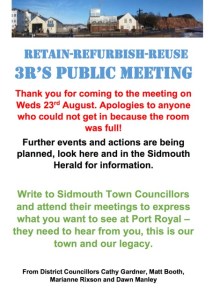
Sidmouth Port Royal: “Retain, reuse, reburbish” meeting Wednesday 23 August 7.30 pm

The meeting, on

Wednesday 23rd August
starts at 7pm at
All Saints Church Hall, All Saints Road, Sidmouth.

“More than a thousand people have now signed the petition “an alternative plan for Sidmouth’s Port Royal—the 3 Rs.

If you, too, feel strongly about appropriate development at the eastern end of the seafront, but haven’t yet added your name, it is urgent to do so as a decision is imminent.

Signatures for the ‘Retain-Refurbish-Reuse’ option are being collected online at

https://you.38degrees.org.uk/petitions/alternative-plan-for-sidmouth-s-port-royal-the-3r-s

or alternatively on paper – for example at this week’s 3Rs Public Meeting, organised by EDDC Councillors Matt Booth, Cathy Gardner, Dawn Manley and Marianne Rixson, and Chaired by Di Fuller – see header above”

Is it time for some more rebellious towns?

Colyton proudly announces itself as “the most rebellious town in Devon” for its part in supporting the Duke of Monmouth against James the Second.

Is it now time for another rebellion?

EDDC is the largest District Council in Devon with a population of about 140,000. It is growing rapidly. All this is happening against the backdrop of relocating EDDC’s headquarters and possible mergers amongst councils, in particular the creation of Greater Exeter.

Does everyone in East Devon want to be part of this process of rapid population growth and incorporation into the Exeter conurbation?

Residents of Exmouth, Honiton and Cranbrook may well look towards Exeter and work in the city, but our more rural and coastal communities increasingly see crowded and congested Exeter as something of which they do not wish to be a part. They tend to look towards the slower population growth and protection of the environment that can be found across the border in Dorset.

Budleigh Salterton, Sidmouth, Beer, Colyton and Seaton, and perhaps Ottery, seem to see themselves more as operating in an economy linked primarily to tourism and agriculture. They have no wish or requirement to be absorbed into the Exeter behemoth. Cleaner and greener.

These communities also have little representation in the hierarchy at Knowle, (or even acknowledged by Greater Exeter) where the leadership is dominated by councillors from Exmouth, Honiton and Axminster.

In such circumstances, and with relocation offering a timely opportunity, is it not time to seriously consider splitting the District Council and introducing a healthy dose of localism?

We already see many functions and services involving cross-authority cooperation. Such sharing of services could and should continue were coastal East Devon to secede. But those coastal communities would have far greater control over their own affairs.

Is it time for Eastern East Devon, or perhaps “Jurassic Devon”, to secede from EDDC and withdraw from the Greater Exeter project?

And maybe join with Dorset’s idea of a Jurassic National Park?

All it takes is a few rebellious people to get it started!

Exmouth Regeneration Board notes* – not all going to plan**

*They can’t be called minutes as it can only make recommendations not take decisions

** Assuming there is a plan

Click to access 130717-notes.pdf

Highlights

Catering contract marketed with no water or electricity but this will be “overcome” with containers!

“JL reported that a three year temporary catering provision had been marketed and received a lot of interest, with returns expected by 21 July 2017. It was unrealistic to expect anything to be operating on the site this summer season, but it could be a year round offer. The successful tender would be decided on the price/quality offer. The visitor survey had provided evidence for demand for the type of offer at Orcombe Point.

There was an issue with no direct water or electricity services on site, although it was possible that these could be overcome.

It was likely that the provision would be in the form of a containerised structure. The planning conditions were fairly light, including the need to clad any structure to be in keeping with the environment.”

EDDC might “invest” in the Magnolia Centre:

“Members noted that there was the need to look at the retail plan for the town centre. However, it was acknowledged that there was a problem with the disparate ownership of property throughout the town centre, and whether EDDC should consider investing some of its reserves in the purchase of land, such as Magnolia Centre.”

No lease agreed with Grenadier:

“The development agreement and lease had not yet been completed with Grenadier, although it was hoped that points could be finalised with the legal times the following week. It was hoped that an application would come in September.”

BBC to highlight ‘Save Our Devon Seafronts’ campaign this Thursday (27 July). Port Royal, Sidmouth, will be featured.

“Campaigners from Devon’s seaside towns have united in an initiative to ‘Save Our Seafronts’. Sidmouth is included. This Thursday, BBC Radio Devon breakfast show will include an interview with Sidmouth Councillor Matt Booth, one of the four East Devon District Councillors who are leading the 3Rs campaign for an alternative vision for Por Royal – Retain,Refurbish,Reuse’.

The debate may continue on the radio lunchtime phone in programme (tel 0345 301 1034) and possibly on Spotlight TV on BBC 1 that same day.”

BBC to highlight ‘Save Our Devon Seafronts’ campaign this Thursday (27 July). Port Royal, Sidmouth, will be featured.

“38 degrees” petition started on plans for Sidmouth’s Port Royal

“To: East Devon District Council c/o P Diviani and Sidmouth Town Council

Alternative plan for Sidmouth’s Port Royal – the 3R’s

Include our alternative plan for Port Royal: Retain, Refurbish, Reuse in your regeneration proposal in place of the current ‘multi-use development’.

Why is this important?

In October this year EDDC will decide on future development for the Port Royal area of our seafront. This follows a scoping study done in conjunction with Sidmouth Town Council. The large-scale development put forward in the consultation (and as proposed in the Local Plan) will have a huge impact on the views, use of the area and change its unique character. People in Sidmouth have been asking why the area can’t remain as it is, with subtle improvements and changes. We now call on EDDC to reconsider their plan for a large new building and adopt our proposal to Retain, Refurbish and Reuse. Retain existing buildings, allow careful refurbishment of the whole area and open up discussions on potential uses for the Drill Hall.

How it will be delivered

Delivery in person, to the Leader and Chair of EDDC and the Chair of STC”

https://you.38degrees.org.uk/petitions/alternative-plan-for-sidmouth-s-port-royal-the-3r-s?source=facebook-share-button&time=1500191579

Sidmouth Port Royal plans – improvement or defacement?

From Save our Sidmouth:

“Sidmouth seafront: improved or defaced by councils’ Port Royal plans? NOW is the time to make your views known

East Devon District Council (EDDC) and Sidmouth Town Council (STC) have progressed their joint Port Royal Scoping Study, to produce a single option for public consultation. As suggested in our most recent posts, the redevelopment proposed has caused controversy, with heavy criticism on planning grounds and on unsuitability. Various letters to the press have been copied to SOS, and will be posted on this website, for your information.

Two new web pages describe the situation, and include thought-provoking photomontages:

http://drillhall.rescue.historic-sidmouth.uk/port-royal-regeneration-consultation

and

http://drillhall.rescue.historic-sidmouth.uk/port-royal-regeneration-consultation-photomontages

Local resident, Mary Walden-Thill, warns, ”The first meeting of Sidmouth Town Council after the Survey closes, is on the 14th of August. It is very likely that they will make their decision on the redevelopment at this meeting. Once the decision is made the ‘gateway’ closes and it will be extremely difficult to reconsider, it may even require a legal appeal.” (
The Terms are very clear … see:

http://drillhall.rescue.historic-sidmouth.uk/scoping-exercise

Many agree with her that there seems ”no reason why the area could not be improved without resorting to a huge block containing apartments”, and are questioning why the consultation only offers one option.

NOW is the time to let your Councillor representative(s) know your views, by

a.contacting them directly . STC contact details from the council website are listed below, for your convenience.

and

b. completing the brief public consultation survey still open online until 5pm on 31st July 2017, at this link
http://eastdevon.gov.uk/port-royal-consultation/

Sidmouth Town Councillors
Chairman IAN MCKENZIE-EDWARDS, Sidford Ward, ijsmck_ed@hotmail.co.uk
Deputy Chairman John Dyson, South Ward, jdyson@eastdevon.gov.uk
Ian Barlow, Salcombe Regis Ward, wootans@aol.com
David Barratt, Salcombe Regis Ward, davidbarratt@btinternet.com
Sheila Kerridge, West Ward, martin.kerridge@btinternet.com
Jack Brokenshire, Sidford Ward, patandjack42@hotmail.co.uk
Louise Cole, West Ward, louisecolesidmouthtowncouncil@outlook.com
Kelvin Dent, South Ward, kelvinrdent@gmail.com
Michael Earthey, North Ward, michael.earthey@tesco.net
John Hollick, Sidbury Ward, john.hollick@uwclub.net
Stuart Hughes, North Ward, stuart.hughes@devon.gov.uk
Gareth Jones, Sidbury Ward, tgjones46@gmail.com
Marc Kilsbie, East Ward, marc-sidmouthtc@hotmail.com
Dawn Manley, North Ward, dawn.manleytownc@gmail.com
Frances Newth, East Ward, fnewth@icloud.com
Simon Pollentine, Primley Ward, simon_sheelagh_simon@tiscali.co.uk
John Rayson, West Ward, johnwrayson@btinternet.com
Jeff Turner, Primley Ward, jeffreyturner391@btinternet.com
Paul Wright, South Ward, paul_wright_sidmouth_town_council@hotmail.com