“Lack of transparency threatens English devolution and LEPs, warn small firms

“Local bodies responsible for economic growth and business support across England need to become more accountable and transparent to gain full support from the country’s small firms, according to the Federation of Small Businesses (FSB). The call comes ahead of the 100-day anniversary this weekend of elections for six new Combined Authority mayors.

A previously unreleased FSB survey finds that the majority (70%) of small firms in England with an opinion on devolution support the principle of giving more powers to local leaders. Two thirds (64%) feel devolution deals are good for their individual businesses.

However, small firms are concerned about their ability to feed into devolution deal making. Only one in seven (15%) feel they have been consulted on the devolution process in their area. More than half (57%) feel they cannot contribute to ongoing decision-making and a similar proportion (53%) believe there are not means to hold locally elected leaders to account.

Mike Cherry, FSB National Chairman, said: “The success of devolution deals will hinge on effective collaboration between new and existing local leaders. Transparency is key. Combined Authorities must clearly demonstrate how they are promoting growth and establish channels through which they can be held accountable. No doubt they’ll be heeding the NAO’s warning about becoming ‘a curiosity of history’.

“With new devolution proposals in the pipeline, future deals must be established on the basis of need. What we can’t have is the political affiliations of negotiators playing any role in fresh agreements.

“It’s encouraging to see that our new mayors are already engaging with small businesses in some areas. A number have established business advisory groups, and we urge those that haven’t to follow suit, ensuring they bring together representatives from all sections of the business community.”

Small businesses also flag the need for greater accountability among Local Enterprise Partnerships (LEPs). Less than half (45%) of those with an opinion on the issue believe they are able to communicate directly with their local LEP.

More encouragingly, the majority (53%) believe their LEP represents the interests of their local business community, though only one in three (32%) feel LEPs represent the views of their individual firms.

Mike Cherry added: “LEPs do some great work across England and it’s crucial that they’re equipped to maintain their vital business support services beyond Brexit and play a key role in delivering an ambitious Industrial Strategy. That being said, reform is urgently needed.

“All LEPs are obliged to have a small business champion in place and that obligation needs to be met right across the country. Equally, the Government should produce comprehensive business data, including unregistered businesses, at a LEP level so Partnerships can tailor local growth strategies effectively.”

“LEPs need to be beyond reproach in terms of their governance, overall transparency and representativeness. They should be channels for economic growth and targeted business support, not old boys’ clubs.”
https://www.fsb.org.uk/media-centre/press-releases/lack-of-transparency-threatens-english-devolution-and-leps-warn-small-firms

Clinton Devon Estates and Budleigh Hospital Garden – a PR nightmare for today and tomorrow!

In May 2017 Clinton Devon Estates (CDE) ran an online survey which was covered by Owl. Questions were heavily weighted towards suitably glowing answers, such as:

“How credible do you think “We pledge to do today what is right for tomorrow” is as a statement from Clinton Devon Estates?”

In July 2017 Owl then ran the story of how CDE had made a last minute land grab by submitting an outline planning permission to develop half of the Budleigh Hospital Garden for two small houses. The Neighbourhood Planning team had nominated the garden as an historic open green space and the new health hub hoped to use it as an outdoor therapeutic area. As stakeholders in the Neighbourhood Plan CDE had been consulted at all stages but had not divulged their plans for the space.

https://eastdevonwatch.org/2017/07/29/budleigh-neighbourhood-plan-group-apologises-for-being-unable-to-save-hospital-garden-after-being-outmaneuvered-by-clinton-devon-estates/

CDE followed this by launching an appeal on the grounds that EDDC had not determined the application within the prescribed time. This appeal has now been roundly rejected.

A planning inspector has ruled against CDE on the appeal, and it seems CDE might now have to think of other ways to wheedle their way our hearts and minds.

Here is the text of a Budleigh Journal article on the appeal:

“A controversial planning application which sought to build houses on a section of Budleigh Salterton green space has been rejected at appeal.

The outline application, for means of access, proposed two houses to be built on half of the former hospital gardens, in Boucher Road.

Applicant Clinton Devon Estates (CDE) appealed to the planning inspectorate against the length of time it had taken East Devon District Council to reach a decision on the plan.

But planning inspector Andy Harwood ruled that the appeal should be dismissed and that the proposal was rejected.

In his report he said: “The retention of the remaining garden would continue to meet some needs for local people. It would continue to be a pleasant landscaped area. “However, it is not demonstrated how the space would be enhanced by the proposal.”

Mr Harwood also pointed out that under the East Devon Local Plan, development should not involve the loss of land of recreational value.

The whole garden had been earmarked for activities relating to the health and wellbeing hub, due to open at the former hospital later this year.

In response to the ruling, a CDE spokesman said: “We have noted the inspector’s report and will be considering our options in due course.”

Town council planning committee chairman Courtney Richards said: “That land was designated an open space in our Neighbourhood Plan. I am glad to see that will be retained for open space in the town.

“Having that open space available for people at the hub will be of tremendous benefit.”

See the full Inspector’s decision here:

Click to access obj.pdf

The somewhat chilling phrase that CDE are now “considering their options” should no doubt include taking the views of the local community into account when making decisions and pledging to do today what is right for tomorrow.

Owl recollects the First Law of Holes that states that: “if you find yourself in a hole, stop digging”!

Budleigh: Hearing to take place in Knowle over Lilyfarm planning appeal

“A hearing will take place on Wednesday (September 13) on the planning appeal by the owoners of Lilyfarm Vineyard, Budleigh Salterton.

The future of a controversial planning application to build managers’ accommodation on land in Budleigh Salterton is set to be decided.

An ‘informal’ hearing has been set to hear arguments for and against an application to extend Lilyfarm Vineyard, in Dalditch Lane, and to build separate managers’ accommodation on site.

The hearing will take place at Knowle Village Hall on Wednesday (September 13) from 10am.

After East Devon District Council’s development management committee voted to reject the application and Budleigh Salterton Town Council opposed the application.

Business owners Alan and Faye Pratt were disappointed when the proposal to improve facilities was rejected.”

Faye said: “We believe our vineyard makes a positive contribution to the area and we now need to live on the site to sustain and grow the business”.

http://www.exmouthjournal.co.uk/news/appeal-hearing-lilyfarm-vineyard-1-5183580

Tiny, tiny taps on the wrist: now Parish gives one to Tesco

BAD Tesco – go and sit in the naughty corner for 30 seconds!

“Tesco topped the list of plastic bags sales but no other company in the top 10 made administration deductions, including Asda, Morrison, the Co-op, Marks and Spencer, Aldi, Iceland and Waitrose.

“The legislation for the 5p plastic bag charge is clear that the money raised should go to good causes,” said Mary Creagh MP, chair of the environmental audit committee. “Five years after the horsemeat scandal and three years after a false accounting scandal, Tesco finds itself again in the spotlight for doing the wrong thing. They should drop this ridiculous charge immediately.”

Neil Parish MP, chair of the environment, food and rural affairs select committee, said: “As much money as possible from the plastic bag tax should be going to charitable causes. It would be great to see Tesco follow the lead of other retailers and not deduct admin costs. That would be a very positive step for Britain’s biggest supermarket to take. … ”

Deprived seaside towns: residents have their say

“Analysis by Social Market Foundation found that UK communities living by the coast have higher rates of unemployment compared to inland area. In 85% of Britain’s 98 coastal local authorities in 2016 people were paid less than the national average, with those living by the seaside earning £3,600 less. We asked readers to tell us about the areas they live in and how things have changed over the years. …

[Great Yarmouth]
… Then there are the road networks, in particular the infamous A47 Acle Straight which needs work to stop the consistent traffic problems. MP Brandon Lewis is rarely here or shows any interest unless there is an election. All new housing is unaffordable to buy and rent is high everywhere; a lot of people live in cramped, unsafe properties. The excuses change, but everything stays the same and has done for many years. …

… A former mayor of Copeland described Millom as “a place of despair”. Redundancies in local industries (for example, Vickers shipyard which was made defunct in 2007) have led to more unemployment. Local shops have closed as larger nationwide stores such as Tesco have opened. Some local transport links have been shut down and already infrequent local buses have reduced their services. The train service is bad, with trains being regularly cancelled at short notice, and the roads are narrow and poorly maintained. This all increases the isolation communities and individuals feel.

Two bank branches have closed, as well as several pubs and the job centre. The local food bank has more demand and fewer donations. A family member and a school friend of mine committed suicide. Another two school friends have died from complications from alcohol dependency. Then there are holiday homes in the Lake District which price locals out of house purchases. People are hopeless and depressed. The situation will deteriorate without some form of intervention.”

https://www.theguardian.com/society/2017/sep/07/poor-health-is-commonplace-readers-on-living-in-seaside-towns

“The Conservatives’ solution for unaffordable care? No care”

“Seventy thousand older people with complex needs left to fend for themselves: Tory apathy on social care funding could turn a crisis into a catastrophe

• Barbara Keeley, Labour MP for Worsley and Eccles South, is shadow minister for social care and mental health

“Despite evidence that life expectancy may be stagnating, the century-long rise should be a cause for celebration. However, for too many people – unsure whether they will be able to afford the care they may need or to plan for the future – their later years are proving to be a time of fear and uncertainty.

Now we learn there will be insufficient care home places, even if people could afford them: 71,000 more care home beds will be required within eight years – according to a Newcastle University study – to meet the demands of an ageing population living longer, with complex care needs. But there is little hope that these places will materialise.

Residential and nursing homes are already under unprecedented pressure. By the end of this financial year, £6.3bn will have been cut from social care budgets since 2010, with local authorities facing a £2.3bn care funding gap by 2020. These severe cuts, along with rising costs and problems of retaining and recruiting staff, mean that one in six care homes is now displaying signs of financial stress, and across England residential homes are closing.

And in the coming months, the signs are that things will get worse. The Association of Directors of Adult Social Services has reported that councils will have to cut social care budgets by a further £824m this financial year alone – meaning fewer older people getting the help they need with basic tasks such as washing, dressing and eating.

The Conservatives’ policy of cutting funding and leaving people to fend for themselves is simply not working. It has left us with 1.2 million older people living with unmet care needs, one in 10 facing catastrophic costs, and relatives forced to give up work to look after them. Although the Tories backed down from their “dementia tax” plans, more than 70% of people in residential care have dementia, and they face the highest care costs.

These harsh realities are brought home through the many cases I hear about, both in my constituency and in parliament. Cases like the woman whose homecare was cut suddenly from 10 hours a week to nothing. Her son had to step in to care for her, risking his job, which financially supported them both. Or the elderly people left without food or help with bathing when care staff did not turn up.

If this apathy towards the social care crisis continues, there is a risk not only of insufficient care beds, but of serious care failures.

In Labour’s manifesto, we set out comprehensive plans to tackle the short-term funding gap in social care, promising £1bn this year and £8bn over this parliament to stabilise the sector. This would enable us to close the funding gap, implement a living wage for care workers and enable an extra 36,000 people with high levels of need to receive publicly funded social care.

But we also recognised the need for a long-term funding solution to meet the needs of an ageing population. Labour’s national care service would be based on the principle of pooling risks, so that no one is left to face catastrophic care costs alone. A care cap would ensure those unlucky enough to develop conditions like dementia would not be penalised for doing so. And we would raise the asset threshold, so that no one loses everything they own, as well as introducing free end of life care.

Enough is enough. This government has had ample wake-up calls. Now it must give social care the funding it needs and develop a long-term plan to put the sector on a sustainable footing – so that today’s generation of older people and those to come get the care they need and deserve.”

https://www.theguardian.com/commentisfree/2017/aug/17/conservative-solution-unaffordable-care-crisis

Budleigh Salterton mail gets eaten by snails

“Royal Mail apology after Budleigh Film Society letter ‘damaged’ by snails

Budleigh Film Society recently discovered why it hadn’t received a particular membership letter – it was attacked by snails.

An envelope which contained a cheque for the membership fee of the club was devoured by hungry snails in one of Royal Mail’s post boxes.

The group’s membership secretary Fiona Hennah was surprised to discover a letter from Royal Mail explaining the issue.

In the letter, Royal Mail Exeter said: “The item was found during a scheduled collection from a posting box and has been damaged by snails.

“Unfortunately, we find that slugs and snails still occasionally manage to creep into the apertures, fall down into the box and start eating the glue/adhesive on the stamps and envelopes.”

Fiona said she was surprised to receive the letter from Royal Mail and that most of the envelope was eaten away but the cheque remained intact.”

http://www.exmouthjournal.co.uk/news/budleigh-film-society-letter-damaged-snails-1-5183556

Seaton to twin with Siberia?

Rumblings in Seaton and Beer, where direct buses to Exeter (X52) via RDE have been cut to two a day – 10 am and midday from Seaton and 11.20 and 13.20 from Exeter and no X52 on Sundays.

The only alternatives for those wanting to go to the hospital is the lengthy journey (30-40 minutes longer) 9A via Sidmouth, which will require a change of bus in Exeter, or an expensive taxi.

Youngsters (are there any in Seaton?) will be unable to take advantage of metropolitan education, jobs and activities unless they get up very, very early and come home by teatime and those with jobs outside Seaton will definitely need their cars.

And should guests checking-in at the new Premier Inn fancy leaving their cars behind for a day out after they have exhausted the offerings in the sleepy town on a rainy day – well, at least they will be back in their hotel in time for very early dinner and they can be tucked up safely in their beds by 9 pm!

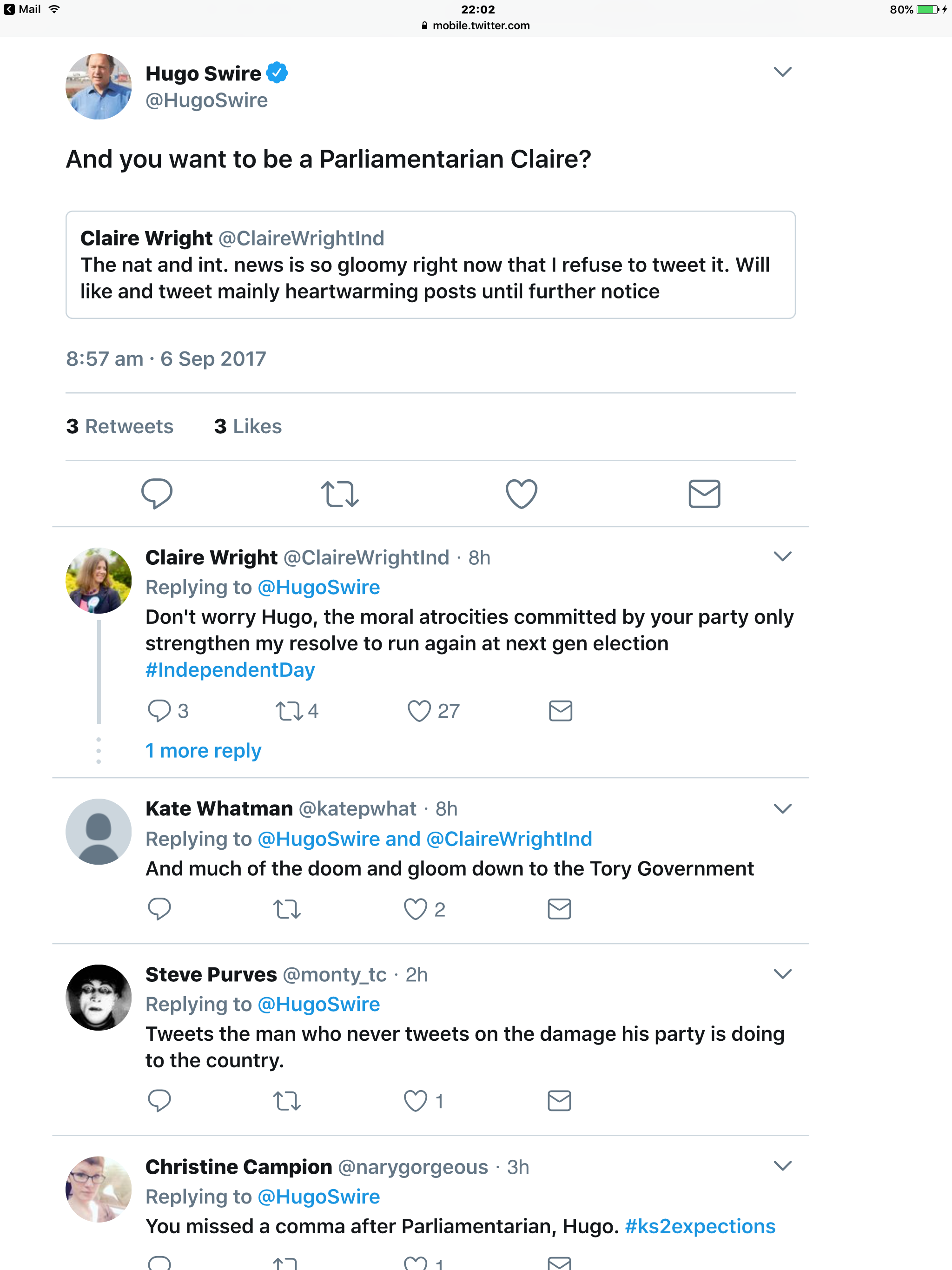
Swire insults Claire Wright because she cares

So, there you can see the difference between Swire and Wright – carelessness and bitterness on his part and caring and compassion on Claire Wright’s part.

Who would you prefer to represent you?

”Devolution deadlock’ putting economic growth across England at risk’

A Local Government Association document draws attention to the failure of LEPs and the need to base devolution on English counties not artificially created areas that have little synergy and where control is ceded to unrepresentative interests and lack of scrutiny and accountability:

“Mark Hawthorne, chairman of the LGA’s People and Places Board, said councils wanted to use greater powers to build more homes, secure the infrastructure essential for economic growth, improve roads, close skill gaps and increase access to fast broadband but feared opportunities were being missed because devolution has “stalled”.

He added: “To reignite the devolution process, the government needs to engage in a debate about appropriate governance arrangements with local areas.

“This is fundamental to ensure that the momentum around devolving powers to local areas is not lost and the billions of pounds worth of economic growth, hundreds of thousands of jobs and homes on offer through non-metropolitan devolution deals is not lost with it.”

The LGA wants the government to publish its annual devolution report, setting out progress on negotiating deals, when parliament returns this week.

Under the Cities & Local Government Devolution Act, the secretary of state is expected to provide annual reports to parliament setting out the progress on devolution across England – this year’s report has yet to be published.

Concern has been sparked as no new deals have been announced for 18 months although the election of six combined authority mayors earlier this year was hailed as a significant milestone for devolution in England. …”

https://www.local.gov.uk/about/news/devolution-deadlock-putting-economic-growth-across-england-risk

The ‘ Growing Places’ report referred to above is here:

https://www.local.gov.uk/growing-places-building-local-public-services-future

W(h)ither LEPs and devolution?

“The Local Government Association has called on the government to urgently release its annual devolution report amid fears the process has stalled across the country.

The umbrella-group’s plea, released on Monday (see next post), marks two years since the government set a deadline for local areas to submit devolution proposals.

Around 34 proposals – from cities, towns and counties across England – have been submitted.

The LGA argues that billions of pounds worth of economic growth and hundreds of thousands of new jobs and homes risk being lost as a result of the so-called “devolution deadlock”.

Mark Hawthorne, chairman of the LGA’s People and Places Board, said councils wanted to use greater powers to build more homes, secure the infrastructure essential for economic growth, improve roads, close skill gaps and increase access to fast broadband but feared opportunities were being missed because devolution has “stalled”.

He added: “To reignite the devolution process, the government needs to engage in a debate about appropriate governance arrangements with local areas.

“This is fundamental to ensure that the momentum around devolving powers to local areas is not lost and the billions of pounds worth of economic growth, hundreds of thousands of jobs and homes on offer through non-metropolitan devolution deals is not lost with it.”

The LGA wants the government to publish its annual devolution report, setting out progress on negotiating deals, when parliament returns this week.

Under the Cities & Local Government Devolution Act, the secretary of state is expected to provide annual reports to parliament setting out the progress on devolution across England – this year’s report has yet to be published.

Concern has been sparked as no new deals have been announced for 18 months although the election of six combined authority mayors earlier this year was hailed as a significant milestone for devolution in England.

Council leaders said this was not the only model of devolution possible and the government should explore further options for the widespread transfer of powers and responsibilities to the whole of England to boost the economy and improve people’s lives.

A Department for Communities & Local Government spokesman said: “This government is 100% committed to devolving powers to local areas where there is strong local support for plans to deliver better local services, greater value for money and clear accountability.”

Localis think-tank chief executive Liam Booth-Smith said: “The wait has simply been far too long for the two-thirds of England that lacks the capacity and robust governance structure to deliver the government’s national industrial strategy.

“Given the economic urgency of Brexit, all parts of England, from major cities to small towns, deserve new powers to revive moribund local economies and with it the opportunity to help themselves.”

Booth-Smith said a Localis report on the industrial strategy recommended the establishment of 47 strategic authorities – based on existing county and combined authority boundaries – to control devolved powers to help drive economic growth.”

http://www.publicfinance.co.uk/news/2017/09/publish-progress-report-devolution-now-lga-tells-government

Oxfordshire unites to fight for its community beds services – unlike Diviani and Randall-Johnson in Devon

Owl says: alas it doesn’t matter one jot what our district, town or parish councils think about the removal of community hospitals in general and removal of Honiton’s maternity services specifically, since the majority party cannot even trust their own Leader of our district council – Paul Diviani – to represent them.

(One more reason to turn up at Knowle on 13 September 2017 and watch those cowardly Tory councillors rally round him and turn out in numbers to overturn a vote of no confidence in him – even though it was THEIR confidence that he sabotaged at DCC when he voted against their instructions to refer bed closures to the Secretary of State- at the notorious scrutiny meeting where Sarah Randall-Johnson ensured that no contrary voices would be heard – only those echoing their Tory masters. Diviani being one of those enthusiastic voices.

“Campaigners backed by four councils have won the first round of their legal action over a claim that a consultation over changes at Horton General Hospital was flawed.

They want to prevent plans by Oxfordshire Clinical Commissioning Group (CCG) to downgrade maternity and critical care services at the hospital in Banbury.

Their campaign has been supported by nearby councils: Cherwell District Council, South Northamptonshire Council, Stratford-on-Avon District Council and Banbury Town Council.

A statement from barristers at Landmark Chambers said: “Campaign group Keep the Horton General has won an important first step in the battle against the downgrading of Horton Hospital.

“Fraser J today granted permission to apply for judicial review of the consultation process.”

The Administrative Court in July refused on the papers permission for a full hearing, but Cherwell successfully challenged that decision this week.
Oxfordshire CCG said last month that its proposed changes would “ensure safety, quality and better outcomes for patients”.

It said the critical care unit at Horton would be downgraded to cater only for less seriously ill patients and it would also lose some beds.

A single specialist obstetric unit would be created at Oxford’s John Radcliffe Hospital and only a midwife service would remain at Horton, though it would gain an improved diagnostic and outpatient service.

A CCG spokesperson said: “We are fully aware of the outcome of today’s oral hearing seeking permission for a judicial review and will co-operate with the process as appropriate.”

“Dorset PCC on merger proposals” – one way to remove Hernandez! ans save money?

The Dorset PCC is a former commended police officer and stood as an independent in Dorset’s PCC elections …

https://en.m.wikipedia.org/wiki/Martyn_Underhill

“Dorset’s police and crime commissioner (PCC) said he welcomed proposals for a “closer working relationship” between the Dorset and Devon and Cornwall forces.

Martyn Underhill said: “I have made no secret about my concerns regarding police funding and the difficulties faced by forces during a time of ever-complex and increasing demand.

“However, that does not mean that we should stop working tirelessly to make the best use of taxpayers’ money.

“It is clear that there is a great deal more work required to understand the potential opportunities and challenges that this proposal might bring.

“Equally, we will need to seek the views of our communities and ensure that feedback is listened to and understood.”

http://www.bbc.co.uk/news/live/uk-england-devon-41124772

“APPOINTMENT OF SIX MEMBERS TO THE INDEPENDENT AUDIT COMMITTEE

Do you have experience of scrutinising financial information and governance?

Can you provide constructive challenge?

Are you committed to the principles of public accountability?

If so we want to hear from you.

Dorset and Devon and Cornwall Chief Constables and Police and Crime Commissioners are creating a single Independent Audit Committee to provide assurance to them on relevant financial and governance matters. They are seeking six independent members to be drawn from across the South West Region.

Minimum of four meetings per year for which an attendance allowance and expenses will be paid.

To find out more, recruitment packs may be downloaded from the website: http://www.dorset.pcc.police.uk or contact:

Telephone 01202 229084 or e-mail pcc@dorset.pnn.police.uk

Closing date for applications: 29 September 2017

We welcome applications from all sections of the community.”

Help-to-buy helps developers much more than buyers

Owl says: But isn’t that what this government and our council wants?

“Housebuilder Redrow says it’s looking forward to working with government to consider the future of the help-to-buy subsidy scheme beyond 2021. You bet it is. Since former chancellor George Osborne in 2013 committed to helping homebuyers purchase new properties with a deposit of only 5%, Redrow has reported record profits every year.

The latest annual numbers – and a share price that has improved threefold since 2013 – shows how wonderful life has become for big housebuilders. You’d almost think Redrow was producing high-tech consumer gadgets. Operating margins are running at 19% and return on capital employed has hit 26%. About 40% of its private sales are to help-to-buy purchases, which is typical for the sector.

After an improvement of a quarter in pre-tax profits to £315m, the company hiked its dividend by 70% and said there’s plenty left in the tank. Profits will rise to about £430m by 2020 and the dividend can be almost doubled again “subject to market conditions remaining unchanged”.

The obvious question is why on earth the government, having spent £4.6bn already, would wish to continue with help to buy after 2021. Yes, the scheme has allowed some people to buy homes who would not otherwise have been able to do so, but the clearest beneficiaries of the stimulus to prices have been housebuilders’ shareholders and executives.

Back in 2013, one justification was the limp state of the mortgage market. That no longer applies. The banks are well-capitalised, high loan-to-value mortgages have returned and the Bank of England these days frets about too much lending, not too little.

Osborne’s other argument was that more demand for houses would increase supply. The numbers suggest modest success, even if some of the increase would have happened anyway. But the point now is that withdrawing help to buy overnight wouldn’t obviously cause the housebuilders to down tools for fear that non-subsidised houses would sell for slightly less. A return of capital of 26% is splendid but it is still worth getting out of bed for 15%.

Before ministers commit to renewing help to buy on the same terms, they should recall the warning by Lord King, former governor of the Bank of England, in 2014: “This scheme is a little too close for comfort to a general scheme to guarantee mortgages. We had a very healthy mortgage market with competing lenders attracting borrowers before the crisis, and we need to get back to that healthy mortgage market … We mustn’t let this scheme turn into a permanent scheme.”

Ditching help to buy outright in 2021 may be undesirable since there is a fair case that first-time buyers still deserve a leg-up. But, as even wiser housebuilders concede, too many houses qualify for help to buy. Current ceilings are set at £600,000 and 20% of the value of mortgage. Both figures could usefully be cut in half before the scheme becomes an addiction.”

https://www.theguardian.com/business/nils-pratley-on-finance/2017/sep/05/help-to-buy-scheme-buyers-builders-subsidy

Exmouth resident disputes terms of Fun Park closure

From a comment from Save Exmouth Seafront – these are views and claims that Owl cannot verify but which do come from a usually reliable source:

“Recently we reported that last minute efforts to keep the popular Fun Park trading beyond 31st August sadly collapsed late afternoon on the final day.

We understand from a very reliable source that an officer of EDDC council said during discussions that the Fun Park was not being granted a licence to remain open to the public and trade because the tenant did not ask for this type of licence.

However it emerges that the tenant did in fact request an extension of his lease explicitly referring to trading after August 31st. This explicit request was in an email sent a week before the closure – to that same EDDC officer.

This information is verifiable. It is shocking to contemplate that an EDDC officer would or could behave in this way.

It reveals what appears to be underhanded tactics in dealing with the closure of the Fun Park. Many Exmouth residents have said they believe the tenant and the Fun Park have been treated unfairly by EDDC. Many have expressed the opinion that he has been victimised because he challenged EDDC through the Courts.

On the surface it’s made to appear publicly everything is being carried out in a systematic and business like way. Behind the scenes, however, it looks like there is no intention of allowing the tenant a decent chance to keep the Fun Park open at this time. Nor is there any intention of giving any credence to the views and wishes of residents and visitors who value and want the amenities of the Fun Park to remain longer.

So, District Councillors – including those of you who also sit on the Town Council, it is time you read, and answer, the emails being sent to you about the closure of the Fun Park. It is time to have a close look on the Facebook pages where Exmouth residents and visitors are expressing their views and their frustration at not being listened to by you. It is time for you to demonstrate that you understand you were elected to serve, not to dictate, what the community wants. The voters in Exmouth for the most part do not have a very high opinion of you at this time. You were elected once but there is a ground swell of dissatisfaction with your performance. Exmouth voters are finding their voice.

It is also time, District Councillors, to question EDDC officers more closely and to expect to be given the evidence backing up their plans and statements. It is also time to stop accepting at face value what you are told in reports and to proactively support what your electorate wants in Exmouth.”

“Mayor refuses plans with ‘unacceptable’ levels of affordable housing”

Of course it’s not in the Tory South West but in Labour London!

“City Hall’s new viability experts scrutinise affordable housing offer

Stance signals Sadiq’s firm approach on affordable housing

The Mayor of London, Sadiq Khan, today rejected plans which would have lowered the proportion of affordable housing on the site of the former New Scotland Yard building, as his tougher approach to tackling the capital’s housing crisis starts to take effect.

The site at 8-10 Broadway in Westminster was sold by the previous Mayor who then allowed planning permission to be granted for a development offering a £10m payment and only 10 affordable homes – just four per cent of all units – on 27 April 2016, days before the Mayoral election. The site was home to the Met Police for half a century until the force relocated earlier this year.

The developer, BL Developments, then sought to increase the total number of homes by 27, from 268 to 295, with no increase in the number of affordable units or payment in lieu, meaning the level of affordable housing fell further still to only three per cent.

Shortly after becoming Mayor, Sadiq instructed City Hall’s planners to recruit a team of viability experts to scrutinise the level of affordable housing in all planning applications referred to him. The first time City Hall has had this in house expertise. Scrutiny of the application to increase the number of homes at 8-10 Broadway found its offer of no extra affordable homes nor any payment in lieu would mean it failed to deliver the maximum amount of affordable housing viable.

Sadiq’s decision comes just a few weeks after he strongly criticised Wandsworth Council for allowing the developers of Battersea Power Station to slash the amount of affordable housing by 40 per cent, from 636 homes to just 386 – or only nine per cent of the 4,239 homes across the scheme. The Mayor had no formal power to intervene under current planning regulations, but wrote to the Council to object to the decision in the strongest terms.

The Mayor of London, Sadiq Khan, said: “A shortage of affordable homes is at the heart of the housing crisis in our city. The scheme put forward for this site is simply unacceptable: it fails to provide the maximum amount of affordable housing that could be delivered on this landmark site, and follows a previous application in which the affordable housing provision agreed by the previous Mayor was already appallingly low. It beggars belief that the initial application was approved under the previous Mayor with a paltry four per cent affordable housing, just days before the Mayoral election.

“This is a site which has only recently been transferred from public ownership and sits within one of the most expensive areas of the country. Having carefully considered the evidence available to me, I have decided to refuse permission for this amended application. …”

https://www.london.gov.uk/press-releases/mayoral/mayor-refuses-plans-lacking-affordable-housing

“Nimbys risk denying my generation an affordable home” – and gushing praise for Cranbrook

Gushing praise for Cranbrook – by someone who appears never to have lived there and seems to have relocated from Devon to London.

It reads to Owl to read like a (not-very-good) essay submitted for the digital journalism course the author has gone to London to study, rather than a well-researched article. Not a quality piece of Guardian journalism or a persuasive testament to the town, with quotes from one resident and the town clerk!

“I’ve been priced out of my home city, but Cranbrook, a new town in Devon with cheaper housing, faces prejudice that could deter newcomers

You’ll be easily forgiven if you haven’t heard of Cranbrook, because five years ago this east Devon town was the fields that cornered the historical city of Exeter. Creating this new town has been one of the few attempts to address a national homelessness crisis, now affecting more than 50,000 households across England. Cranbrook is the first new settlement to be developed in Devon since the middle ages.

I grew up in Exeter, watching it blossom from a modest city into a vibrant hub. I’m proud to say that I have come from the liberal bastion of the south-west: it was one of only three constituencies in the region to vote remain, and has long been a Labour stronghold. However, nimbyism has intensified over fears around an “invasion of outsiders”, and of local services becoming overburdened. Cranbrook has felt the brunt of this, with locals demanding that more housing is built – but “not in my backyard”.

The new town has even been branded as a magnet for unruly northerners and the crime capital of the south-west, renamed by some as “Crimebrook”, even though this is not borne out by police statistics. I remember such hostility circulating even before the first brick had been laid. Listeners to The Archers will be all too familiar with this depressing scenario: one current storyline includes growing opposition in Ambridge against the Bridge Farm housing development. Only Emma and Ed Grundy are in favour, it seems. How else can they hope to get a step on the housing ladder?

These nimbys, in real life, deepen the sense of otherness towards not only outsiders, but also to locals like myself who have been priced out of Exeter. The first phase of Cranbrook consisted of 1,120 homes, 40% of which were for social and affordable housing. Of the social housing available, 65% went to applicants with a local connection to east Devon, the other 35% going to local people in Exeter. The town has also received a £20m government investment, which has increased the development of social houses to 500 a year, accelerating Cranbrook’s ambition of expanding to 8,000 homes within the next decade or so.

Drawn to its location and lower house prices, Jacqui Issacs relocated her family to Cranbrook from Oxfordshire three years ago. “I find a much better sense of community here than I ever did in an established village,” she says. A report released earlier this year by the Devon & Cornwall police on the top crime hotspots within the county placed two of Exeter’s streets third and fourth, with one of Cranbrook’s streets ranked seventh. Issacs remarks: “I have never lived somewhere with so much within walking distance – the shops, the country park, pub and so on.”

Unlike the feudal Disneyland of Prince Charles’s Poundbury in nearby Dorset, Cranbrook has no experimental aesthetic. Nimbys see the town as soulless, but it just needs to be lived in a bit more: Issacs is looking forward to “having our own high street one day”. As the town clerk, Janine Gardner, says, Cranbrook is “not to be seen merely as an extension of the nearby Exeter”. The 3,000 Cranbrook residents already have their own doctors, schools, shops and leisure centre. And the town is uniquely youthful, with a high percentage of 24 to 35-year-olds, who can propel such developments.

I now live in the multicultural mecca of London, and feel that Cranbrook could provide a much-needed point of diversity if given the chance. While it is important for the town to build valuable bridges with Exeter, outsiders should be welcomed as enhancing the existing cultural fabric, not unpicking it.

With average house prices almost seven times people’s incomes, becoming a homeowner, especially for people of my generation, is increasingly a fantasy, even in Devon. Cranbrook is an opportunity not only to find a house, but also for us to make a home.

Rome wasn’t built in a day, and Cranbrook has only just put down its foundations: the nimbys just need to give it the time to build itself up.

• Jessica Cole, 23, an English graduate, will study digital journalism at City University”

https://www.theguardian.com/society/2017/sep/05/nimbys-risk-denying-my-generation-affordable-home

“Coastal communities amongst most deprived in UK, says think-tank”

“Britain’s coastal communities rank among the worst performers for earnings, employment, health, education and a range of other economic and social indicators.

That is the message from the Living on the Edge report by the Social Market Foundation (SMF) think tank, which found economic output per capita was 23% lower in coastal communities compared with inland local authority areas.

The research took ‘coastal’ to mean anywhere adjacent to the sea, not just traditional holiday resorts.

It said five of the 10 local authorities in Great Britain with the lowest average pay were on the coast: Torbay, North Devon, Gwynedd, Hastings and Torridge.

Five of the 10 areas with the highest unemployment rate were also coastal: Hartlepool, North Ayrshire, Torridge, Hastings, South Tyneside and Sunderland.

Half the 20 council areas with the highest proportions of the population with bad or very bad health were coastal.

SMF chief economist Scott Corfe said: “Many coastal communities are poorly connected to major employment centres, which compounds the difficulties faced by residents in these areas.

“Not only do they lack local job opportunities, but travelling elsewhere for work is also relatively difficult.”

He said the government needed a clear definition of a coastal community and should make more effort to address their economic problems.

Policymakers overlooked some poor performers because they were in the south east and so formed islands of deprivation in generally affluent areas, Corfe added.

Issues in coastal communities rose to prominence with a report from the communities and local government select committee in 2007, when MPs took the unusual step of objecting that the government’s response had been complacent and pressed for further action.

The committee said coastal communities tended to be at an economic disadvantage as the sea reduced the size of their economic hinterland compared with inland towns.

They were also likely to have high proportions of retired people, an exodus of younger people and to be geographically remote from population centres.

Following this report, the Labour government created the Sea Change Fund to regenerate coastal towns, which was succeeded under the Coalition by the Coastal Communities Fund.

Coastal communities minister Jake Berry said yesterday there will be a fifth round of funding for this in 2019-21, to provide at least £40m of assistance.”

http://www.publicfinance.co.uk/news/2017/09/coastal-communities-amongst-most-deprived-uk-says-think-tank

“New homes for edge of Exeter approved despite concerns they would overlook neighbouring properties”

“Plans for 34 new homes on the edge of a 1,500 home development on the edge of Exeter has been given outline approval.

Councillors unanimously backed the outline plans for the housing scheme on land adjacent to Honiton Road in Clyst Honiton.

East Devon District Council’s development management committee were told that 50 per cent of the homes would be affordable housing and that it would join onto the 1,500 homes that will be delivered as part of the Tithebarn development.

But they raised concerns about some of the details of the plans and requested that when the application returns to them for reserved matters approval, some of the houses would become bungalows as there were concerns about residents of Blackhouse Lane being overlooked by new homes. …”

http://www.devonlive.com/news/property/new-homes-edge-exeter-approved-429104